Taking a chainsaw to said fence on the request of a non-emergency request line would be perfectly legal. They are obstructing public space, no different from a pothole or an abandoned vehicle.
I had a similar experience recently on the other side of the river, though less extreme I think. Between London Bridge and Greenwich there are a few stretches that are ostensibly "public" but not that easy to access. Some are behind gates that are in fact unlocked, so you can just walk through, if you try, but they don't look very welcoming or accessible so I think a lot of people probably don't even bother. Other times the gates are in fact locked for non-residents and you can access the river by some other more roundabout way.
Bit of an aside, but although the area around Greenwich is lovely, I've always preferred walking the Thames Path out west, eg Putney to Richmond. Very peaceful and green, and IIRC all pretty accessible (apart from a stretch of the path near Barnes that is completely underwater when the tide is high).
I think the south side is the "official" Thames path, but I did think through London the north side was just as doable. I've walked the entire south side but not tried the north yet.
I do recall several difficult bits in the area you describe. One part seemed to have some new "food market" development, which was completely closed when we tried to go through. It got weirder the further we got and we questioned whether we'd gone wrong somehow. Eventually the path just stopped forcing us to double back and make for the road which added a mile or two to the walk.
We haven't had any such problems along to the west, all the way to Maidenhead so far.
They apparently moved the location, but protesting at the new location is still heavily restricted [0] with a dystopian narrative.
> In order to achieve the balance between the rights of those holding a rally and the rights and freedoms of others to go about their business we have put together this guidance and simple application process.
Every single thing in the text you (inaccurately) quoted.
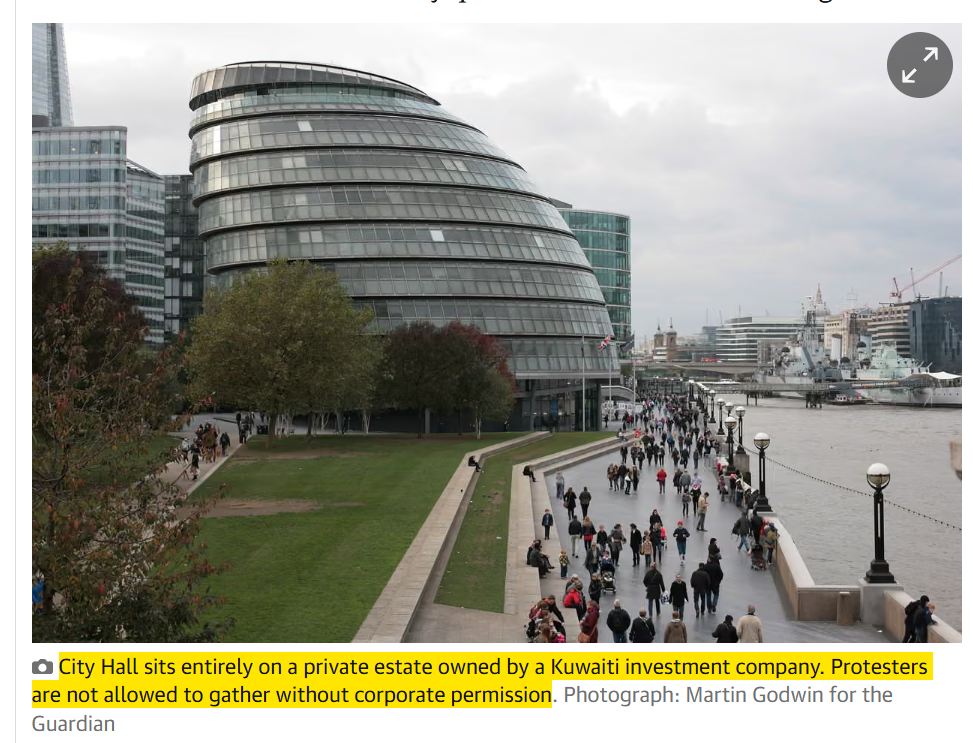
City Hall is no longer on a private estate, no Kuwaiti investment company is involved, and the application process involves no "corporate permission" - you submit a form to the city government, and it sounds like the point is to make sure each rally is allocated a separate area, and they don't deny permission outright.
> Every single thing in the text you (inaccurately) quoted.
Your first sentence makes no sense. It's quoted directly from the Guardian article, not from me.
> it sounds like the point is to make sure each rally is allocated a separate area, and they don't deny permission outright.
FWIW, look at the next article I linked. You're really understating the restrictions for a public, outdoor venue. This is on brand with restrictive public use.
- No noise directed outwards
- no noise after 6PM
- confined to two lawns (that can't fit more than 3k people)
- no sound speakers
- no overnight rallies even if quiet
- leave no trash
- no food for others
- you're strongly advised to fill out a notification form if your group is larger than a dozen people
> London’s seat of democratic governance now sits entirely on a private estate owned by a Kuwaiti investment outfit. John Biggs, the London Assembly member, tells me he has been prevented from doing television interviews outside the building by private security guards who insist he needs a special permit; protesters are not allowed to gather without corporate permission. “I think that as active citizens we’ve got a reasonable responsibility to test and push at these public/private borders,” he tells me. “It’s clear we’ve got the balance wrong at the moment.”
You “quoted”:
> City Hall sits entirely on a private estate owned by a Kuwaiti investment company. Protesters are not allowed to gather without corporate permission.
Doesn't the UK (or at least England) also have some kind of network of public pathways, many of which are on private property? Are there similar conflicts in that system, or does it work differently somehow?
Yes. It's a little different between England & Wales, Scotland, and NI, but public rights of way (footpaths and bridleways) are very much a thing.
My experience is that it works well in general, but some landowners are better than others, and some highway authorities (which enforce the laws) are more zealous than others. Most of the issues I see around me is farmers allowing crops to grow through low use footpaths such that they become impassable.
The other tricky bit of PRoWs is that any path used by the public for 20 years continuously, without force, secrecy, or the landowner's permission, is legally presumed to be a public right of way, even if it isn't shown on the definitive map kept by the local authority. That can lead to legal fights e.g. [1] and [2]. There are also 'permissive footpaths' where landowners have agreed to allow the public to pass, but not become a PRoW. There are also s106 agreements (planning obligations) where developers must allow the public to use land as a footpath. The Thames Path has a mix of these.
In Scotland, there is a more general 'right to roam' which allows anybody to access most land (excepting buildings and their curtilages, military sites, and other obvious exceptions), but there are affirmative duties to maintain PRoWs that don't apply to open access land making them still relevant. England and Wales have some limited open access land as well, but much much less of it. NI has no open access land and (subjectively) fewer public footpaths.
Maybe we are solving the wrong problem? Should it be, where at the economies of scale in "building places for people to live in". I'd be interested to hear from others about relative costs for high rise, multi-family dwellings, double storey dwellings and so on relative to single-storey single-family dwellings.
I had a taste of OReilly books through ACM/IEEE. A few years pass and I'm working on some obscure legacy code and a book saved me. Needed it in a hurry so signed up for OReilly books for a year even though only needed it for four weeks. I have renewed it since and enjoy it, being able to dip into topics, just for fun, written by people telling a story. The long form of a book is quite different from SO and new books keep coming out. I'm hooked.
For a vehicle with a highly visible unique identifier on the front and rear? In my country basically every private carpark has ANPR cameras, the tech is dirt cheap now.
You wouln‘t really have the kind if hardware there. The communication relies on a multi hop mesh that would‘t work anywhere without sufficient coverage.
To understand speeding you need to understand the concept of "speed choice". Everyone chooses how fast to drive, only those who choose above the speed limit are speeding. If your environment gets you to choose a speed below the speed limit you won't break the law. Your choice can be influenced by many factors such as:
* narrow looking roadway
* speed limit signs
* your car has self driving
* what everybody else is doing
* speed limiter on your car
* curvy road
* bad weather
* male or female
* risk appetite
* driving experience
* experience of that route
* perceived risk of getting caught
If you fix "speed choice" the problem of speeding diminishes.
If you ring for the ambulance, (Australian context), you will be told what to do! The telephony scripts have first aid baked in. The paramedic will come (not necessarily with an ambulance) and start appropriate definitive treatment as good as what you will get in a hospital. A consequence of a stroke is a cardiac arrest. If you are driving you won't know and won't do CPR.
The 1996 movie Transpotting still gives me shivers up my spine by putting someone in a car and drop at ER rather than calling for help. Too many people die needlessly, even today, when well meaning people load shooting victims, stroke victims and heart attacks etc into their car and drive to ER without asking their local emergency services for advice.
PS. You can't 100% of the time get to ER faster than the ambulance. There are more ambulances than emergency rooms by number. If an ambulance is at the county hospital they'll be faster than you.
I'd really like a rejection physical letter back saying thankyou for application but no thanks signed by a human. I put some effort in to applying, they could at least exert some effort coming back, rather than simply ghosting. A reasonable barrier to bots collecting CV's.
>I'd really like a rejection physical letter back saying thankyou for application but no thanks signed by a human
If you want personalized human rejection letters to come back to you, then the hiring process would have to be equally friction based: i.e. mailing in notarized copies of documents and interviewing in person, for it to scale and not overwhelm a company's resources.
>I put some effort in to applying
Yeah but so did hundreds of other people. This worked in the world of 20+ years ago, but it doesn't scale anymore in the era of online applications where every job posting gets hundreds of applications within a week.
It doesn't matter if you put in more work in your application than the other 200 candidates who are doing "spray and pray", it's too much noise for humans to swift through with without some automated screening that might just as well drop you through the net because it can't tell the amount of work you put in, you're just a number in a queue.
Not the same industry but at least one literary agent does this: if you physically print and mail your book proposal, they will respond with a short but polite, physical rejection letter if they reject you.
But I think it's a generational thing. The younger agents I know of just shut down all their submissions when they get overwhelmed, or they start requiring everyone to physically meet them at a conference first.
In Germany it used to be that in some places, not only you were expected to have a proper application folder with various sections for the various kinds of material (CV, application letter, recomendantions, certificates, photo), they would post it back if refused.
This stopped being a thing about 15 years ago though.
I still have some of those applications in a box somewhere.
I hope the students can choose to use their own wifi at home if they have it, much better service for them. Depending on how it's setup, the cellular contract may be not be that crippling. When enterprises buy thousands of services they pool data across the SIM's and get quite reasonable rates for what is used, be it a fleet of IOT devices with low usage or laptops with some high usage. If you are just buying one service, you are really at a disadvantage compared to enterprise deals.
To be honest, the first moment I saw the page, it did seem to give my eyes a negative reaction, but after reading a few of the results, it started to look fine pretty quickly.
What about helicopters? Does Melbourne not have/use theirs in those cases or is the system just overwhelmed?
Asking because (different country) when we had a person present with stroke symptoms and called 911, they sent both an ambulance and the helicopter. The heli came first but it had to land a ways off on a field and they had to walk over and basically arrived around the same time as the ambulance. A couple minutes earlier basically. No fire engine dispatched but that made sense too as it's volunteer based and while they would've been much closer, getting them to the station would've taken longer than the helicopter.
Driving time for the ambulance if it came from the same place as the helipad would've been about 15 min for the ambulance. Fire engine driving time from volunteer department: 2 min but no dedicated paramedic services, just volunteer firefighters. Heli time in air probably about 2 minutes given the "as the crow flies" distance I just checked, add whatever time is needed to get them in the air and such.
Now I can't really trust these numbers fully of course but according to "a quick AI analysis" :P Melbourne with millions of population has 0.08 helicopters and 8-10 ambulances per 100k population while the aforementioned location is at about 0.3 helicopters per 100k and 6-12 ambulances. Can it be true? It also says New York City has no emergency helicopters at all? Los Angeles has 0.18 per 100k? I know my current location definitely also has none at all. For millions of people.
I was under the impression that air ambulances in Victoria are mostly for rural areas - either responding to incidents in the middle of nowhere, or flying patients to Melbourne for urgent specialist care. Most of them aren't even based in Melbourne, they're out in regional centres like Bendigo and Warrnambool[0].
A helicopter seems like it would be pretty useless for landing in an urban area. I can't imagine winching is risk-free or would save much time, and you can probably put many more ambulances on the ground for the cost of a single air ambulance.
I don't think my taxes/insurance costs/donations to charity are high enough. London (donation funded) has a helicopter service that attends 6 serious trauma cases a day. Denmark, Germany and others has a Helicopter Emergency Medical Service which delivers a senior doctor and paramedic. It probably doesn't scale well.
Basic issues like overhead powerlines make life difficult for helicopters. They are used in rural Australia as an alternative to road, but only due to time saving. In a city, well you get a road ambulance/paramedic/medical team.
The (Melbourne) Victorian Ambulance Cardiac Arrest Registry claims third best in the world in out of hospital cardiac arrest.
Yes it's Hatzolah. It's a volunteer Jewish organization - run (and paid for) by the local Jewish community, but we respond to anyone who calls us, regardless of background or ethnicity.
(There are Hatzolah organizations all over the world, where there are Jewish communities.)


reply