> But what happens in practice is no one feels like they are entitled to the time they should be entitled to, and negotiations from the employee side always come from a place of weakness. It's a terrible system
> Undoubtedly someone will respond to this post with just how amazing their manager is and that they have never had a problem.
That me! Except I don't think it has anything to do with my manager or company.
I've worked 5 different jobs over the last 12 years with 8 or 9 different managers and literally never had an issue with taking the time I want while taking 6-8 weeks of PTO a year. I've hit the point where when I'm looking for a new job unlimited PTO is kind of table stakes.
I manage a few teams now with some people in the US where my company does unlimited PTO and others in Canada where our company cannot give unlimited PTO. Looking at my teams, the amount of PTO people take has almost no correlation to whether they have unlimited PTO or a set number of days. I have US employees who take a ton of PTO and Canadian employees who have burned through their entire balance and then some and I have employees in both places who take essentially none.
I get that if you're in that second group it's preferable to be in a place where you'll get paid out for the days you didn't take, but I'm pretty convinced that unlimited vs set days has almost no bearing on how many PTO days someone will actually take.
> Looking at my teams, the amount of PTO people take has almost no correlation to whether they have unlimited PTO or a set number of days.
If the number of PTO days taken is the same between the groups, isn't it CLEARLY superior from an employee perspective to have a set amount? That way, you get paid out if you leave or are fired.
I know quite a few people who use their PTO as a sort of emergency fund if they are laid off... they will at least get paid that amount to hold them over until the next job.
> If the number of PTO days taken is the same between the groups, isn't it CLEARLY superior from an employee perspective to have a set amount
For me, no. I take more PTO than most companies with limited PTO offer. Most big tech companies offer 20-25 days and I'm taking 30 minimum. I take 6-8 weeks a year and the year I got married, I took 10. A normal year of PTO for me is 2 weeks during the summer for a vacation, a week at Thanksgiving, a week in April or May since my family has multiple birthdays in that window, 2-3 weeks in the Christmas/NYE period, and then random days here and there for the rest of the year.
For my team, for the people on the low end banked PTO is probably better. For the people on the high end they often take more than the allotment for CA employees, so no.
Everyone's experience will be different, but in my career I've always found that unlimited PTO often means no one cares how much PTO you take as long as you're getting your work done. I value that freedom. I know it's not for everyone and I'm not saying that every company should be unlimited PTO, but I just hate this narrative that it's a scam.
So "unlimited" for you is literally one week more than 5 weeks tech companies cap at?
Why not take 10 weeks or 12 weeks? If it's unlimited?
And how many other employees are only taking half of what they would be taking because they feel silently pressured to - and do all of those missing weeks make up for the single extra week you're taking?
Some people do like it, and I'm glad it's working out for them--I really am.
But adding all that manager and corporate discretion sets one up for abuse when things go wrong at either the manager or corporate level. For some, I suppose the benefit is worth it--but if "unlimited vs set days has almost no bearing on how many PTO days someone will actually take", then people are giving up a lot of guarantees for very little benefit on their side. Especially the payout when you leave.
> But adding all that manager and corporate discretion sets one up for abuse when things go wrong at either the manager or corporate level
I have never worked at a place where I didn't need manager approval for my PTO. That includes places where I had a set PTO balance.
In my experience, having banked PTO days doesn't actually give you any real protection from abuse. A manager can still deny every single PTO request or load you up with so much work that taking any PTO will result in you falling behind. The only difference is that the company then needs to pay you out for those days, which isn't nothing, but it's also not a ton of protection from abuse.
>>A manager can still deny every single PTO request or load you up with so much work that taking any PTO will result in you falling behind.
I was once on a team where the manager thought he was being tough by really discouraging PTO taking in their team, and it was all great until we got to the end of the year with pretty much everyone on the team still having 20+ days of PTO left. HR just made everyone take the entire december off to use those days up, after that once incident no one had any issues booking PTO the following year.
I have thought for a while now that skills were a bad abstraction. There's a lack of definition around what to use them for that I think contributed to why they rose to the top, but that's also why I think they aren't a good long term option.
The fact that I can have a skill that is just general guidance on front end design best practices that an agent can call upon whenever they feel, and another that is essentially a run book of steps that need to be followed exactly only when explicitly triggered, and a third that is basically just instructions on how to use a specific tool and all of those are acceptable just feels wrong to me. I get why it caught on and why the flexibility is attractive when the entire world is collectively learning a new tool, but skills have come to feel like the junk drawer in the kitchen where you just throw random shit when you don't want to think about a better place to put it.
I would love to see the world standardize on something like:
- Agents: Essentially personalities for a model to take on. This becomes the new place for skills like "front end expert" where you're not telling an agent to do a specific thing, just to think in a certain way about a task.
- Prompts: Repeatable instructions for specific tasks that an agent should follow when prompted. This could be something like a checklist style run book on how to resolve a certain error that an agent needs to follow exactly or it could be something like here's an idea I have for a new feature please poke holes in it.
- Tools: Tools (like CLIs, MCPs, or scripts) and instructions on how and when to use them. I'm purposefully not calling this skills because I think the term is overloaded, but that's kind of what this is.
I mostly agree here. I just treat skills as “prompts”, and I scope them to domain specific tasks. I’m surprised when I see skill files that are really short. Most of mine are pages long.
Polymarket is now two separate entities. Last year they were banned from the US and stopped taking on new US customers and made their site withdrawal only for anyone based in the US. You could bypass it with a VPN, but they did enough to at least look like they were complying.
They've now created a separate company that I believe is called Polymarket US which has it's own version of the site/app which they are using to re-enter the US market. This switched from invite only beta to open sign ups a few months ago.
Polymarket US is mainly just sports betting with a small number of crypto, commodities, and political election based markets, although they have said they plan to expand their market options. Their US based site almost certainly doesn't violate those rules. The version that is used outside the US is the one that has markets that violate that, but since they're not in the US, there's not much that can be done.
I'm not an expert in this, but I thought one of the biggest arguments for why a wealth tax is needed the whole "buy, borrow, die" thing where the ultra rich can use their assets as collateral to take out a never ending series of ultra low interest loans until they die and then have most of the tax burden of selling assets to pay off those loans wiped out because the tax code is much more favorable to selling assets to pay off the debt of someone's estate.
If (big if) I'm remembering that correctly, I don't get why we just go after the problem directly and do something like treat putting down collateral for these type of loans as a taxable event. I'm sure it's not as straight forward as it sounds, but I can't imagine it'd be more convoluted that needing to track the wealth of every high net worth individual.
Maybe I'm in the minority on this, but I actually don't care if Jeff Bezos' net worth went up by $5 billion because Amazon had a good day in the market. If the shares are just sitting in an account doing nothing other than proving ownership it's all kind of just numbers in a computer, IMO. A painting is probably a better example than stock, but if I have a painting on my wall that was worth $1 million dollars yesterday and today it's worth $10 million that change in valuation is essentially meaningless as long as the only thing the painting is doing is hanging on my wall.
What I do care about is when he's able to access the cash value of that $5 billion of Amazon stock without paying the taxes that would come along with selling the stock. If he wants to leave $5 billion in Amazon stock just sitting in his account doing nothing until the day he dies, that's totally fine, but the second he puts it up for collateral we should tax that. I think this has the added benefit of simplifying things by avoiding a lot of questions around fair valuation of assets. If I have a $10 million dollar one of a kind painting on my wall that I'm never planning on selling, it's kind of hard to put a valuation on that and it can be easily manipulated by finding the right appraiser. If I put a painting up as collateral for a $10 million loan it becomes a lot harder for the owner to argue that it's actually worthless or the IRS to argue that it's actually worth $1 billion.
This is exactly the reason -- or a tax against borrowing against assets once your net worth is high enough -- or not reseting capital gains at death. The entire system is currently basically rigged such that these ultra rich people pay no taxes.
Moreover if the bug is that income isn't tax at death, why not just fix that bug? Otherwise it's like arguing: "wow there are people in poverty? Better have a communist revolution to fix that!"
> > Each 1% of wealth tax is equivalent to 20% of income tax.
> Mathematically sound.
Don't most wealth taxes that have been proposed have a certain level of wealth that you pay no taxes on? If so, doesn't that make this at least partially incorrect?
Maybe I'm missing something, but if I have $100 and have to pay a 1% wealth tax on it then sure that's roughly 20%. If I have $100, but I only have to pay a 1% wealth tax on everything over $90 that's more like a 2% income tax.
The rules for each contract are provided when you bet, but ultimately there are plenty of markets that are settled in controversial ways and users have little recourse because the sites TOS's often say their rulings are final (this is the same for many sports books as well).
To give an example, I wagered on a market a while ago that Trump would say "Mamdani" before the end of the week. He responded to a question Mamdani where the reporter asked about the mayor by name and Trump said "Mandami" instead of "Mamdani" (switched the m and n). Kalshi ruled that that didn't count as Trump having said the word.
Trump ultimately said Mamdani correctly the next day so it ended up not mattering and I think the rules have since been updated to accept obvious mispronunciations, but I think it's a good example of how much gray area some of these markets can have.
I'm not saying this as an argument for or against prediction markets, but that's essentially what the vig is at traditional sportsbooks.
Someone calculates what they think the odds of an outcome happening are and then they allow people to take positions on either side at worse odds than what they think the real odds are. As long as their prediction is correct, over time they make money. It's why putting $1 on a 50/50 bet on a sportsbook will usually only pay out around $1.91 instead of $2 if you win.
There's the same upside as pretty much all other forms of gambling. Plenty of people enjoy it and it can be used to generate tax revenue for the state.
Don't get me wrong, there's tons of harm that can come from it, but the arguments to allow them are essentially the same arguments for allowing sports betting.
This is true, however many of those arguments are weaker when applied to things for which the outcome is more consequential than the outcome of a sporting game.
Sure, but that's not really an argument to ban prediction markets, it's an argument to regulate what the public can or cannot bet on.
Most major online sportsbooks have taken bets on the US presidential election for well over a decade. I can't imagine anyone really arguing that it's okay for DraftKings to offer that market, but not okay for Polymarket to offer it.
I put it somewhere else in this thread, but there are actually two different questions that need to be answered separately. Are prediction markets just sportsbooks by another name and are there certain things that we should not allow people to gamble on.
The argument around prediction markets always seems to squish those two into one which I think does people who want regulation a disservice. I think to most people, the answer to first question (are prediction markets just sportsbooks by another name) is a pretty resounding yes. The second question has a lot more room for debate though. Even if people agree that there should be things we don't allow people to bet on, there's still plenty to argue over where we draw the line. The problem is that as long as we mush these two together, people will use the disagreement over the second question to prevent action from being taken on the first.
> Sure, but that's not really an argument to ban prediction markets, it's an argument to regulate what the public can or cannot bet on.
I wasn't making any argument above in either way. But the reality is that sports betting is not legal in much of the US. DraftKings is only legal in about half of US states.
Minnesota does not permit DraftKings to operate in their state. They don't permit any kind of online gambling whatsoever, and I don't think they think any differently about Polymarket... and Minnesota's regulators have answered that clearly in this case by enumerating it specifically.
And more generally speaking, laws apply to what someone is actually doing, not what they claim they are doing. If a law bans wagers on the outcome of a sporting event, it doesn't actually matter whether you call it something different. Someone can't sell crack cocaine and call it a "dietary supplement" and get away with it, because the law doesn't depend on the label the actor gave their own actions, it hinges on the definitions of the actions as defined under the law.
And as for the second question, in gambling there's always a risk of harm to the bettors themselves. I don't think most Americans have a problem with that, currently.
But, there's also risk to corrupting the subject of the bet itself. In a casino, this is easily mitigated by regulating the game, and the potential risk is only to the participants. In sports betting, this risks corrupting the games themselves. This is a slightly larger risk, and it risks corrupting sportsmanship for the athletes involved, but ultimately it is still a game.
But wagering on other events up to and including literal war literally poses a much larger human risk than simply spoiling a game.
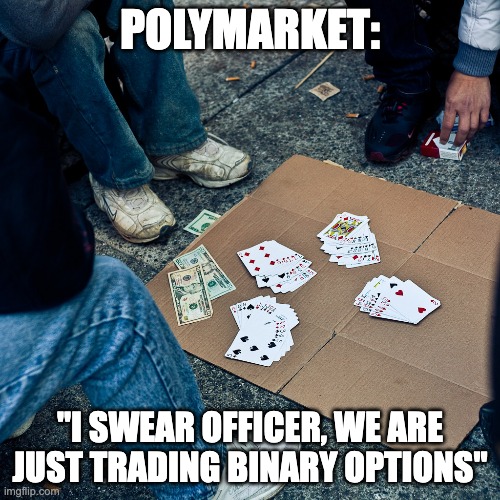
You could take this "prediction market" laundering of words to an absurd conclusion: "A large binary option that someone will [insert any illegal action]" is just literally a payment for someone to do a crime using different words.
> Most major online sportsbooks have taken bets on the US presidential election for well over a decade. I can't imagine anyone really arguing that it's okay for DraftKings to offer that market, but not okay for Polymarket to offer it.
DraftKings is legal in about half of the US. It is not legal in Minnesota.
I totally agree with your response to my first point. I have another comment in this thread that might be at the top right now, but I basically say that I think the fact that Minnesota, a state that has a complete ban on online sports betting, is bringing this case actually gives them an advantage over previous states who've brought cases because the entire argument can just be "if it walks like a duck and talks like a duck..." as opposed to trying to explain why betting on the Super Bowl on Kalshi is somehow different than making the same bet on DraftKings.
On your second point, I don't disagree, but those issues aren't tied to prediction markets. Traditional online sportsbooks have allowed gambling on presidential and state elections for at least a decade now. Kalshi and Polymarket have taken this to the extreme, but they didn't start the fire.
We should be restricting what people can bet on regardless of the technology used. My concern with tying these two points together is that law makers will assume that solving problem one also solves problem two, when it doesn't. I'm worried that law makers will just outright ban prediction markets and go, "job done" leaving the door open to bring them back by creating some new gambling method that technically isn't a prediction market.
I don't want Polymarket allowing bets on whether we're going to war, but I also don't want DraftKings offering that bet. On the flip side, I frankly don't care if someone wants to bet on the Super Bowl, or the winner of Survivor, of how much rain New York will get tomorrow whether it's on Polymarket, or Kalshi, or DraftKings, or anywhere else. Prediction markets are how people are placing bets. I don't actually care how the bets are places, I care what is being bet on and I think most people would agree with that.
> as opposed to trying to explain why betting on the Super Bowl on Kalshi is somehow different than making the same bet on DraftKings.
I think the answer to that is also the same: if they're the same thing, and both are gambling, then Kalshi should have to be subject to gaming regulations and inspections the same as DraftKings is. Gaming is highly regulated even where it is legal.
Personally I don't have an issue with gambling, and I also don't have an issue with states that decide to ban it.
But I do have an issue with Polymarket, Kalshi, etc, using bullshit language to pretend they're not doing what they are obviously doing. They are obviously booking wagers. And as such, they are subject to the laws that states have outlined regarding those that take wagers.
90% of the volume on prediction market sites is on sports. Yes, there are smaller markets that are easy to manipulate, but that's no different from traditional sportsbooks.
Yes, What MrBeast says on his next video is easy to fix, but so is something like betting on a D3 basketball player to have less than 10 points or some English 5th league soccer player to have a yellow card.
For the record, Minnesota currently has a complete ban on sports betting.
We've seen a couple other states that allow sports betting go after prediction markets. Personally, I feel that any state that allows sports betting is going to struggle to argue a case to ban prediction markets because you're essentially arguing over implementation details. Even arguments that certain prediction markets are ripe for insider trading or morally wrong fall a bit flat when you realize that traditional sportsbooks let you bet on things like college basketball player props and the little league world series.
I'm still not sure Minnesota will win their case, but it feels like that detail gives them a lot better chance of winning compared to many other states.
Arguing over implementation details is a pretty common thing for laws to do. Maybe it would weaken the logical consistency of their laws, but that's not really a thing that matters.
Why do states allow hunting some animals and not others? Why do states distinguish between different forms of income to tax? It's all implementation details.
I wasn't saying we shouldn't debate the implementation details. I just think they should be separate arguments.
It's like if someone killed my dog with 3d printed gun and so everyone started talking about banning or regulating 3d printers. It's like, yes, debating 3d printer regulation is probably a worthwhile debate to have, but regardless of where we end up on that it doesn't change the fact that that person killed my dog.
We should be having a debate as to whether there are certain things that are off limits to bet on, but regardless of where that debate goes, if a state has banned sports betting, it should be banned regardless of the platform.
This is both one of my pet peeves and a thing that legislators seem to love: Somebody does a thing that is already illegal, but in a slightly novel way. Perfectly valid statute exists to prosecute, but legislators want to be seen as doing something, so they pass another law to make the already criminal action more specifically criminal.
Arguably bans on cellphone use while driving are a good example. It's not that it isn't bad, it's that distracted driving already carries a hefty fine without being specific as to the mode of distraction. So does causing an accident, which presumably is the harm we're actually trying to avoid.
Making laws more explicit in important cases is valuable because it reduces uncertainty about legal interpretation. Using your example of cellphone use, under distracted driving laws the prosecution would have to prove that the specific case of cellphone use was distracting enough to be a safety hazard. With the more specific ban on cellphones, that is no longer an obstacle.
> any state that allows sports betting is going to struggle to argue a case to ban prediction markets because you're essentially arguing over implementation details
I think their point was that your "going to struggle to argue a case" belief does not logically follow from a need to argue "over implementation details"
I don't see why it even would weaken the logical consistency. Just because a state allows gambling does not mean they need to allow anyone to open a casino or betting site. You still need to apply for a licence and follow local regulations. If the prediction markets make sure to follow the regulations they should obviously be granted a licence to operate.
I think you could make a case in separating the two, of course opening further discussion, but because sports betting takes place in a comparatively very controlled environment I think the risk profile is pretty different versus, idk, betting that the temperate will be at or above a certain point and then someone sticks a hair dryer on the thermostat[1]. Cheating can happen in sports of course, but the risk profile and real-world impact I think is quite a bit different. Worth discussing, but I think that's an important distinction.
Separately, I believe over time that prediction markets will become the source of real world truth. Why? Because money is at stake and so validity and verification matter. It'll be interesting to see how, if this comes to fruition, how laws in states like Minnesota affect news reporting and journalism. It seems likely to me that at a certain point prediction markets will buy traditional media and news outlets to hire out the fact-finding and reporting teams to ensure ground truth, and of course to use journalism as the gateway to the market. So you read an article "China disappears random person" and then at the end you click a button and bet whether that person is alive or dead or whatever.
> So you read an article "China disappears random person" and then at the end you click a button and bet whether that person is alive or dead or whatever.
Congratulations, you just created a murder market.
Create “Is person X dead?”, and put a large limit order buying No.
Anyone with means can capitalise on it by fulfilling the physical obligation of the market and buying up the limit order.
Don’t create the murder market.
---
It would be a stupid thing to do given the trail, bit it gives the person ordering it sort of plausible deniability.
> I think you could make a case in separating the two, of course opening further discussion, but because sports betting takes place in a comparatively very controlled environment I think the risk profile is pretty different versus, idk, betting that the temperate will be at or above a certain point and then someone sticks a hair dryer on the thermostat[1]. Cheating can happen in sports of course, but the risk profile and real-world impact I think is quite a bit different. Worth discussing, but I think that's an important distinction.
That's kind of the point I was getting that. That's not really an argument about prediction markets, it's about what things should we be allowed to bet on.
I'm looking at FanDuel right now and I can bet on 1v1 eSports games of FIFA. The bets aren't even just who will win, but it's things like how many goals will a team score or who will score first. During the last Superbowl books were offering bets on things like what color tie the announcers would wear. I get that there's maybe a slight difference between that and betting on what words a sports announcer will say during the broadcast, but IMO, you're splitting hairs. They're both very easily to manipulate and very open to insider trading.
I think you probably agree with this, but IMO, there needs to be two separate conversations. One, are prediction markets sportsbooks by another name? Two, are there certain markets that we should not allow betting on?
Personally, I think the answer to both of those is yes, but I think if you smush them together into one conversation it makes things really messy.
> So you read an article "China disappears random person" and then at the end you click a button and bet whether that person is alive or dead or whatever.
So think really hard about what the problem with this whole concept might be...
The environments of various bets have varying degrees of "control" from insider trading. I wouldn't say that sports is more controlled than most other environments. Point shaving scandals are certainly as old as college sports.
The real question is what the purpose of prediction markets are. For sports, there isn't really much of a purpose to the markets except entertainment for the bettors, and harvesting cash for the bookies. There are also various advantage bettors (who may be involved in corruption or not), who attempt to harvest cash from some combination of the bookies and the bettors. Generally IMO these are bad due to simple human frailty though. We figured out a long time ago that for the most part, making gambling available to the general public was a net negative to society, because it mostly transfers money from addicts to big corporations, destroying lives.
For major world events, one purpose of prediction markets is just to generate a price. It's potentially useful for people to know that, in an adversarial market, what the aggregate probability of an event is. It can also be useful theoretically to hedge risks. Whether it's practical to do that depends on the depth of the market though, and with the current markets, it's not. Even more traditional "prediction" markets like commodity futures aren't deep enough to usefully hedge most risks. For example, you might think that major oil companies might hedge future pricing risks, e.g. they want to drill an oil field with a high production cost, but they're worried that the price might go down before they finish production on the wells. Generally though, the markets aren't deep enough for them to be able to do this, so they just won't drill fields that have a production cost more than roughly the lowest price in the past 20-30 years, depending on the age of the executives in charge of the decision.
There's this other purpose of prediction markets though, which is money/information laundering. People may have secret information where their employer has a strong interest in it remaining private, however the person with the information isn't that well compensated, so they monetize the information on prediction markets. On the darker side, you can have wildly illegal markets like "assassination futures" where people bet on when someone will die, and you can bet on a particular outcome, and then make it come true. There are lots of markets somewhere in the middle where someone can take an action in the context of them being a trusted agent of an organization, but instead of following their duty as an agent, they do what is profitable based on their bets in the prediction market.
Overall, IMO there are some good uses for prediction markets that allow people to hedge risk on both sides and enable useful economic activity, but most of the uses I've seen in practice are a net negative.
I think the argument for hedging is further weakened by how large actors have other (better?) ways to hedge, such as with futures contracts or insurance policies.
Those may have the added benefit of protecting you from price changes. If I need widgets and I'm worried a geopolitical event will disrupt supply, the money from a "won" bet might be minimal compared to the new costs as everyone raises the price of widgets.
I think sports betting is a lot less harmful than prediction markets. With sports betting if someone throws a game to get a pay day, for instance, the only real consequence is on the reputation of the sport. In prediction markets, people can do all sorts of awful things to make money as insiders..
Most available data suggests that sports betting is much worse for the people making the bets, as it better targets people with poor impulse control. Bad bets in political markets aren't causing measurable increases in bankruptcy and domestic violence rates (https://thezvi.substack.com/p/the-online-sports-gambling-exp...).
I live in IL, and digital slots have taken over so many spaces. Online sports betting is bad enough, but more than that is going on.
Not just bars, but restaurants. Places you might take a date for nice Italian food have little corners with digital slots. Gas stations, Taco joints, sometimes an entire business in a strip mall dedicated to digital slots.
It's insane. The only place like it I'd seen prior to a some years back was Nevada. Businesses must be making crazy money off of them to be so prolific in putting them in, and that money comes from somewhere (i.e. not likely to be casual players).
I passed through some of the cities around Chicago and was shocked by seeing the random slot machines everywhere. It brought to mind the hospital scene in idiocracy https://www.youtube.com/watch?v=wymc2SGJkk0
That said, I actually played one at a restaurant while waiting for a carry out order and it ended up killing some time and paying for our meal that day. The impending downfall of society paid off for me that afternoon.
I don't think that article supports your claim that bad bets in political markets aren't causing measurable increases in bankruptcy and domestic violence rates. It only tells us about online sportsbetting, and it was written in 2024 before prediction markets really took off. If anything, it provides evidence weakly in favor of the argument that bad bets in political markets would negatively affect the bettors.
Sports gambling a few advantages over any other subject that seem near insurmountable to me:
- it has the semi-respectable veneer of something that normal people have done throughout human history
- it has completely parasitized existing sports media to target new users in ways that aren't available for other topics
- some variant of 'sports' is happening 24/7/365 with enough prop bet granularity to capture the full attention and disposable income of addicts. There's an ongoing controversy with a star college football quarterback who was going to MLB games to place bets on every single individual pitch.
You can basically think of gambling addicts as a finite resource that these different companies are competing for. Many people get addicted to lootbox/gacha games at an early age, and even larger portion are already deep in sports gambling. The target demo for non-sports prediction markets roughly matches to people in earlier times who got into commodities futures or optimal strategies for casino games (which clearly existed but never at a scale to rival what we see with sports betting right now).
"Hudson also redeemed 489 gambling inducements, including 302 from Sportsbet and 72 from Bet365, the court heard – likely to be an underestimate of what was offered to him."
"On multiple occasions, Gray said, Hudson withdrew all the funds from his gambling accounts, and did not bet or deposit again until he received a deposit match inducement."
He opened his first gambling account literally on his 18th birthday. He had gambling accounts with five different bookies. His behaviour triggered alerts at the bookies dozens of times.
Yeah, prediction markets are like if you could bet on arbitrary decisions a coach or manager might make. Like starting lineup or different trades of players between teams or the size of a players contract in dollars, rather than events that happen during gameplay. There are people who know the facts already but the public does not.
There's a pretty decent counter-argument though: Prediction markets are just a market for users to counterparty each-other. Which means, technically, for every trade there is a winner and a loser, and both the winner and the loser are generally just normal people (or market makers). Polymarket/Kalshi just take X% on the top as a fee. Versus, with sports betting, the counterparty is the casino. Its the difference of trying to outsmart a massive casino, versus a more peer-to-peer system; the potential for ROI is (probably) higher in prediction markets.
I am still very, very anti prediction market, to be clear. But that is one reason why I would agree with a soft statement like "prediction markets are less harmful than sports betting" (in much the same way that a handgun is less harmful than a fully automatic rifle).
The counterparty in prediction markets are whales though, and those are the few players making money off it. The ROI is also less negative in casinos and sports betting than prediction markets.
First, over 90% of the wagers on Polymarket and Kalshi are already on sports (quoting John Oliver's Last Week Tonight on that one). Despite the headlines, Kalshi and Polymarket are mainly just sportsbooks.
Second, while yes, some of the markets available on prediction markets can push people to do awful things, there are plenty that are harmless. I'm cherry picking to make an extreme point, but I would so much rather have someone betting on what the temperature in Los Angeles is going to be tomorrow on Kalshi than betting on who will win the little league world series on DraftKings.
I support regulation saying certain things should not be allowed to be bet on, but allowing bets on morally questionable things isn't a quality unique to prediction markets.
Technically they are betting exchanges. But they also probably have contracts with some of the big sportsbooks to provide liquidity too making them also kinda a sportsbook. I used to work at a betting exchange and we did have liquidity partners that made sure to increase the liquidity on our exchange.
>Kalshi and Polymarket are mainly just sportsbooks.
How? They sell contracts between two users. One side each. Completely different from a sportsbook where users are betting that the lines they set are not correct.
If they sell contracts on market prediction, then any person doing for example insider trading on corporations, fixing outcomes of sport events, directly paying out others to force event outcome, blackmailing people, or just directly adjusting some result like the CDG weather guy are completely in line with the platform rules and all that is perfectly legal. But since Poly and Kalshi themselves admit that those things are "unfair" and forbidden they have themselves removed their "just a contract" status and transitioned to a gambling status, where indeed fixing matches is bad.
90% of the betting volume on Kalshi is betting on sports. I know how prediction markets work and how they're different that traditional sportsbooks, but they ultimately allow customers to do the same things.
If you are saying Kalshi isn't a sportsbook because the house isn't on the other side of the bet, you might as well argue that DraftKings isn't a sportsbook because they don't actually track your wagers in a book.
Prediction markets have a positive externality, the public gets information sooner. I never bet on kalshi or polymarket but I look at the markets because it's information. But I don't care about sports.
> Personally, I feel that any state that allows sports betting is going to struggle to argue a case to ban prediction markets because you're essentially arguing over implementation details.
This seems to be based on the false assumption that state legislation on distinct but related topics must generally be based on a coherent, consistent rationale. This is, very much, not the case under any law that binds US states, nor is it a rule that, despite not existing in binding law, is in practice imposed as a constraint on state governments by the actions of the voters.
(Conversely, even if such a rule was imposed, in law or otherwise, any state that has rules regulating the offering of insurance contracts, including who could buy insurance against what events—which, as it turns out, every state does—would have exactly the basis they need to apply the same kinds of rules to prediction markets.)
I think the case is pretty clear regardless: gambling is supposed to be a state-regulated activity, and Kalshi is gambling but is regulated by the CFTC at the federal level. So I think the argument is "we want to be the ones to regulate sports gambling in our state," whoch is independent of whether or not it's currently legal in the state.
Or maybe I'm wrong, and "we don't want sports gambling" is different legally from "we want to be the regulator of gambling." But it seems like they're just variations of the same question, which is: do states have the power to regulate this?
I mean, that's exactly why a state has the right to regulate this, historically it has been an extremely regulated activity. You can personally feel however you want, but the fact that a state does allow sports betting does not diminish this even slightly.
This has been banned for generations. It's called gambling.
Of course, we all have to sit through another round of Silicon Valley pretending they've discovered some new exciting business model that's just vice.
Unlicensed gypsy cabs, SROs, shift work, patent medicines, narcotics dealing, customs fraud, and smuggling already had established market entrants I guess.
I'm not a fan of sports betting, but surely you can see how betting on a game is not the same thing as betting on a war? People generally don't die because of a sports game (although it happens rarely).
But I thought the Supreme Court said online sports betting was interstate commerce and out of the domain of state legislation. Or did I get that completely wrong?
You have it backwards. Murphy v NCAA ruled that the federal legislation banning sports betting was unconstitutional, and that it was up to the states to regulate gambling.
No, the SC said the federal government can't outright ban sports betting. The logic was that a ban interferes with states right to legalize sports betting.
(To be clear, it is still an nonsensical decision though. Congress does still have the power to regular gambling under the interstate commerce clause, just not outright ban it)
I think it is a inconsistent position that the federal government can regulate gambling but not ban it.
The Controlled Substances Act also rests on the interstate commerce clause. Can you imagine if the federal government was allowed to regulate heroin sales but not ban it?
My question wasn't so much about the contradiction between regulating & banning authority, but questioning the authority to do either in the first place. I.e. I don't understand why gambling must necessarily be considered to be inter-state. But I now think this is unrelated to the point you were trying to make.
I agree that the broad reading of the interstate commerce clause seems dubious, but the same precedent [1] underlies the controlled substance act, clean water act, violence against women act, endangered species act and a whole lot of other laws. Unless you are willing to hack away a large chunk of US law, you can't really undo that one.
[1] Wickard v. Filburn ruled that growing wheat FOR USE ON YOUR OWN FARM can be regulated as interstate commerce because otherwise that demand would tend to raise prices on a interstate grain market.
I have a website I run that is focused on sportsbetting so while I know high level what is legal where, I'm not actually in Minnesota, so I don't know every single detail especially when it comes to what's allowed in person.
My guess would be that either A) that's tribal land and there's an exemption for that in the current laws or B) they have a casino, but don't offer sports betting or C) they only allow sports betting on the property by either requiring all bets to be placed in person or the app they offer is for sportsbetting is geo-fenced to their property (which is how states like WA do it)
Long story short it is a compromise between the Mdewakanton Sioux, the state, and Canterbury to keep gambling exclusive to Mystic Lake Casino and Caterbury. The State flirted with the idea of expanding gambling and started moving in that direction, but Mystic basically now props up Canterbury, lets them have some amount of gambling on site, and the State did not expand gambling and generally is protective of Mystic. It's like a pressure release valve on gambling with some small kickbacks to the nearby legacy horse racing track. It's a strange local arrangement. Grew up in Prior Lake and had a few tribe members in school so this is just my bias on the arrangement.
I don't particularly care for sports betting, but I'm extremely against the prediction markets that blatantly violate he Dodds Frank act, such as bets on whether America Will attack another country or if fires will swallow California.
The CFTC uses the following argument in their press release: [1]
> This Minnesota law turns lawful operators and participants in prediction markets into felons overnight,” said CFTC Chairman Michael S. Selig. “Minnesota farmers have relied on critical hedging products on weather and crop-related events for decades to mitigate their risks. Governor Walz chose to put special interests first and American farmers and innovators last.
Its an interesting angle; how do you draw the line between "a prediction market about what the temperature will be" and a futures contract that's used as a legitimate hedge? Minnesota's law is EXTREMELY broad in its definition: [2]
(e) "Prediction market" means a system that allows consumers to place a wager on the future outcome of a specified event that is not determined or affected by the performance of the parties to the contract, including but not limited to: (1) an athletic event or game of skill, or portions thereof or individual performance statistics therein; (2) any game played with cards, dice, equipment, or any mechanical or electronic device or machine; (3) war, state or national emergencies, natural or human-made disasters, mass shootings, acts of terrorism, or public health crises, or the ancillary effects thereof; (4) any event or events happening to a natural person or group of people;(5) a federal, state, or local election, or the actions or conduct of the federal, state, or local government and the government's agencies, employees, and officers; (6) legal actions, including but not limited to a civil or criminal suit, grand jury action, jury trial, settlement, plea, or conviction; (7) the death, assassination, or attempted killing of a person or group of persons, or mass casualty events; (8) short-term weather events or conditions; (9) events in popular culture, including but not limited to awards and the date a piece of entertainment will be released; and (10) whether a person will make a particular statement.
There's a bunch of exceptions that reference prior laws, which I haven't gone through, though they'd likely have to exempt, you know, Chase Bank, because if not that definition would clearly disallow Stocks.
A better question to ask: Regulated futures markets haves existed in the US for over 100 years. Why haven't they added sports (or any other category that prediction markets cover)? The answer is simple: There is no legitimate economic need.
Right. Futures markets exist to hedge some already present risk.. airlines can buy fuel futures to protect against the risk of fuel price rises, etc. Prediction markets create a new source of risk.
the argument that prediction models are sports betting is not much different than the argument that stocks are sports betting. Who's to say that capitalism isn't a competitive sport? I mean consider that people have agents making trades for them. It is basically a video game at this point.


> Undoubtedly someone will respond to this post with just how amazing their manager is and that they have never had a problem.
That me! Except I don't think it has anything to do with my manager or company.
I've worked 5 different jobs over the last 12 years with 8 or 9 different managers and literally never had an issue with taking the time I want while taking 6-8 weeks of PTO a year. I've hit the point where when I'm looking for a new job unlimited PTO is kind of table stakes.
I manage a few teams now with some people in the US where my company does unlimited PTO and others in Canada where our company cannot give unlimited PTO. Looking at my teams, the amount of PTO people take has almost no correlation to whether they have unlimited PTO or a set number of days. I have US employees who take a ton of PTO and Canadian employees who have burned through their entire balance and then some and I have employees in both places who take essentially none.
I get that if you're in that second group it's preferable to be in a place where you'll get paid out for the days you didn't take, but I'm pretty convinced that unlimited vs set days has almost no bearing on how many PTO days someone will actually take.
reply