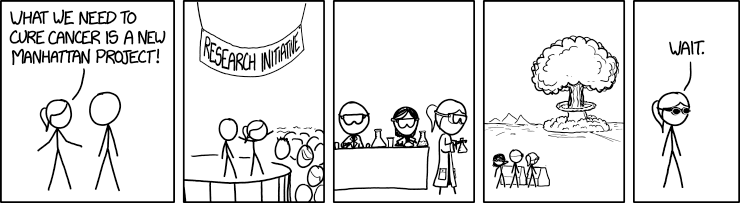
"Build an atomic bomb" is a lot more specific than "cure all diseases." In fact, "cure all diseases" is kind of the opposite of a SMART (specific, measurable, achievable, realistic, time-based). Whereas, to goal to build a device capable of detonating via nuclear fission is pretty specific, particularly to a physicist. Also very measurable and highly time-based.
Not even the Gates foundation is trying to cure all diseases, and Bill Gates is smart and gets stuff done. This sounds like feel-good charity to me, but we'll see what the results are in 100 years, I guess.
True, and a good point to make. My understanding of the difficulty of the atomic bomb was that everyone knew what to do (smash enriched uranium together such that was more than a certain mass), but they had a lot of difficulty getting the spherical detonation right. So the problem wasn't unknown from the physics side, but was rather an engineering problem. Compare to "cure all diseases," which we don't even know how to do theoretically.
Arguable. We can only compare difficulty after the fact, if Einstein hadn't rolled along with relativity and 3 decade gap for research, the atomic bomb wouldn't have been possible.
There may be a 'relativity' level discovery in biology/aging/cancer that will change the historic perspective. We can't know until after the fact.
The difference between "yes we can!" re: the atomic bomb and Zuckerberg's post is that the former happened after the fundamental discoveries in physics that made the atomic bomb possible. By the time someone said "yes we can!" a theoretical analysis of how the bomb would work already existed.
That fundamental advancement in biology hasn't happened yet. That's the difference between rational optimism and irrational and mindless optimism.
The fundamental discoveries necessary for the nuclear bomb weren't discover until after Leo Szilard [0] proposed the weapon. Given that none of us were alive between 1906 and 1945 it's hard to fully grasp how the scientific understanding evolved over those 39 years.
Einstein's work paved the way for Leo Szilard's vision but that vision was in no way a given. If it weren't for WWII, and Einstein's support, Leo would not have been able to garner the $2 Billion (1940's money) in support that was necessary to build the bomb.
Even then, there was a coin-toss level certainty that it would do anything.
Similar to Einstein's work preceding the discovery of Fission and the Atomic bomb. We have a great deal of work in biology around aging, telomere's, transcription errors, and more that hasn't been leveraged by the medical industry for varying reasons.
I'm not ready to be a naysayer on this topic, historically as a species we've had remarkable success in accomplishing things that were considered impossible before we did them.
The discovery of fission was not the product of the Manhattan Project but a continuation of research into the atomic nucleus that had been proceeding for decades. Once that happened, Einstein's theory told you that the process would release a large amount of energy, and a bomb became simply an engineering task. By the time someone wrote a check, the basic mechanism of the runaway fission reaction was understood.
That's totally different than the current situation with say cancer. In the world of physics and engineering, a "coin-toss" shot at working is actually a pretty well-developed idea. There is no ready-to-go idea you can point to and say "if we spent $20 billion building this it's have a coin-toss's chance of curing cancer."
I don't know where you see me stating that the discovery fission was a result of the Manhattan Project, it was a predecessor. The order of actions was: Einsteins Relativity -> Leo's Bomb Patent -> Discovery of Fission -> Manhattan Project -> Bomb.
> By the time someone wrote a check, the basic mechanism of the runaway fission reaction was understood.
I find that to be a gross simplification. I would challenge that the basic mechanisms of the fission reaction were as well understood then as we understand the basic mechanisms behind cancerous mutations now.
> There is no ready-to-go idea you can point to and say "if we spent $20 billion building this it's have a coin-toss's chance of curing cancer."
Over what time-horizon? We've achieved a great deal in the last 100 years that would have received less than a coin-toss probability if one were to be having this same argument in the early 1900s. The Haber Process [0] is a great example of something that we had no way of expecting we could accomplish (the energy efficiency aspect) before it happened.
What would you prefer Zuckerberg does with his money? I mean, he could build a massive yacht like Jobs before he died... As a species we have consistently accomplished feats that were as unlikely as the mitochondrial symbiosis that allowed us to exist in the first place, is there a reason to discount our abilities to continue this trend?
The relevant time is right now. If the U.S. government had said "yes, we can do it!" and invested $20 billion in building an atom bomb in 1915, they would've pissed that money away. It would've been mindless optimism. Doing it after fission had been discovered was a calculated investment.
> Over what time-horizon? We've achieved a great deal in the last 100 years that would have received less than a coin-toss probability if one were to be having this same argument in the early 1900s. The Haber Process [0] is a great example of something that we had no way of expecting we could accomplish (the energy efficiency aspect) before it happened.
The issue is that we're quite a few "Nobel-worthy" inventions away from curing Cancer.
I mean, biologically we're not in the equivalence of 1950's physics. We're holding in 1300's physics.
I saw that someone once compared curing Cancer to landing on a moon without knowing basic Newtonian physics.
I expect that before we cure cancer, we'd have found ways to cure all "normal" diseases, have "designer babies" without side-effects, have "instant, proof-perfect medicines", etc.
I'd want his to work on those issues.
Right now it'll probably end up like Google X. A great lab, makes great prototypes, but practically get left behind by incremental technology.
I strongly disagree that you can only compare difficulty after the fact. The full class of cancers is an object of lots higher complexity than quantum mechanics. For one, you need a theory of quantum mechanics to fully predict from the details of a cell (this is not the same thing as saying cells leverage entanglement and maintain superpositions).
A population of cells is more complex than an atom as it requires more parameters to be fully specified. It is also harder to predict because there are several levels of non-linear feedback interactions within an environment that can never be fully given ahead of time. A population of cancerous cells is more complex than a population of cells because their dynamics are not stationary in time. Unlike a typical population of healthy cells, cancerous ones are able to, in effect learn and more effectively than even the immune system. Extend this to the full class of cancers to see why a simple mathematical theory of the kind we find in atomic physics is highly implausible.
As such, we have an object of higher descriptive and predictive complexity than atomic physics. Searching for this theory will take longer and is much, much more difficult in a formal sense.
> The full class of cancers is an object of lots higher complexity than quantum mechanics.
Could you elaborate as to why you believe that?
Having worked on both biological and physical simulations the limits from a ground-up perspective are quite similar. While there are no well-understood analytic forms to describe biological systems, unlike in quantum systems, the fundamentals of the problem are the same: we can't predict things because there are too many interactions to easily model.
There is a whole world of non-traditional techniques opening up with increases in computational capacity.
You see the problem yourself by pointing out the required increase in computational capacity. Quantum mechanics can be described and predicted using fairly straight forward mathematics. Its descriptive complexity is lower than for a cancer whose functioning is a non-linear dynamical system not at thermodynamic equilibrium and changes in time. It's true that for QM, the computational complexity quickly goes up beyond toy harmonic oscillator problems but in a search for a theory, the descriptive complexity and number of fundamental parameters per observation is what controls search time.
We also don't know to what extent quantum computation would aid predictive modeling of protein interactions. It's possible that there are no leaks at the classical level of abstraction as to hurt predictability. But the problem still remains that experiments to fix parameters are hurt by the fact that the system is changing under you and interacts in a complex way with its environment which can't be known ahead of time. So the computational complexity is not necessarily easier (in a practical sense) even if we assume that there is no utility in modeling quantum effects.
One very theoretical idea of solving cancer (per cancer) would involve searching for a 'problem', an insult, outside of the learnability class of evolution which also does not harm healthy cells. This is computationally likely harder than BQP. Anything less, even if equipped with a quantum computer, would be evolved out of and with any survivors less attackable. Any way you look at it, it is a far harder problem than working out fission.
Just from a data volume perspective cancer and atomic bombs are magnitudes apart. Throw in the fact that cancer evolves and understanding those mutations requires unraveling millions of years of evolution and you've got a doozy.
I strongly believe that our analytic capabilities (as a species) have grown by orders of magnitude since we built the bomb.
My entire point was that the bomb wasn't a given in it's day (in spite of what the retrospective belief seems to be), just because something is out of our grasp now doesn't mean we won't reach it if we try.
Reading your comments it really seems like smart and knowledgeable people are trying to make substantive arguments replies and you're answering with woo-woo. You should probably listen more. I've learned a lot from reading them.
You don't need Einstein or relativity theory to build an atomic bomb. Experimentalists discovered fission, and could have built a bomb even if there were no theoretical basis for it.
You are 100% correct about what could have been. However, the reality is that Einstein's work paved the way for Leo Szilard to envision an atomic bomb before fission had been discovered.
Edit: Reflecting on this, without quantum mechanics (which stemmed from Einstein's relativity work), Oppenheimer would not have had the mathematical tools that were heavily leveraged building the bomb. The bomb is more than throwing together two sub-critical pieces of material, knowledge from quantum mechanics was critical in the prediction of which fissile materials could yield a functional weapon (of which there are very few).
He's likely thinking of the urban myth that over 10% of the US's power generation was used for the Manhattan Project [1] and confusing it with the cost of the project, for which estimates vary but is around $2 billion total (1945 GDP was $2 trillion).
Blowing stuff up is usually easier than fixing stuff. Do we have cold fusion yet (not Macromedia :)? Do we have fusion reactors yet? In fact, we seem to be slowly losing ability to have any use of nuclear energy except blowing stuff up - it's next to impossible to get a new nuclear plant built, and old ones are being closed down. By the same 2100 we may have the atomic bomb as the only way to use nuclear energy we have. And still no fusion.
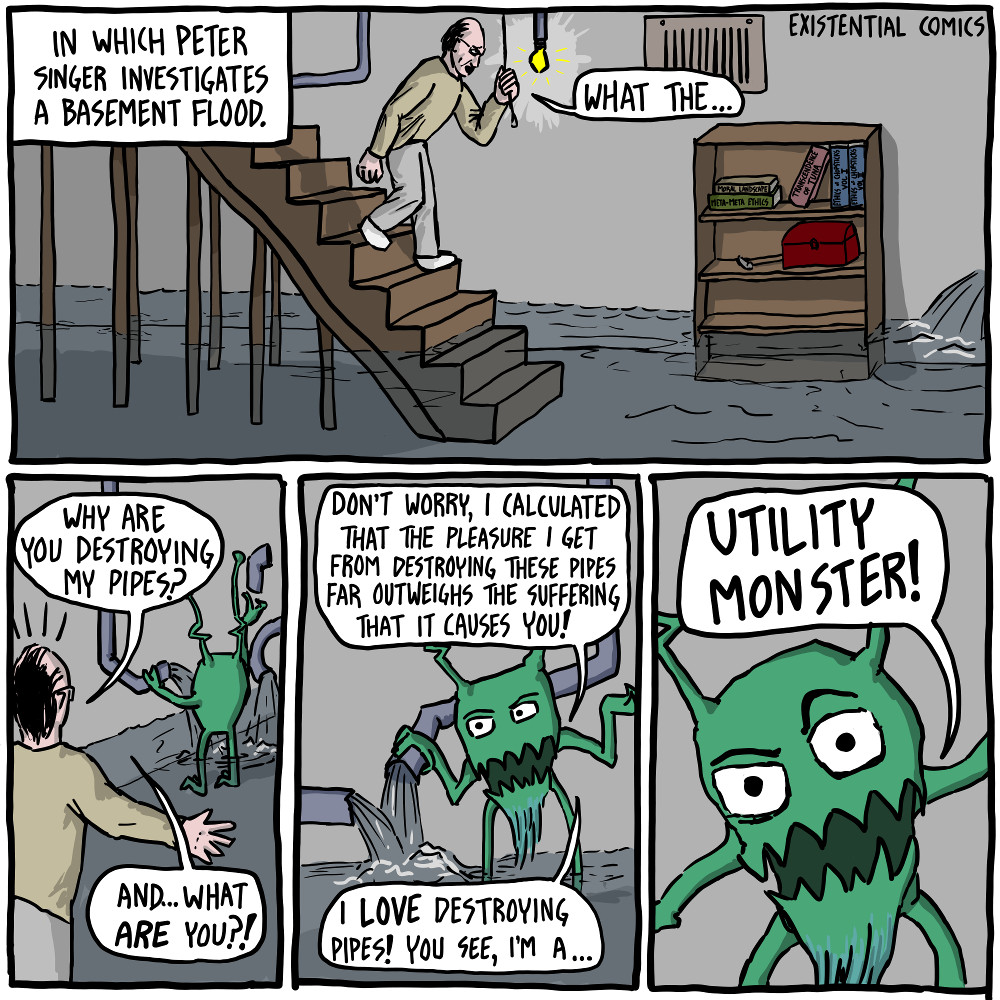
That is wondrously hilarious. I am saving it, thank you.
Yes, there are some good counter-arguments (such as the one the comic refers to), but in my mind they more indicate potential pitfalls that need to be discussed and worked around rather than completely destroying the theory.
Most of this stuff doesn't translate into real world scenarios effectively regardless, I look at it more as helping guide complex decisions which have to be made in a chaotic and fast moving world that is difficult or impossible to reduce down to pure data.
Malaria is more akin to an exploit than a vulnerability.
However, if we are to persist with your example, what you are trying to say is more akin to "Studying malaria and developing, or buying, a genetically engineered infectious disease that uses malaria's infection vector, and stockpiling it in a warehouse, and sometimes secretly using it, and not telling anyone about this isn't making people any sicker."
Most of those activities do not make people sicker. The hoarding part certainly does not. We ought to be realistic in identifying each action for what it is, rather than labeling it all as one thing.