Splitting water into free hydrogen and oxygen is important because it is an essential step for using electrical energy in the chemical and metallurgic industries.
For long term energy storage, free hydrogen is not a good solution, but it can be used to synthesize hydrocarbons, which are suitable for long term energy storage or for aerospace transportation.
Even with abundant and cheap dihydrogen, using it for energy storage in vehicles is a bad idea.
How does this refute the comment you replied to? That comment was implying that Toyota Mirai et al are ill-advised, so seems like your "nope" should be a "yep."
I agree that it was not the best introduction when that would be seen from the perspective of "ill-advised" companies.
What I meant is that for rational companies there would be no reason to be happy about this development, because it does not solve any of the problems that prevent free hydrogen for being suitable for energy storage, especially in vehicles.
It is not the cost of generating hydrogen that makes uncompetitive the cars with hydrogen, but difficulties in its storage and transportation.
Most of the energy used by living beings also passes through splitting water into oxygen and hydrogen, but the hydrogen is never stored as such, but it is immediately used for synthesizing reduced carbon compounds, which are suitable for long storage and easy to carry by mobile beings. This has been proven in practice for billions of years as a suitable solution for long term energy storage.
Can anyone give me a semi-technical reason on why the hydrogen division are delusional? I'm actually convinced of it "osmotically", but I just don't know enough about it. I've got chem 101 behind me but otherwise I'm a finance & tech guy. It would be nice to actually understand why it can't be done though.
If we manage to get enough solar such that energy essentially becomes infinite then the inefficiency would no longer matter. Otherwise, it would only make sense in vehicles that require high energy density like airplanes.
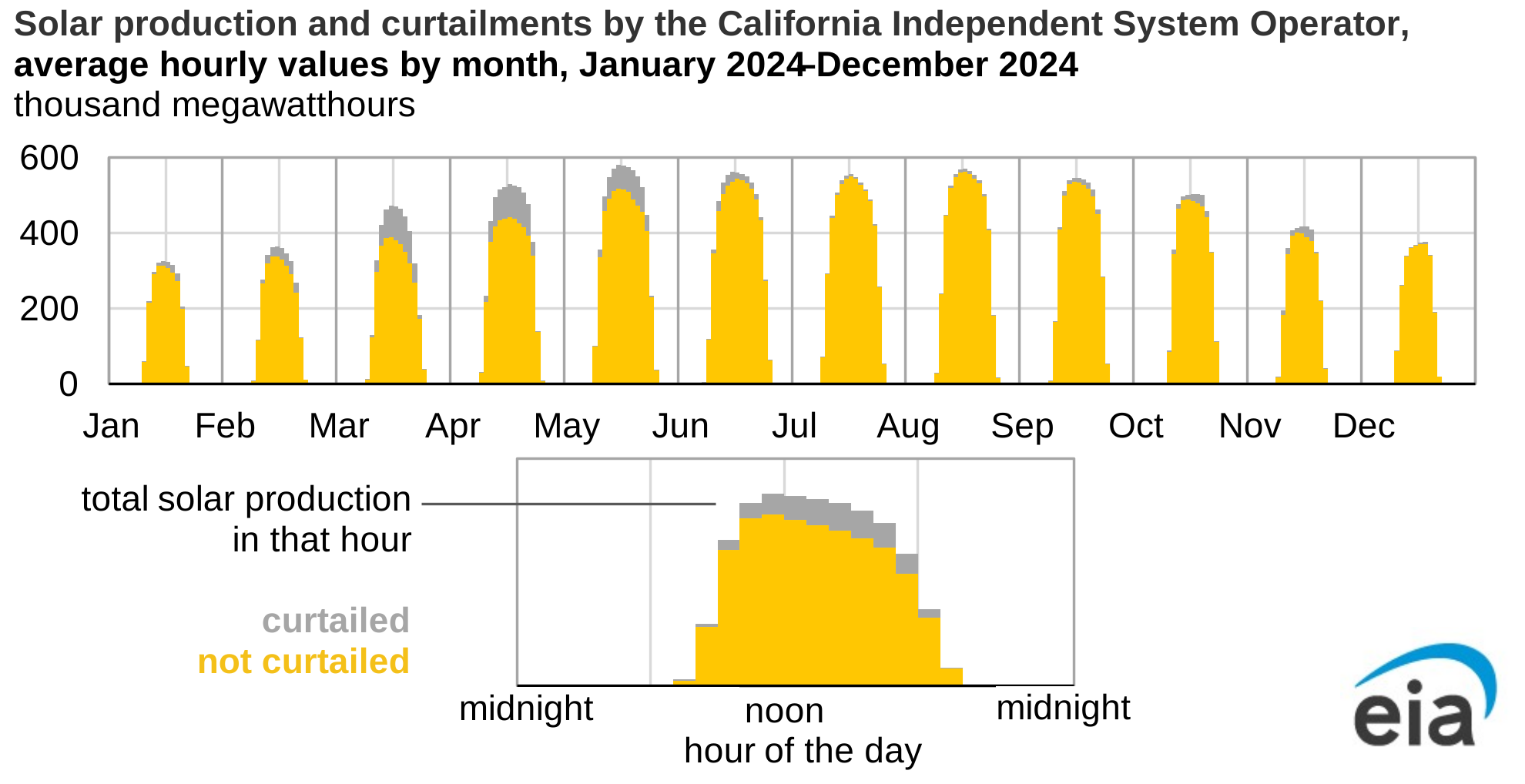
There is already free energy. In 2024, California curtailed 3400 GWh of solar. Hydrogen is one of the easier ways to load shift that to winter or processes which need something denser than batteries. I actually prefer synthetic methane (worse efficiency) because it is more immediately usable.
Looking at the charts[0], load shifting all the way to winter seems unnecessary. You only need to load shift until ~6pm, in which case there are plenty of better options out there like grid-scale batteries, flywheels, pumped storage hydro, etc.
It depends on your energy mix. The more solar you go, more load shifting is required. Winter solar production is relatively crummy and you need to offset that loss somehow for the entire season.
That chart is showing some curtailment in winter because the grid knows to expect less production. It is already tuned to spin up more gas because solar will underperform relative to Summer.
Hydrogen leaks too much. You cannot transfer it without spilling a good chunk, around 8 percentage of it into the atmosphere. Now match that loss by your long term refuel needs and you'll simply run out of it. It can't scale up to anywhere near what would be considered a replacement technology for EVs.
Japanese car manufacturers were late to EVs, and in order to prevent a gap in the market where EV-first competitors can steal market share from them, they lobby the government to subsidize and create a new market segment in the form of hydrogen cars. There they have a head start via some latent research and more reuse of ICE car platforms. I'm sure the hydrogen division is well aware that they are doing research on a dead-end technology (at least for the automotive sector).
The exact same thing happened in Germany. In 2020 there was a huge push from politicians to push more hydrogen technology to distract from the fact that German car manufacturers were lagging behind, as well as general missed initiatives for renewable energy. Now, 6 years later those initatives are deader than ever.
Yep... Anyone who looked at how CNG cars went in the US and was like yep, let's do that but with a gas that's harder to transport and store and has no existing network, had to know it wouldn't work out very well.
CNG fleet vehicles work out for many fleets; especially those that have vehicle depots where fueling happens.
I haven't looked into detail for the hydrogen cars, but I wonder if they made the same kinds of designs with regard to the fuel tanks. On pressurized fuel vehicles, the tanks expire after 15-20 years; on most CNG cars, the tanks take a lot of labor to replace, so most vehicles will expire when their tank does; I suspect the same for the hydrogen cars. Fleet vehicles tend to do a lot of miles, so a time based tank expiration is less of a problem.
In its defense, hydrogen cars would use fuel cells, not the IC engine of CNG cars. So there's at least a theoretical case that could be made for them. In practice it didn't work well at all.
The case for BEVs becomes even more clear when you look at complexity. BEVs are just simpler, even simpler than today's IC engine cars. IC engines have become baroque and expensive. The tooling needed to make these engines has become a boat anchor on the old car companies. And similarly for transmissions: the transmission of a BEV is a very simple thing, just a single stage of gear reduction without a clutch.
Fuel cell cars were a bet on the proposition that BEVs would be inhibited by range and charging time concerns, but rapid charging and widespread availability of such high power chargers has nixed that.
> In its defense, hydrogen cars would use fuel cells, not the IC engine of CNG cars.
Looking at a CNG car and thinking the reason they didn't get adopted is ICE and not gaseous fuel is pretty silly. Fuel cells are cool, but they don't solve the problem of tank expiration, and hydrogen storage is harder than CNG storage.
ICE may be complex, but most of the complexity comes from emissions controls / efficiency mandates. CNG "solves" emissions. You could burn hydrogen, and you'd really solve carbon emissions, if your hydrogen wasn't just coming from natural gas anyway. You'd probably need DEF, because high combustion temperatures with air intake from the atmosphere is going to generate NOx. Might not be as efficient as fuel cell vehicle, but it really doesn't matter when the problem is the fuel.
BEVs are clearly going to win as ICE is pretty close to fully optimized and batteries are still getting better. Although, if you could make a fuel cell vehicle based on a STP liquid that is energy dense and reasonably non-corrosive, it would have a chance.
Indeed, the theoretical argument for hydrogen vehicles did end up being silly. But it's important to understand what it was, if only to help one avoid mistakes like that in the future.
You're explaining the practical consequences of their delusion, but delusion it remains. Hydrogen for cars isn't going to work to save them, even with the lobbying. Granted, they were probably screwed anyway, so they had no good options.
Killed themselves after using it for fifteen minutes. I used to have to teach a commercial "Intro to Unix" course which had a section on SCCS - shudder!
I don't know - RCS just made more sense to me. And I really disliked RCS. You know some things are bad when something like CVS seems all warm and cuddly in comparison.
> I'd have thought that alcoholism would have been enough to numb the pain.
You may be right - it would certainly explain some aspects of my life since those days ;)
What percentage of the US population that finds themselves in need of an SSRI or similar medication can afford to obtain and fill such a prescription as compared with citizens of EU countries that enjoy universal healthcare?
I realize that you're baiting, but it's just a google search away. We're at about 10%, vs some EU countries' 13-14%. Considering that - it's highly unlikely that anybody who needs access to SSRIs does not have it.
Forgive me, I wasn't baiting. I was just trying to elude to the fact that a substantial percentage of the American population can not afford to get a doctor to prescribe them medication and often can not afford to fill that prescription. The lack of insurance and prevalence of underinsurance in the US very likely an important aspect of what we're talking about.
That both isn't true and ignores how long it takes in Europe to get an appointment. The US healthcare system isn't bad, its expensive. Its expensive because regulations force it to be expensive, often for the best reasons (minimum standards of care). It isn't an accident that rich Europeans travel to the US for healthcare. You can probably see the problem with all of this. But who wants to be the politician that legalizes cheaper care for poor folks. Even though its good public policy, the other side will vilify them for it. Most public policy problems are caused by those with no knowledge of a topic getting involved (even if its just voting based upon that issue) in it.
Concern bait is still bait, considering I've worked in the healthcare system enough to know you're adamantly incorrect about both the cost and availability of psychiatric care. Unfortunately I also know that attempting to convince you otherwise is a mug's game.


reply