The review confuses psychological optimism with a problem-based definition of optimism: that problems are solvable (and hence progress is possible).
As David Deutsch points out in The Beginning of Infinity, Winston Churchill was an optimistic leader and a fan of science and progress who nonetheless suffered from depression (the 'black dog') [1].
Whereas Thomas Malthus (mistakenly) predicted mass starvation due to population growth [2] and was therefore a pessimist who nonetheless was of a sunny disposition and the life and soul of dinner parties in London.
>To think of this book as any kind of scholarly exercise is a category mistake. The purpose of Pinker’s laborious work is to reassure liberals that they are on “the right side of history”.
>Judged as a contribution to thought, Enlightenment Now is embarrassingly feeble. With its primitive scientism and manga-style history of ideas, the book is a parody of Enlightenment thinking at its crudest. A more intellectually inquiring author would have conveyed something of the Enlightenment’s richness and diversity. Yet even if Pinker was capable of providing it, intellectual inquiry is not what his anxious flock demands. Only an anodyne, mythical Enlightenment can give them what they crave, which is relief from painful doubt.
If you are trying to signal to an out crowd that Pinker is misguided, ill informed, or otherwise wrong, provide evidence.
If you are signaling to a crowd that they are right to ignore him for reasons they know, this is how you do it. With a broad grin and no effort to actually engage. :(
That is, this seems to be setting up a battle of "elites" where the call to action is to loudly decry Pinker without having to read him.
Is there more to this story than this? Was this just a particularly bad quote?
He's trying to "signal" that he wants you to read the article that he linked, and to entice you into doing so he has picked a few quotes that sum up the author's point of view. If you disagree, perhaps you should click and find out if the article is any good...
Apologies, my criticism was at the linked article. The quoted part was particularly bad. To the point that it really detracted from any point and only seems to exist for the signaling aspect.
I don't mean to be overly picky about Gray's response, but proper English is: "Yet even if Pinker were capable...". (I am not aware of this being a British-ism.)
When an author, none less, writes incorrectly -- it makes me question his basic thesis.
I knew that Gray was not American. I do not know British English, so I don't know whether Brits speak that way. I pointed this out. Do you know the answer?
I suppose at schools that don't teach English well, those 'many' could argue anything that's not correct as being correct. I was taught in Catholic school, and there we learned that other schools had lower standards.
Shall we lower our standards so we all speak more grunt-like? Is this where we are headed?
Why is my comment down-voted? I believe it does not violate any HN rules or is otherwise erroneous. Just trying to 'get it right'. I'm genuinely curious -- would one of the anonymous down-voters please create a throw-away account and explain, in detail, your reasoning? Thank you!
I suspect it's that it comes across as overly pedantic. I'm a big fan of the subjunctive mood myself, but I also understand that language changes and prescriptivism just makes me miserable. It's also in the middle of a contentious discussion, so people are going to be more on edge and probably more likely to react more harshly to what they perceive as nitpicks. That's my read on it, anyway, and it's supported indirectly by other comments down thread.
FWIW, with respect to the HN rules, it is frowned upon to comment on voting:
> "Please don't comment about the voting on comments. It never does any good, and it makes boring reading."
Thanks. I greatly appreciate your comment. I thought it might be others, not me. I'll assume that was it, as I would think that accuracy would be prized by programmers and such.
I think that 'guideline' about not commenting on voting is circumspect, because it means that people, in the heat of the moment, can press a button when they are pissed off, and don't have to craft a logical response ('the why'). It cheapens HN, I believe, and I'll mention this to Paul next time I see him.
Removing the guideline won't change voting behavior. And I'm pretty sure people who are going to downvote without commenting aren't likely to add a comment at the urging of another comment. The guideline is there to avoid exactly the type of thread this has become: tedious, boring (in the sense that it's been repeated time and again in other threads) and unlikely to do any good.
Pinker avoids addressing the social breakdown of families and the increased polarization and technology-driven personal atomization in the current mileau, whose undertow underlies a lot of the big issues today.
Otherwise, an admiral figure from the elite academy.
> Pinker avoids addressing the social breakdown of families
Is it really a problem that families aren’t together? Previously (with some hold outs) there wasn’t much choice and families had to stay together due to issues around control through money, religion and social pressures. Go back further (hopefully, though this is still pretty grim in many areas) and domestic violence was also legal.
“Breakdown” of families is a considerably better option than what was previously available.
> the increased polarization and technology-driven personal atomization in the current mileau
I don’t understand what this means, could you give an example?
> Is it really a problem that families aren’t together?
if you care about the epidemic of loneliness, the negative medical consequences of social isolation, and the demographic sustainability of developed countries, yes.
Research shows having a roommate is enough to combat feelings of loneliness.
Marriage in and of itself isn’t shown to automatically increase happiness; most folks reported having maintained their baseline mood after the wedding
Maybe this is just old definitions needing to be updated, but “family” in the traditional mom-dad-kids all visit grandma and the like, isn’t essential to the species.
Socializing is, but not the traditional structures
Random, mostly substance-free articles is hardly convincing evidence that this is a problem. Notably, none of the crappy articles mention whether this "problem" is even new.
Blinders help even less. And whether the problem is "new" or a few decades old is really irrelevant.
There's some trend to have huge issues, felt and experienced by tens of millions, studied by tons of different groups, admitted by experts, pointed at by tons of different statistics, etc, and people wanting to have some definitive "this is the final 100% statistical proof with n confidence" on it, or else it doesn't exist.
It's more lalala hands in the ears denial than actual science. Same thing for the environmental change deniers.
See the difference there is that you don't need shallow feel-bad articles about climate change. There's hard science there; it's incontrovertible.
In contrast, neurotically wringing our figurative hands about imagined problems like the link between vaccines and autism, the link between video games and school shootings, or disintegration of traditional values in modern times; all without hard science backing it up; will continue to fail to convince all but the most blinded.
And whether the problem is "new" or a few decades old is really irrelevant.
Why should we think it's not tens of thousands of years old?
Pinker also looks at relative numbers a lot, to me this seems disingenuous given for example that every day an equivalent number of people as a fully loaded 747 die to car accidents alone. We have been on the brink of complete nuclear annihilation at least once, to say we're very far from another such incident would be almost mad. Pinker avoids the giant elephants in the room so sure, the fast that we're still here makes his arguments look good, but they could be very shortsighted specially if there is no one to talk about them.
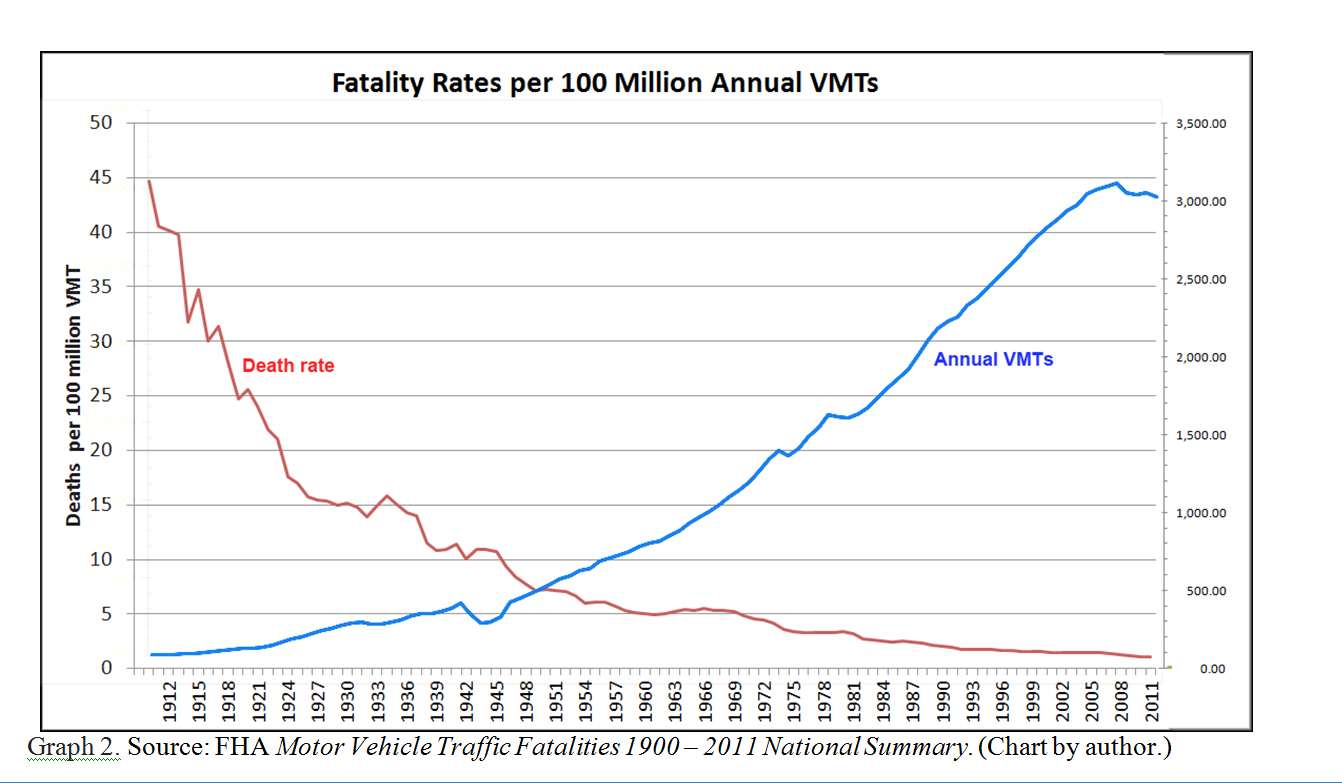
Half the reduction occurred from 1912 to about 1922, the first decade of large-scale auto use. Bt 1940, it halved again. The next halving gets you to the eary 1970s.
The present rate looks to be about 1 death per 100 million vehicle miles travelled (VMT), or roughly 1/5 the rate in 1970.
My main takeaway is diminishing marginal returns, and a fairly consistent trend of halving the rate every 20 years or so, after the first decade.
They're attributed to 9% of MVA deaths, and 16% of MVA injuries as of 2016, though trends seem relatively flat (or declining) since 2010.
Overall accident instances tend to scale with miles driven, which are a pro-cyclical economic factor. That is: as economic activity increases, people drive more, for both commuting and recreation.
> Enlightenment advances were tied to empire building and the nascent Industrial Revolution, predicated not just on noble ideas and scientific curiosity, but also on slavery, genocide, exploitation and cultural triumphalism. Like the Renaissance, it ended in chaos and conflict, including the French revolutionary wars of 1792–99.
> Both eras show that science and evidence-based thinking do not necessarily triumph over irrationality and ideology
I can't tell if Ian is saying:
1) Science and evidence-based thinking are the direct cause of these eras "ending in chaos and conflict", and that "irrationality and ideology" could have been preferred, or
2) Science and evidence-based thinking were insufficient.
If it's 1, I doubt that's really true and would definitely need evidence.
If 2, then insufficient at what? Insufficient to act as a moral compass? Insufficient at convincing people to hold similar values in utilizing science and evidence-based thinking? Something else?
I think there's a '3' here: Science and evidence-based thinking are (relatively) orthogonal to the emergence of social chaos and conflict.
If I'm not mistaken this is implied in Marxist thinking, so it is an idea that is 'out there' (in the sense of being available). I think the idea there is that our rational thinking largely serves as justification rather than being something very powerful on its own.
The way I see it is that (at least much of) rational thought is the latest stage in 'elaboration' of lower-level mental/emotional processes. In which case, our rational thinking on subjects which impact real circumstances in which we're invested will be constrained and influenced by our goals, values, and something like coefficients for strength of influence of various emotions etc.
i think he is omitting a few words: he might want to say that science created the means for European powers to build empires by dominating people in far off places; these empires ran on slavery, racism & genocide in far off places (the colonies); much later in the twentieth century the violence & genocide came back to continental Europe in the form of two world wars (when the same weapons and ideologies that were developed to kill 'colored' people were turned on the Europeans). in the aftermath some people try to make sense out of this mayhem and they ask the question of 'what's the point of this project ? Are these ideas of enlightenment at fault of getting into such a mess? (or might it have been something else like how we applied them) ? and what can we do about it ?' . Is that correct ?
I still have to read the book, but I am a bit worried that it will have a similar fate to Fukuyama's End of History..
It's interesting to compare Pinker and Chomsky. IIRC, in some interview Pinker said that he has much more skeptical view of human nature than Chomsky.. And yet, regarding the humanity as a whole, he seems to be more optimistic than Chomsky, who considers (and rightfully so, I think) global warming and nuclear war as two grave dangers. Although Chomsky also often states that things are somewhat getting better when it comes to human rights and so on.
I think "The End of History" gets a bad rap. People say the rise of China (for example) is a counterexample to his theory, as it is becoming economically successful without being a democracy, but with all the clever wordplay Chinese citizens are using online to get around attempts of censorship, it is really questionable how long China's educated and technologically sophisticated populace can be controlled by a one party state.
Genuine question: what values count as enlightenment values? And who gets the credit for coming up with these values? I heard Pinker on Ezra Klein's podcast and he seemed to imply that Gandhi/MLK's non-violent movements were the product of the enlightenment. Isn't that a patently ridiculous claim?
I looked up wikipedia to see who the intellectuals of the enlightenment were and it seems many of these people are racists, slave-owners and colonizers who literally thought that Gandhi/MLK were sub-human. Their military philosophy seems to boil down to might is right and their values AFAICT are pretty close to Richard Spencer's. Sure, some of these people were great scientists and politicians, but I'm having a hard time seeing them as moral exemplars.
The enlightenment's values and luminaries are enumerated in any number of sources on the subject. The rest of your comment appears to be a dubious framing, with numerous distortions caused by feats of time-travel within your modern, progressive mind. Within the past 5 years, it has become a necessity - an emergency - to disassociate oneself as far as possible from people, their ideas, their friends, and their friends' friends, at the faintest hint of la problématique. I like to imagine Gandhi and MLK were more mature, and better able to handle the cognitive dissonance in the human mind.
'Outing' Benjamin Franklin is not even a tiny bit like outing Harvey Weinstein, and 'outing' historical figures as racists and sexists is practically content-free, since it's no secret. If social justice enthusiasts continue down the path you seem to be alluding to, you'll wind up burning every book written before 1970, and plunging us into another dark age.
If this is not the answer you wanted, my only suggestion is to try to pose your question more thoughtfully.
Afaik, there were big discussions about slavery and racism all the time concepts existed. The discussion about some past actors being more racist then others or even actively pushing for slavery while others were not should not be taboo.
It is relevant that someone writing about freedom conveniently did not counted whole groups as deserving that freedom in the first place.
It is much easier to be for free speech for example, when the group of people most likely to oppose you dont count.
Edit: by this logic, you cant critize Robespierre. Or Lenin/Stalin, because they were product of time and built an imperium anyway.
It is also relevant that nice sounding definition of freedom was used to defend the slavery or that the rational science at the time was actually exercise in motivated reasoning convenient to speaker (whether practically or just made him feel good and superior) - but not really result of fair unbiased cold look at world.
The general thrust of “mainstream” thinking on “enlightened” thinkers of the past is that they offer a framework for freedom and justice, however I’m perfectly framed, and in spite of them falling short of living up to the ideals they espoused.
To deny the concept of human rights, and the validity of science because some foundational thinkers fell short is ridiculous.
> The general thrust of “mainstream” thinking on “enlightened” thinkers of the past is that they offer a framework for freedom and justice, however I’m perfectly framed, and in spite of them falling short of living up to the ideals they espoused.
OK, that's fair. Is the claim that such a framework did not exist before? Or is it that this new framework was somehow "fairer" and closer to our modern ideals of justice than the ones that existed before? Because neither of these claims seems defensible.
> To deny the concept of human rights, and the validity of science because some foundational thinkers fell short is ridiculous.
But where did I (or anyone else for that matter) deny the concept of human rights or the validity of science?
Good thing no one is denying science here. The parent refused to see them as moral exemplars.
If mainstream thinking ignores rather large holes in human rights these people espoused, both in theory and practice, then it makes even more sense to point that out.
If your framework of freedom boils down to "might is right" in rather large amount of cases and brings unfreedom to big enough amount of people, then it is absolutely relevant while discussing your freedom concept. Exactly as reign of terror is relevant when discussing French revolution ideals.
The answer I want is a clear explanation of these so called enlightenment values.
What I'd also like is for you to stop putting words into my mouth, I never advocated for disregarding all knowledge generated before 1970, nor did I suggest that we must disassociate ourselves from anyone.
I just want to point out that the so called values of the enlightenment were never really put into practice. Rule of law and democracy didn't exist for African Americans or colonial citizens of color, the power of nonviolent protest and it's ability to effect change was mostly thanks to leaders who stood in opposition to those who supposedly represented the values of the enlightenment, and the relative peace of the last 60 years is a result of the devastation caused by great wars that were entered into by societies that were supposedly enlightened.
I'm just calling bullshit on the notion that the ideals of European nationalism fuelled by the industrial revolution can claim any credit for the social progress we've made as a nation. Technological progress? Sure. Social progress and justice? Not at all.
Well it seems very simple to me. There were different aspects of the enlightenment. The most central one is probably reason over superstition. Some aspects are considered good now, some are not. Just make the distinctions; don't paint the whole thing according to its worst aspects and thinkers. What's the problem?
DFW put it nicely in "Authority and American Usage", and it's stuck with me as a pithy counterpoint to this kind of teleology.
Describing pinker's thoughts on linguistic descriptivism:
Steven Pinker's 1994 "The Language Instinct" is a good and fairly literate example of this second kind of Descriptivist argument, which, like the Gove-et-al. version, tends to deploy a Jr.-high-filmstrip SCIENCE: POINTING THE WAY TO A BRIGHTER TOMORROW-type tone...
I think it's a lot closer to the truth to say that humans tend to be human throughout history, for both good and ill, and that this alone is why neither anyone's idea of utopia nor dystopia will ever really happen. We're always somewhere in the middle.
We've already had plenty of dystopias: Nazi Germany, the Soviet Union, Maoist China, Cambodia under the Khmer Rouge, North Korea today... As for a utopia? Nobody can agree on what that would look like. When somebody claims to have a plan for a utopia, my first question is: "for whom?"
How does any ideological utopia work without excluding anyone? I have yet to see a satisfactory answer. The paradox of tolerance would suggest that utopias are impossible, at least with human beings.
I suspect your dystopias have in common that they all had utopian visions. Instead of focusing on real problems and making gradual progress they kept talking about building heaven on earth. Apparently they just needed to tear down existing institutions and kill a few people first...
Optimism is good, but it could have turned for the worse: we are lucky that we had the 'nuclear taboo' ; nukes are kept strictly as a weapon of last resort. If nukes were to be used in 'limited conflicts' then we all would life in quite shitty place. (in the real world nukes kept Europe safe and prevented big wars between regional/superpowers)
I think we should be thankful for our extreme luck.
You never know how the next advance in science & technology will change the pace and character of human conflict.
We can simply look at /Better Angels of Our Nature/ to know what a hack Pinker is. His thesis is only good for intra-civilizational violence on decline, which is true and fascinating. Not a cause for celebration, but for study -- he should take into account the purpose of study is to study, not celebrate. This failure cripples his work beyond his knowledge area (psychiatry, neuroscience).
Anyhow, /Better Angels/ is the most messed up, sloppily cited, cherry-picked history of human civilization I may have ever read from an academic. There is a certain Eurocentrism deep throughout, but one does not have to read between the lines. His estimates of battle deaths are prima facie ridiculous. Ancient wars always take the highest estimates. It's a wonder humans did not go extinct millenia ago, given how they kept killing a quarter of the population on a regular basis. Modern wars like Iraq, even at his time of writing in 2010-11, had far, far more deaths than he counts.
Maybe he does not want to count anything that isn't a uniformed combat death, but then he would have to admit something happened to cripple typical life expectancy.
I was about to lose my mind at the incredibly racist portion on Polynesians and genetic predispositions to violence and cannibalism. I say "incredibly" literally. I cannot fathom how it got published and praised. I imagine the exorbitant length meant most reviewers stopped a third of the way through.
And Pinker has been the head of the editing panel for the American Heritage Dictionary since the Fifth edition, a serious downgrade from the Fourth, by the way.
Pinker is more than jack of all trades, master of none. He is a charlatan. It would be all the more tolerable if he had a sense of humor.
Pinker is more than jack of all trades, master of none. He is a charlatan. It would be all the more tolerable if he had a sense of humor.
No.. really: tell us what you think? Pinker is smart, and writes well, and holds opinions you don't agree with, but this is an eggregious take-down. Do you really question his chops on linguistics too? Or is it just that he chose to step outside his baseline and do work you don't want to respect or bond with?
Put up better stats if you want to refute his numbers.
You can get a reasonable 20 minute summary of the books ideas from Pinker's recent talk "Be Positive, The World Is Not Falling Apart"
https://www.youtube.com/watch?v=1s2qyYQIRQE
I'd say the huge moral innovation of the 20th century is scientifically showing the human fetus is neither human, alive, nor a person. In a previous era, society frowned on abortion and contraception due to the old fashioned Judeo-Christian moral views, and so we had over population and widespread violence and poverty. But, thanks to the moral innovation of fetal science, we've discovered that we can stop violence before it happens by eliminating fetuses instead. So, instead of millions of dead humans, we have millions of terminated fetuses. The great gift of 20th century science is an ability to define the problem away, in a sense. And today we are almost at the point where we can completely discard of morality altogether, which will bring about a true utopia on earth because then nothing will be wrong.
Yes, because letting grown up woman die because of someones believe in fairytales or forcing preteen rape victim to give birth is very moral.
I think some should take more time and find out more what science is and what morality is.
I can't believe Steven Pinker isn't met with outright ridicule. The cult of positive-think is strong - I imagine anyone criticizing him publicly would be seen as 'being negative'.
Steven Pinker uses statistics to argue that health, prosperity, safety, peace, and happiness are on the rise, both in the West and worldwide. It attributes these positive outcomes to Enlightenment values such as reason, science, and humanism. [0]
Enlightenment values? Humanism?
Did we not just live through 2 world wars, a cold war, etc? What is USA's military budget again? 597 BILLION USD in 2015? (Google 'usa military budget')
Some humanist world power we have, it doesn't even provide health care for it's own citizens, while letting them buy guns!
Some humanism that is... Shall we go down the list and discuss how humanist China is?
The book concludes with three chapters defending what Pinker sees as Enlightenment values: reason, science, and humanism.[4] Pinker argues that these values are under threat from modern trends such as religious fundamentalism, political correctness, and postmodernism. [0]
One of the top three concerns for humanity, according to Pinker, is political correctness... I don't even...
This criticism boils down to a disappointment in humanity's progress. It's true that humanity could be Star Trek-level in 2018, if things had gone a bit better for us historically.
But we'll get there in 2118 or whatever. It's an inevitable result of technology building on itself. Even if it costs a dozen World Wars and rebuilding civilization from ashes. And it hopefully won't even cost us a WW3, though it may.
The journey will be a rough ride for humanity but on the other side is an end to most forms of human suffering and limitation.
We don't even know what's on the other side of this level of progress except that humanity will not remain humans as we think of ourselves today.
Well, he is frequently met with outright ridicule. But to be fair, he does address those points. I haven’t read his stuff for a while, but I think he argued that, even with the two world wars and all the other atrocities of the 20th century, there were still fewer violent deaths per capita than in the previous century.
I don’t agree with everything Pinker says but there does appear to be a statistical fact that fewer people die from violence each century. He looks for for explanations for this general trend.
Yeah, those are bad things, but Pinker’s thesis is that things are improving. All the historical societies I’ve read about had astounding levels of savagery and brutality. Along with disease and no real medicine.
Why is it so hard for people to grasp this idea of “progress.” It implies improvement, not perfection.
I blame it on the schools. Academia has a fetish for "dead shit", and the "enlightenment" was the most recent batch of dead shit within the average level of reading comprehension.
It's not just Pinker. Both mainstream ideologies have been circling up around nth-order regurgitations of enlightenment thought for as long as I've been alive.


As David Deutsch points out in The Beginning of Infinity, Winston Churchill was an optimistic leader and a fan of science and progress who nonetheless suffered from depression (the 'black dog') [1].
Whereas Thomas Malthus (mistakenly) predicted mass starvation due to population growth [2] and was therefore a pessimist who nonetheless was of a sunny disposition and the life and soul of dinner parties in London.
[1] https://www.goodreads.com/book/show/10483171-the-beginning-o...
[2] An Essay on the Principle of Population (1798) http://www.esp.org/books/malthus/population/malthus.pdf