The part that confuses me is:
The North Carolina State Patrol had said the bridge was not maintained by local or state officials, and the original developer’s company had dissolved.
So, nobody is maintaining the roads in that neighborhood? It makes very little sense. The roads in my neighborhood are owned and maintained by the neighborhood (not that state or county) and we (the HOA) carry liability insurance.
It's the same as your neighborhood, but without the maintenance being performed.
My little 15-unit private drive was a single homeowner's 25-acre plot in 1950. Someone built a house in the back, with a long driveway up to it. Then they sold three lots for others to build nearby, then in the 1970s they sold another dozen lots, including mine. In the 80s they pooled some money together and turned the gravel drive into a paved road, still private, we all just have an easement that allows us to drive on it. Now, 40 years later, that paved road needs repaving to the tune of $90,000, because tree roots are breaking it up and it's delaminating in spots from an inadequate repair job a decade ago.
But try convincing 10 retirees with limited funds, and 5 families with small children, to each dig in their pockets and come up with $6,000 for a new driveway. Most people have bigger priorities, which is why there's currently a few nasty potholes on the route Google will suggest for you (the only route to my house).
This is even worse, because a bridge like that probably costs a lot more than $90,000, and instead of 14 out of 15 people driving over it every day, most of the neighborhood residents don't need it.
The difference is we have a formal HOA with an annual budget. The HOA owns all the common property, including the roads, paths, and a few chunks of garden/yard. We all pay quarterly dues into the HOA's general fund. The only part I'm not sure about is what happens if the HOA becomes insolvent - that's not a situation I've heard about locally.
Who actually owns the main road in your situation? As you each have easements, it sounds like the original house still owns it? I've heard of similar situations and it always confuses me, for just the reason you mention - I would never buy a house in neighborhood with no means to maintain then neighborhood infrastructure.
Lots of factors can impact the HOA's ability or willingness to maintain things, though, as you note about the potential for insolvency.
Presumably a bridge being swept away in floods could be something insurance would weasel out of paying, as an "act of god" or whatever, so unless the HOA has enough reserve to cover the (potentially very large) expense of replacement, it comes down to the members approving an assessment to fix it. If the bridge being out didn't significantly affect the daily lives of the residents of the neighborhood, it kind of makes sense that they'd be loath to shell out who-knows-how-much on repair, on top of their regular dues.
This is one of the concepts addressed by StrongTowns.org, basically that American suburban infrastructure development has been following an unsustainable pattern for decades and we're now starting to reap what we've sown, here's an article on this exact topic: https://www.strongtowns.org/journal/2015/11/1/suburban-bailo...
Sometimes driving on gravel or a less than stellar road is a simple concession to live this lifestyle. I have lived in an HOA and I will expend whatever resources are necessary to never live in one again. It is the worst form of local governance.
I suppose, but when that broken down road becomes a safety hazard, then what? That appears to be what caused the incident in the article.
FWIW, I tend to agree that HOAs are less than ideal (and downright evil in some cases). But, I don't have a better solution the problem of shared common areas and infrastructure. I'd much prefer the county/state took over all roads, but in my neighborhood, we still have to deal with trash collection and common area maintenance (parking spaces, neighborhood entrance, signage, lighting on sidewalks, etc).
Do roads not break down and persist in an unsafe condition when under government stewardship? I agree this is a hard problem, but the solution is probably something like "mandatory inspections of private roads on a cadence by the nearest local government and shared liability for roads not marked as out of service." The government may not be responsible for maintaining the road, but it is reasonable to require they maintain road condition records for their jurisdiction, reporting obligations (including to mapping providers), and mapping providers (Google) should share in liability if they are not updating their records with regards to road safety when information is furnished (as this article indicates Google did).
Governments are large enough they can always find money to fix a road, so it's a matter of raising enough stink about it in public. With small-ish private owners and HOAs, the situation is reversed - there's only so much they can afford, and only so much damage bad PR can cause; you hit that limit, they'll just shrug and stop listening to you.
Do roads not break down and persist in an unsafe condition when under government stewardship?
They can, but in my experience, anything that approaches a collapsed bridge in severity is resolved quickly. Large potholes can hang around, which can be unsafe, but anything bigger doesn't get left to fester.
Being rarely used is an advantage, though. You can solve the safety hazard component of the problem with a few hundred dollars worth of signs and barriers, rather than by actually repairing the thing. The convenience part can then be ignored.
If you do this in a college town or something, have fun replacing those signs and barriers every few weeks, as they are graffitied, vandalized and stolen.
My parents live in a community where one of the roads is named something like "High Street" (not actually that; it's a little road within their development). That sign gets stolen a few times a year by college students from the next town over because it includes the word "high". They have never had a road barrier stolen or meaningfully damaged, though -- they have maybe a dozen in various places.
They budget about $50/year to replace the signs. Still much less, even over rather a long period, than the cost of rebuilding a bridge.
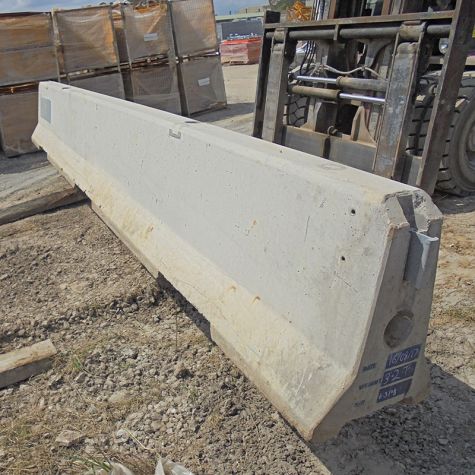
Ideally, the concrete jersey barriers are temporary until the bridge is either repaired or dismantled appropriately (with proper road closure on both sides).
It still blows my mind that a bridge on an otherwise publicly accessible road was privately owned and maintained. That's a new one to me - around here, there are plenty of private neighborhood roads, but none have bridges.
I live in a place that is also off a private road and the solution that was come up with was "like" an HOA, but just maintains the actual road. They collected 10K, and then dropped the yearly collection to $125/year. 11 houses on this road. Because yes, road repairs are very expensive. At one point, they were looking at 45K to get the road just functioning until they convinced the city to take like 100 feet of it under their control
It has never made sense to me that a neighborhood is responsible for paying for a road that people beyond the neighborhood can use. Portland and Multnomah county work this way and as a result, part of our 1950s neighborhood has a gravel road that's become extremely problematic. The economies of scale make it easier for a city or county to maintain machinery for paving roads and making sidewalks, and yet some municipalities force this on residents. In our case, not everyone in my neighborhood make enough to be able to contribute to the construction of a road, much less repaving.
> The economies of scale make it easier for a city or county to maintain machinery for paving roads and making sidewalks
Generally that equipment is useful for more than just paving roads and is owned by private contractors in the US - the same contractors could be hired by county, city, or neighborhood.
It depends. Where I live the city owns a lot of roadbuilding equipment directly, and employs people to operate it. The roads they build are garbage. Uneven, bumpy, rainwater pools on them, etc.
Sometimes they have too much work and contract some jobs to private paving contractors. The roads they build are flat, smooth, and drain well.
Not claiming this is the best solution, but with a formal HOA there are mandatory annual/quarterly dues, a proper budget for services/maintenance, reserve funds, etc.
I'd prefer road maintenance was handled by the state, but the HOA works for maintaining common space and other services not handled by the government (trash collection).
There are often profound DISeconomies of scale in municipal contracting. Sloth, corruption, feather-bedding, etc. are all chronic problems in cities.
If nobody in the neighbourhood can pay for a paved road, then maybe the road should be gravel. Especially a cul-de-sac -- the road exclusively serves the residents. If they won't pay for it, why should anyone else?
Ugh. That’s a pet peeve of mine. There are a fair number of farms to the west of me that once had passable farm roads. They’ve since been sold to developers who put up gated communities. So now you have to go around the whole development. None of these are high traffic areas - they aren’t preventing unsafe or noisy traffic, just being selfish.
This is a big problem in North Carolina, especially in the exurbs surrounding the Triangle (Raleigh / Durham / Chapel Hill / Cary / Apex / Holly Springs / Clayton / Zebulon / etc). Developers have no problem buying land and building new neighborhoods, and even funding the initial road & utility construction/connections, but in a number of cases already (in neighborhoods less than ten years old) there have been issues where infrastructure required expensive repairs or updates and the developer claimed their contracts washed their hands of it, and that the HOAs hold responsibility for maintenance. I sincerely doubt the majority of home buyers in these neighborhoods would have expected to be on the hook to maintain sewer/water & electrical infrastructure, not to mention roads, sidewalks and signage.
Guessing dissolved companies don't make a great target for lawsuits, even if you win they have nothing to give you. Which is why they are going after google instead.


So, nobody is maintaining the roads in that neighborhood? It makes very little sense. The roads in my neighborhood are owned and maintained by the neighborhood (not that state or county) and we (the HOA) carry liability insurance.