I'm curious if there has ever been an instance where people have been able to "tame" a technology to consider a broader, societal good, or if we've always just been at the whims of how any particular tech naturally concentrates or dissipates power.
For example, if you look at the boom of the middle classes in the mid 20th century, this appears to me largely a consequence of the fact that industrial technology at the time was both incredibly productive compared to what came before but it also required legions of humans to operate it. Ford didn't pay his workers more out of the goodness of his heart, but he correctly realized that it would ultimately be the most profitable to him if he could build legions of cars and had a large customer base that could afford them. In a similar vein, it looks like we may eventually (at least at some point) turn the tide on CO2 emissions, but not because anyone (at large) really sacrificed anything, or did something that was mildly painful now in the hopes for a better future, but instead because renewable and battery tech is just getting to be the economic best option.
So I guess I'm looking for some specific examples of where we've actually consciously, as a collective society, altered the course of technological progress for the greater good, because I honestly can't think of any. But this is not a rhetorical question - I'd like to be corrected if I'm wrong.
The mid-20th century Ford argument misses policies and society. It’s not like the pope can only affect reality by changing the hearts of big tech CEOs. It could go through what voters and workers think is possible, what they tolerate and demand. The middle class is not just Ford having a brilliant idea, it is the workers movement, unions, in many countries in cooperation with the church. If you are looking for sources of large scale and long term effects this might be it, like the 19th century strikes supported by the church and Rerum novarum https://en.wikipedia.org/wiki/1889_London_dock_strike#Church...
> In a similar vein, it looks like we may eventually (at least at some point) turn the tide on CO2 emissions, but not because anyone (at large) really sacrificed anything, or did something that was mildly painful now in the hopes for a better future, but instead because renewable and battery tech is just getting to be the economic best option.
One should not forget the reason that these technologies have become so cheap is policy interventions. Especially renewables got kick-started by programs like the German Renewable Energy Sources Act (EEG) which then created demand for Chinese mass manufacturing to eventually lower prices.
No, we don't. Even in the worse case scenarios, a runaway greenhouse effect a la Venus was never remotely part of the scientific consensus. Heck, the IPCC just retired the worst case RCP 8.5 scenario saying it is now scientifically implausible. Now a big reason it was deemed implausible is the transition to renewable energy is happening. But even if RCP 8.5 did happen, it was not a humanity ending scenario.
I would not take solace in IPCC retiring a scenario. Their predictions are based on conservative aggregates of existing science, and have always been considered by many in the climate science community to be underestimating climate change.
> have always been considered by many in the climate science community to be underestimating climate change.
This is exactly wrong as it relates to RCP 8.5. A number of research papers came out basically showing how 8.5 was completely implausible, and it was only after these papers were widely cited and reached consensus did the IPCC retire 8.5.
This article by some of the original authors of one of those papers explains the situation well: https://www.theclimatebrink.com/p/on-the-death-of-rcp85 . If you actually read their linked research paper, I don't think any unbiased observer could think 8.5 is plausible anymore (and, in fairness, 8.5 was always proposed as a worst case scenario, not a "business as usual scenario", as that climatebrink article explains very well).
This idea that climate change would lead to "ending humanity" just shows to me how a lot of the popular messaging outran the actual science on the issue.
Again, a "runaway Venus" was never really in the cards. As far as I am aware, basically all the carbon that is now locked in the ground in fossil fuels was once in the environment, and Earth still supported copious life at that time. E.g. at one point when dinosaurs roamed the Earth, there were no polar ice caps (Antarctica, even when it was near its current position over the South Pole, had lush green forests and lots of dinosaurs, even with many months of darkness), sea level was many meters higher, but life still flourished.
I'm not downplaying climate change. A significant, geologically fast rise in global temperatures would kill millions/billions of people, inundate coastal areas, result in major migrations and resource wars, etc. But "ending humanity" by making the entire planet unlivable was never supported by the science.
For another 50 years after we do stabilize them, yes.
The contrarian throwaway said: "A significant, geologically fast rise in global temperatures would kill millions/billions of people, inundate coastal areas, result in major migrations and resource wars, etc."
-- this sounds close enough to what I said, simply "We all die." I didn't say the oceans would evaporate. But with that amount of damage, global civilization and culture would probably not survive. Going carbon-neutral is not a "meh, let's do it later, or not" type of thing.
We're now, in 2026, currently at 1.5 degrees above baseline. This used to be the threshold at which we decided it would be too late and everything would be fucked and human civilization would inevitably collapse.
That won't happen, of course, since we kept increasing the threshold every time we approached the previous threshold. Luckily for us now, human society won't collapse until we hit 2 degrees!
> This used to be the threshold at which we decided it would be too late and everything would be fucked and human civilization would inevitably collapse.
Man, reading these comments is making me realize how crazy the messaging on climate alarmism actually got. No, 1.5 C was literally never the threshold where "everything would be fucked and human civilization would inevitably collapse." Where are people getting this misinformation? It wasn't from the IPCC, nor from the broader scientific consensus, nor was it part of the Kyoto or Paris Protocol statements. Yes, there would be colossally bad impacts, but "everything would be fucked and human civilization would inevitably collapse" is just total bullshit.
its science journalism tbh, the realities of climate change's impact is so spread out and complicated that it's difficult to communicate to a largely scientifically-illiterate audience. see the perennial confusion over cold heavy snow winters being an artifact of global warming due to increased energy in the weather systems causing more volatility instead of just a simple "everything is warmer now."
so journalists focus on Number, because Number is simple and understandable. even when Number is mostly or completely bogus.
Check out Charles C. Man's "The Wizard and the Prophet". In this book, a wizard is someone who approaches a problem with technological innovation. A prophet is someone who approaches it with societal transformation, usually involving sacrifice by the masses.
e.g. Malthus (and others) observed that human populations were growing exponentially, but crop-land is a finite resource. Humanity seemed doomed to starvation in just a few short generations. As a prophet, Malthus tried to get people to stop having so many children. Other prophets repeated this effort multiple times, always warning of an apocalypse that was just a few decades away. Meanwhile, wizards tried spreading bat guano on fields and started breeding new varieties of wheat, rice, etc.. The result has been a continual stream of innovation that has led to the world's food supply growing faster than its population. Yet, the warning of the prophets remains sound. There's an ultimate limit.
Humans seem hardwired to both be and love prophets while totally failing to follow their advice. Prophets have been warning us to reduce our energy use, eat local, bicycle everywhere, etc.. Some of us do some of these things some of the time, but not nearly enough to make a real difference. Wizards have gotten solar and wind to the point where they're economically viable enough to supplant coal and internal combustion engines, and that is making a huge difference.
Prophets are valuable for identifying problems, such as AI, but their demands for abstinence and self-sacrifice usually don't gain much traction. It's when the wizards show up that things usually start cooking.
Prophets have identified AI as a problem and are calling for limits, but history has shown that not nearly enough people are likely to listen. How might a wizard approach the problem in a way that lets people keep doing their thing without the world ending? The pace of AI development is so quick that we also have to ask, is there enough time for the wizards to do their thing?
---------------
EDIT: On the bright side, while the rapidity of the AI revolution seems utterly unprecedented, so too is the concentration of power in those who control it. The prophets really only need to convince or coerce a handful of billionaires in order to buy the world's wizards years or decades.
At the same time, it was a cartel of industries that felt threatened by the emerging green technology and became one of its greatest opponents. Government policy only meant the official loss of one side to the other.
We will never reverse CO2 emissions until humanity entertains itself less, spends less time in tourism, and does fewer unproductive recreational activities like drinking and drugs. Only then will waste go down significantly and utility go up. And only then will we reverse co2 emissions.
> So I guess I'm looking for some specific examples of where we've actually consciously, as a collective society, altered the course of technological progress for the greater good, because I honestly can't think of any.
Firearms and explosives are not abused nearly as much as one would have imagined before their invention (or soon after). I don't think it's because we stunted the explosives tech-tree, but the social contract and general stability have kept large-scale antisocial behaviors at bay.
But there's not an everyday use case for firearms and explosives for the average person. There's civilian, everyday task that would be easier were better firearms and explosives available
I think the 22 million people who died in World War I, for reasons there is no consensus on, would contest your claim. And that is just a fraction of a fraction of all humans, with their own stories and dreams and loved ones, who have died (and continue to die) in vain to firearms and explosives.
Thanks! This answer was actually the one that I found most helpful. I feel like some of the other responses to my comment were talking about how we regulate lots of other tech, but that wasn't really my point - I understand that we regulate tech, but only when it becomes "economically convenient".
But your last sentence "Electric utilities did not end up ruling the world" really struck me. It's a great point, and TBH I don't really actually know why electric utilities didn't end up becoming more powerful. Time for me to go research the early history of electrification.
Edit: This reddit thread on AskHistorians has good info and links: https://www.reddit.com/r/AskHistorians/comments/8373wv/how_f... . Again, thank you very much for your mention of electricity, because it looks like it actually was a pretty severe power struggle between electric companies and governments at large trying to regulate them, and if anything it has given me some hope that maybe "the people" will eventually win out.
> Time for me to go research the early history of electrification.
Yes. Electric utilities were at one time quite powerful, around 1900 or so.
Read up on Samuel Insull [1], the early history of antitrust, the Utility Company Holding Act, and the history of public utility regulation. Many countries just nationalized the electrical power industry. The US didn't, but regulated it strictly for most of a century. As is typical, this followed a financial disaster.
The electricity infrastructure where I was live was owned by the government. It's only in the last 15 years it was sold off to private interests [1]. I suspect you will find that the electricity systems in many regions are still government owned.
Should be noted that Australia, and even NSW, had quite a few different systems. Country NSW was largely done by the (local) county councils and they didn’t seek to profit by once the debt was cleared and instead wanted to give out cheap power until they had to take on more debt.
This was deeply offensive to the economists of the 80s and 90s and so they were taken over by the state government and turned into a for profit company.
It was corporatised before it was sold off. Privatisation of the NSW energy market began about 30 years ago at this point.
> But your last sentence "Electric utilities did not end up ruling the world" really struck me. It's a great point, and TBH I don't really actually know why electric utilities didn't end up becoming more powerful. Time for me to go research the early history of electrification.
I have for a while theorized that transport is what causes an (undue) aggregation of power. Cheap mass shipping was needed for the current industrial globalization to even work. Cheap communication is what gave rise to the internet giants we have today, and the power structures in general.
Transport of energy, especially electricity, is still relatively expensive, and so a distributed structure is naturally preferred. This, along with the ability to produce it in a more-or-less decentral way of course.
If we one day figure out really-cheap transport of electricity, I'm 100% sure it would only take quite a short time for a few global companies to stomp out all the competition.
But companies and governments owning the natural resources that powers the utilities took over the world.
US for example owns the LNG trade right now and that’s a major choke for power production across the world, China owns the rare earth metals that goes into solar and wind.
Yes, but because electricity is mostly produced by gas turbines, and you could say oil & gas companies do rule the world. Utilities mostly take care of the distribution, and are naturally monopolic/oligopolic businesses which is why in most countries, they are regulated (or owned) by the state.
Nice answer! And thinking about it, isn't the telephone and maybe also the internet in the same category. In México the telephone company was first a public company and then a private one that made our biggest billionare (Carlos Slim), so maybe not so much here :-p, but you can argue that both have been a net benefit for the whole world.
Although there is not necessarily a cognate from the past to accurately describe what AI becomes in the future, I wonder if electric companies were once thought to have "better" electricity than others, like how AI companies have proprietary algorithms which are all basically very similar.
We may arrive at a point where standardized AI is a commodity, and since it was developed using reams of public data, proprietary rights become severely limited. (Personally, this is beyond my current level of optimism in law, ethics and humanity.)
I wonder though... it seems the tech behind electricity has no moat, broadly speaking, and so was commoditized. Whereas if one of the AI companies finds a proprietary breakthrough algorithm that won't be the case... at least until others catch up.
> it seems the tech behind electricity has no moat
Sure it does. You have to run a separate set of wires to each house to compete at the retail level. There have been regions which had two competing phone systems in the past, and there are areas which have two competing fiber systems now. But that's rare.
> I'm curious if there has ever been an instance where people have been able to "tame" a technology to consider a broader, societal good, or if we've always just been at the whims of how any particular tech naturally concentrates or dissipates power.
One example that comes to mind is cloning. It's technically fully possible to clone a human right now (as in make an embryo with one person's DNA), but it's wildly taboo.
> but he correctly realized that it would ultimately be the most profitable to him if he could build legions of cars and had a large customer base that could afford them
I think that this is a common misconception. I can't find the reference, but I remember reading that this might have been a "marketing" or PR spin, rather than reality - which was, simply, that he needed to pay well to keep talented workers or take them from other industries.
Also the "five dollar day" was kind of a marketing gimmick too. Your daily pay was still $2.50, but if you stayed two years, went to church on Sundays, tithed, didn't go to bars, didn't go to union meetings, kept your house clean, and didn't send remittances overseas (and he had people checking on all of these things), you got the rest as a bonus in the form of savings bonds.
We have (for now) restrained ourselves from the more vicious applications of technology to war, in the form of nuclear, biological, and chemical weapons. Although I could see the argument being made that such has not occurred for strictly humanitarian reasons, but instead as a predictable consequence of game theory.
In less important matters, we've regulated many harmful substances that the free market would love to poison the populace with. Nicotine, trans fats, gambling, alcohol. Some regulatory interventions have been more successful than others...
The USA is currently undoing their previous PFAS regulations and declaring "game on" for poisoning the populace. And who doesn't want Glysophate on their cereal?!? The "free market" has done such a great job protecting us from corporate poisoning. /s
But I think the action regulating CFCs is kinda what I'm talking about. As a consumer in the US, I don't ever remember having to sacrifice on my refrigerator or A/C - heck, I generally remember those appliances going down a lot in price from the 80s to the early 00s.
So my argument is not that we can't regulate technologies, but that we only do so when it becomes "technologically convenient". I think the comparison of CFCs to fossil fuels also highlights this point. CFCs were used in a relatively small area of the economy, and replacing them was pretty easy, so not a lot of regulatory will was required. Contrarily, the entire world economy runs on fossil fuels, so replacing them is an enormous task, and as one example you get tons of powerful invested interests pushing back. I honestly don't remember any crazy people shouting "the ozone hole is just an elite conspiracy", but you hear that all the time with respect to global warming.
My fear with AI is that it is such a powerful tech (or is at least viewed as such) that the powers that be are scared of being surpassed by another country/company if they slow down.
The question isn't what what you're experience of the 1980's, but what would have an alternate 1980's with flagrant use of freon been like? Freon was used everywhere, it's how air-conditioning worked back then. That technology was held back because of the hole in the ozone layer above Antarctica. With a lot of money poured into researching alternatives, alternatives were found, but humanity deliberately held back use of freon for the greater good of humanity.
I heard that when cars were becoming popular, some scandanavian country had lots of protests about how dangerous they were and that they were successful. I don't remember the desired outcome though
Fixing the hole in the ozone layer is kinda like what you’re asking. Everyone around the world got together to ban the newly invented chemicals and…. It worked.
This took quite a while. The idea had kicked around before, but basically, when Israel was thought to have one, the Soviets invented 'nonproliferation'. This was the theme of the hysteria that led to their triggering the 1967 war. God forbid the Jews have the capacity to protect themselves.
As far as I can tell, once humanity gets an opportunity to build something we build it. There's always some number of people who want to make it happen -- even if the consequences are not good for society writ large.
I would wager that investment in battery tech, solar, wind and electric vehicles was largely driven by the trust of companies in institutions that carbon pricing will continue in the future.
I'm not a macro economist, I also haven't looked for any sources on this, but this is my guess.
Same for LEDs. I would guess that adoption, investment and improvement of LED tech was driven in large parts by a clear roadmap abolishing incandescent lighting.
> So I guess I'm looking for some specific examples of where we've actually consciously, as a collective society, altered the course of technological progress for the greater good, because I honestly can't think of any
Incandescent lightbulbs vs fluorescent? Low-flow toilets?
Antibiotics. Some countries limit access via doctor's prescription (this has eroded somewhat with the rise of the internet), not using them as cattle feed additives, etc.
Regulated because of the common good, even though there is money to be made selling them OTC as cold remedies or whatever.
The thought experiment of what would have happened if manufacturing had required much less labor to begin with night be an interesting one. We would have had fewer jobs but the equilibrium price of the products would also have been much lower. The money spent on labor didn't come from Ford alone it ultimately came from the costumers. Ford wouldn't have lowered prices out of the goodness of their hearts but because competition is real.
I expect prices of goods would have been much lower and the labor would have been used elsewhere and the comp would still have gone a comparable if not longer way because goods would have been so much cheaper.
- Human Cloning
- Human DNA editing (though we'll have to see)
- CFCs
- Various agrochemical products
- Geneva convention (mostly)
- Radio, television & newspaper all had much stricter rules around what could be said on them
I think new forms of media, like radio and television, are worthwhile comparisons to AI. They were hugely influential technologies in the 20th century, making a small number of media companies hugely powerful. That sounds a lot like AI.
The difference to AI is that we regulated the heck out of radio and television companies. I think this is evidence in favor of heavily regulating AI.
Adding to my previous answer, here's a reading suggestion: Hot, Flat and Crowded, by Thomas Friedman. The book was written almost 2 decades ago and it has aged really well.
>I'm looking for some specific examples of where we've actually consciously, as a collective society, altered the course of technological progress for the greater good
Imperfect example, but nuclear. We regulate that. Sure the US and other nuclear powers build it, and we have side effects of mutually assured destruction to keep us at bay, and other countries off the table.
Maybe this shows that there are indeed simply more variable in the calculus of how we optimize towards things as a society.
And that indeed we can feel now that certain variables, antithetical to the continued success of many people, are at risk.
"Nuclear weapons don't kill people. People kill people". So obviously we should let everyone order their own personal nuke from Amazon and let the market sort it out, or something.
Technology concentrates power. Yes, people may be the problem, but "taming technology" is obviously not a "flawed premise". There is a big difference between people having the power to bludgeon their neighbors with sticks and stones compared to blowing up entire continents with nukes.
Speed limits, safety features, fuel efficiency for cars. Every government regulation is to moderate some human behavior and when that behavior is related to technology it is "taming" that technology.
We also restrict making changes to the environment, resource extraction, waste disposal, building permits, etc.
chemical engineering answers that in the small.. There are endless systems of testing within the chemical engineering discipline.. it has a bad name to the lay population, probably for real reasons, but the actual rigor is real also.. much worse scenarios from large scale industrial and agricultural applications could have happened..
one of many caveats to that is lead additives to gasoline, which is a wound to the living Earth to this day.. there are others.. RoundUp comes to mind in a similar way
>I'm curious if there has ever been an instance where people have been able to "tame" a technology to consider a broader, societal good, or if we've always just been at the whims of how any particular tech naturally concentrates or dissipates power.
I like the expressionn "if you look at the boom of the middle classes in the mid 20th century", when incidentally it was precisely during that period that the marginal tax rate in the US was something between 94% and 70%. It might seem unrelated, but the main question is related to who benefits the most from tech, just a few or everyone?
"renewable and battery tech is just getting to be the economic best option". This also didn't happen in a vacuum. The place where they are evolving the most is in China, where government policies have been a huge incentive, with huge government investments made in the sector.
In my own country, Portugal, the adoption of renewal energy, was largely the result of government policies that kicked off the market. Now, it seems to have become self-sustaining in the sense that the market is now carrying on regardless of any incentives. I suspect that we might be reaching a point of no-return, if we haven't reached it already. We're still very far away from becoming energy independent, but we're much better than a couple of decades ago.
Moreover, the internet itself didn't just happen because the market led to its creation. It was a result of the cold war. The IP protocol was born in DARPA.
Still, the previous examples I gave were about the government (which is a form of us "as a collective society") spawning new tech or its adoption. Going in the reverse direction, here are examples where it required collective society to "tame" a technology:
- Nuclear weapons: Eventually the most dangerous tech ever invented by mankind. Maybe the reason we're still here is because of the numerous treaties we've been making to curb them. The SALT agreements, the START agreements, and so on.
- TV, Radio and the printing press: All of these are technologies, which we tend to see as forces for good (well, I at least still do), but also with incredible potential for destruction - radio was used by the guys running Germany in the 30s. It required very careful rule making to strike a balance (and the balance varies a lot from democracy to democracy) between freedom of speech and the misuse of this tech for unethical purposes like defamation, intentional misinformation and so on.
- Car Safety: While seat belts were the invention of the market, governments have been regulating cars to make them safer, not only for occupants, but for pedestrians.
What an incredible demonstration of whitewashing history. No, the technology itself does not have a telos, it’s not something external for us to tame, or that naturally falls somewhere. This is demonstrated by the mid century “middle class” boom which happened because labor/left-wing organizing that forced concessions by the capitalist class.
But that gets replaced with Henry Ford wanting a larger consumer base.
> So I guess I'm looking for some specific examples of where we've actually consciously, as a collective society, altered the course of technological progress for the greater good, because I honestly can't think of any.
As a collective society we managed to make industrial society work better for most people. In the First World at least.
I think of everything we do to stop these forces more like a break. We can never stop what is going to happen, but we can make it last long enough to get the chance to adjust before it breaks something.
> As Pope Francis warned, we must realistically ask ourselves who holds this power today and how they use it: “It must also be recognized that nuclear energy, biotechnology, information technology, knowledge of our own DNA, and many other abilities which we have acquired… have given those with the knowledge, and especially the economic resources to use them, an impressive dominance over the whole of humanity and the entire world.” [7] In the past, it was largely up to the State to guide and direct innovation. Today, however, the main drivers of development are private, often transnational, parties that are endowed with resources and the capacity to intervene that surpass those of many Governments. Technological power thus takes on an unprecedented, predominantly “private” aspect, which makes it even more challenging to discern, govern and direct such power toward the common good.
I look forward to reading this in detail. As I get older (and perhaps as AI has allowed me to spend more time thinking and less time doing) I've found myself thinking more and more about what it means to live a virtuous life and about ethics and morality and so forth. I don't have any answers (and I'm not looking for them, really, just musing) but I do find it very interesting to read and learn from and about those whose job it is to think about the answer to those questions.
When he quoted Tolkien, my heart stopped. This passage might provide you with a suggestion on how to live a virtuous life:
"The twentieth-century Catholic author J.R.R. Tolkien, in the words of a protagonist in one of his novels, described our responsibility in this way: “It is not our part to master all the tides of the world, but to do what is in us for the succour of those years wherein we are set, uprooting the evil in the fields that we know, so that those who live after may have clean earth to till.” [187] The civilization of love will not arise from a single or spectacular gesture, but from the sum total of small and steadfast acts of fidelity that serve as a bulwark against dehumanization."
It’s my biggest frustration with so many expressing progressive beliefs. I’ve lost count of the times a progressive expresses unwillingness to address problems at a smaller, local or personal level. Instead there is a demand to fix everything forever and at once at the highest levels, or do nothing at all.
But how do you judge the consequences? Either you have an infinite regress, or you end up declaring by fiat that some things are good and others are bad, just because. Which is...deontology--what "consequentialism" was supposed to be opposed to and an improvement on.
The concept that I think the world would be a better place if people of all political stripes could internalize is that nobody knows for sure what is good. We all have to make moral and ethical choices with incomplete knowledge. So when people make choices that you disagree with, the default presumption, at least, should not be that they're evil, but that they have different information than you do. That information can include different judgments about what is good and what is not. There is no single moral or ethical system that has all the right answers--including "consequentialism".
Neither Deontology, Virtue Ethics, nor Consequentialism describe the ends; only the tradeoffs.
You could have a deontological commitment to never giving a sucker an even break.
You could have a virtue ethicist who considers the Joker a paragon--I think some of them are in politics.
Consequentialism just says that deontology is too myopic, and locally following the correct rules is sometimes less good than maximizing long-term gains.
Consequentialism is ceteris paribus correct; but ceteris is often not paribus for humans, so pure consequentialism has a lot of footguns in it.
> Neither Deontology, Virtue Ethics, nor Consequentialism describe the ends
If you insist on just looking at the general, abstract terms as categories, instead of the actual ethical systems that are usually described as falling into those categories, I suppose that's true. But I don't see why it's relevant. In order to actually make ethical choices in the real world, you have to specify ends--your ethical choices have to bottom out at some point in saying that some things are good and some things are bad, just because. That's true whether you think you're doing Deontology, Virtue Ethics, Consequentialism, or what have you.
> Consequentialism just says that deontology is too myopic, and locally following the correct rules is sometimes less good than maximizing long-term gains.
And in making such claims, Consequentialism is both misdescribing Deontology and avoiding the actual issue.
First, there is nothing that restricts Deontology to "locally following correct rules". More generally, there is nothing that forbids Deontology from looking at consequences! Indeed, Deontology often requires you to look at consequences, since actions that might be innocuous taken in isolation can have serious ethical implications when put in context.
Second, when you say "maximizing long-term gains", what counts as "long-term" and what counts as "gains"? Any answer to such questions is going to bottom out, as I said, in claims that some things are good, and some things are bad, just because. There is no way to avoid that. But Consequentialism bills itself as avoiding that--as avoiding "just following rules" and looking at things rationally instead. And it doesn't and can't deliver on that promise. It just obfuscates what it's actually doing.
The fact that you call them progressives hints at a more general frustration that I doubt has anything to do with the problem.
There is nothing wrong with some people working on a regional or global fix while others work on a local one. The important thing is that they’re working for it.
I think there's more nuance to it. The big failing of progressive movements is that they seek, often from a position of disadvantage, to impose power over society too, but in the ways they feel are more just. The vast majority of progressives I know aren't very interested in listening to the other side, or implicitly believe that the other side is wrong and it's just a matter of making them see that.
But this ignores the humanity of people on the other side of the issue--people who may have legitimate moral and philosophical questions about very difficult and complex issues.
It does seem that acting locally, within the realm of actual human relationships rather than alienating impositions of authority, would likely result in much greater good in the long term.
Even if you do think the other side is evil in many of their beliefs and actions, you still may need to work with them on issues where you find agreement.
Like diplomacy with regimes you find reprehensible may still be preferable to war.
Those people are not progressives. They are brainwashed wokes riled up using anger and cynicism; a mob in the making to counter a government; a transient missile fired at an opponent existing while it fires through and fleeting after it hits a target.
A formative moment for me was reading Richard Stallman's writing on the GNU website and seeing him quote [0] Rabbi Hillel [1]:
"If I am not for myself, who will be for me? If I am only for myself, what am I? And if not now, when?"
This inspired me to seek out more about Rabbinic Judaism and its theology more deeply, and I found the language and analogies concerning the idea of "repairing the world" (which you referenced, but which I think at first glance aren't necessarily something most people would identify as a specific core doctrinal theme) particularly inspiring [2]. To me it's frankly beautiful and something I recommend anybody interested in metaphysics or ethics/morality looking into; it also ties into the Kabbalah. IMO this aspect of Jewish theology deserves to be more widely known because it's something all of us can learn from.
>Therefore man was created single in the world to teach that for anybody who destroys a single life it is counted as if he destroyed an entire world, and for anybody who preserves a single life it is counted as if he preserved an entire world.
(Directly from the Mishna in the Talmud Yerushalmi)
To me that never made sense. If the world is really ending, there is no point in planting a tree.
It only made sense as in, you never know if the world is really ending. So assume it is not and do the right thing, even if things seem dark. Everything we do matters. Always.
That is a really beautiful passage, thank you for sharing - I hadn't made it to that section yet and still haven't. I'm still reflecting on the stuff in the opening!
> If we focus only on contingencies, we risk letting the succession of emergencies dictate the direction of our path. We are living through a rapid phase of transition, a “change of era,” in which — while some are vying for the future of new technologies and others dedicate themselves to reflecting on the matter — most people are watching and waiting, observing from afar and merely hoping for the best. For this very reason, crucial questions impose themselves on our conscience and can no longer be avoided: Where are we going? Toward what goal do we wish to orient ourselves? What direction should we choose as a people and as a human community?
> If we focus only on contingencies, we risk letting the succession of emergencies dictate the direction of our path.
That's a maxim for leaders generally. It's quite common for CEOs to spend all their time on managing crises and not enough on trying to progress and improve the business. It's even worse for politicians.
Yes, I found that really striking. I am still making my way through this document, but I think there's quite a high wisdom-per-sentence value. For me, there's a lot to learn from here, and I'm very grateful for it!
It's a classic management remark, but one that you don't see that often.
One form it takes is that a manager should spend a sizable fraction of their time with the subordinates who aren't having problems. They're the ones who move things forward.
Most certainly but after two thousand years the Magisterium have mastered the art of universalizing the moment. A direct call out would age poorly. A hundred years from now, nobody will remember Thiel or Palantir (inshallah) but the sentiment will still most certainly ring true.
"But the effect of her being on those around her was incalculably diffusive: for the growing good of the world is partly dependent on unhistoric acts; and that things are not so ill with you and me as they might have been is half owing to the number who lived faithfully a hidden life, and rest in unvisited tombs."
> Certainly, the decisive turning points in world history are substantially co-determined by souls whom no history book ever mentions. And we will only find out about those souls to whom we owe the decisive turning points in our personal lives on the day when all that is hidden is revealed.
Sure. And this is what everyday people do. And this is why CEOs and billionaires refuse to do (doing their fair share), and freeride on the people's work and dedication
> what it means to live a virtuous life and about ethics and morality and so forth
> I don't have any answers (and I'm not looking for them, really, just musing)
I'm not sure why, but even in my general pessimism it hadn't occured to me that there are people out there who are uninterested in what living a virtuous life means. I truly just assumed that just about everyone had some sort of convoluted self-justification. That you say you don't even try, and want to read about it from "those whose job it is to think about", blows my mind. Do you think of yourself as an ameoba without free will or something?
This has weird “look what you made me do” undernotes. A Christian can live by their values without forcing them on others. As anyone can from any religion or not religious at all.
We are all in the trenches of the war you refer to. For those of us who engage with a spirit of for the greater good, the side you are rooting for is as dangerous and malevolent as the side you supposedly plan to protect yourself from.
The "we must do it or someone else will" logic is pernicious and dehumanizes both the enemy and the supposed good-guy. I cannot count how many times it's been used after the first couple answers to "why are we doing this?" fall flat.
I remember talking to someone who worked on quantum computing explain how interesting the domain was, and at the very end he concluded with "if the Chinese figure this out before we do, then it's all over".
>but it is very easy to say when you are currently not in the trenches.
the point of the entire Christian faith is that even God was in the trenches and died on the cross instead of picking up the sword. To the Christian the reality is the Christian life and the kingdom of God, the unreality is ceasing to be a Christian to engage in a nihilistic struggle for this world.
Given that a lot of people brought up Tolkien being mentioned. The Christian act is to reject the ring, not say I need the ring because someone else wants it.
No man can control the behavior of others, in the end. All any of us can do is conduct himself properly, and encourage others to do the same. It's worth acting right even if nobody else does.
There are a frightening number of people in the world who simply don't care about what happens to people they don't know or they simply think they're going to be at the top of the food chain one day so they think they will benefit from the current system. This is captured in the quote where most Americans see themselves as "temporarily embarrassed millionaires", attributed (possibly falsely) to Steinbeck.
It's been interesting watching the various approvals for AI data centers and, as far as I know, zero communities have wanted them. I'll be happily proven wrong on this. It is at least the vast majority. Yet their elected representatives simply do not care. Sometimes there are votes in the dark of night, sometimes the police are used violently against any dissent, sometimes anyone protesting these are called violent (even terrorists) and so on.
It goes so beyond unpopularity though. The tax breaks given will be paid by everybody else, as will the extra electrical infrastructure, while the data centers get preferential electricity rates.
What's really depressing is that not only do the representatives not care, there is obviously no fear of repercussions. Will they get voted out of office? Probably not. But even if they do, i guarantee you they'll find themselves in some nameless six-figure job in the industry for their service afterwards. Their children will get these same "jobs". It is so nakedly corrupt and nobody cares.
This simply can't continue while everything becomes increasingly unaffordable, ironically much of that driven by AI (eg RealPage driving up rent prices or the meat-packing collusion driving up beef prices). I firmly believe we're rapidly bouldering towards complete societal breakdown.
All this while we'll likely mint our first trillionaire in our lifetimes. And that means a literal billionaire will be closer to being homeless than being the richest person on Earth.
It's particularly funny to me that the US administration has gotten into beef with the Pope for being too "woke". Honestly, I had my doubts when a Chicago man became Pope but he seems to be a rare voice for compassion in this world thus far.
We honestly need to look no further than the Global South to see how this will play out. Many in the West just don't realize how horrific and predatory colonialism is and that's not a historic artifact. It continues to this day.
> All this while we'll likely mint our first trillionaire in our lifetimes. And that means a literal billionaire will be closer to being homeless than being the richest person on Earth.
Elon Musk is currently worth ~800 billion dollars. This could happen in a much shorter timeframe.
Not new for software and hardware industry though, practitioners have just chosen to ignore it. From the Association for Computing Machinery, which encompasses all forms of software development, the very first principle is the public good:
"Software engineers shall act consistently with the public interest. In particular, software engineers shall, as appropriate:
1.01. Accept full responsibility for their own work.
1.02. Moderate the interests of the software engineer, the employer, the client and the users with the public good.
1.03. Approve software only if they have a well-founded belief that it is safe, meets specifications, passes appropriate tests, and does not diminish quality of life, diminish privacy or harm the environment. The ultimate effect of the work should be to the public good. ..."
From the IEEE, which also encompasses computer engineering, their first principle and its first few sub-items are:
"To uphold the highest standards of integrity, responsible behavior, and ethical conduct in professional activities.
1. to hold paramount the safety, health, and welfare of the public, to strive to comply with ethical design and sustainable development practices, to protect the privacy of others, and to disclose promptly factors that might endanger the public or the environment;
2. to improve the understanding by individuals and society of the capabilities and societal implications of conventional and emerging technologies, including intelligent systems; ..."
This would be more meaningful if, perhaps, we had to swear an oath to it before being able to practice. And practitioners would be treated more seriously if everyone knew we swore that oath. And the legal utility as accountability and defense would also be useful.
Of course people are going to ignore it if there's no force behind it.
Enlighten us to these drawbacks. On the surface I am inclined to say the pros would outweigh the cons. Compared to other professions, software engineering seems to struggle the most with H-1B/Green Card abuse and interview processes. Job interviews are absurdly different (easier) for doctors, lawyers, et al. than for software engineers, and that I believe is because of the licensure. I do think licensure adds overhead to an industry (e.g., malpractice insurance, governing bodies, license management) and that probably discourages anyone with real power (like FAANG) to pursue it and try to set it as an industry-wide standard. Most software engineers in the U.S. are making around $130-140k, but lawyers and medical doctors usually make significantly more (perhaps because of the licensure overhead - I'm not sure if malpractice insurance is included in a medical doctor's salary- I would imagine it's not and is taken out of each paycheck like any other industry's health insurance benefits).
> "Job interviews are absurdly different (easier) for doctors, ..."
The job interview for doctors is a 5-7 year residency under tight supervision of an attending physician: https://en.wikipedia.org/wiki/Residency_(medicine) . People do flunk or drop out as well, meaning they can never become a physician. There's nothing easier about that.
I think the parent commenter agrees with you: because there is tight quality assurance and - in many countries - a license needed to practice medicine, the interviewer can just trust the system instead of having to evaluate the competence of the applicant through questions and coding assignments.
(I'm not sure whether I agree with the commentator that a SE license would be that helpful in practice.)
I don't think there are more grey areas in software engineering than in medicine. The difference is the feedback loop of the outcome - if you design a dopamine slot machine you will ruin the generation and that's a long arc.
And that makes it hard. I am open for banning all comercial advertisement - but general society is largely fine with it. So is someone designing new targeting algorithm for ads breaking his potential oath of doing good for society?
We need to find an organization to which software engineers can report corporations abusing these principles, that can then take legal action or at least disclose those practices to the general public.
I think not just (computer) scientists but the general population thinks to serve the common good makes sense, not last because we understand it's eventually for our own good.
It is however just that very small minority of the population with highly psychopathic/narcissistic traits - those that, in pre-historic times, would have been kicked out swiftly of hunter & gatherer / small village communities because of their parasitic nature - that in bigger civilisations seem to thrive due to abstraction (distance/time of the effect of their actions) and obfuscation (PR) and instead unfortunately seem to rise to the top (CEOs, presidents, 'thought leaders' ...) to steer the world's overall economy and mindset - and steer it in the abyss.
Sometimes I think humanity was just not made to scale, and this aspect is one very large aspect of it.
Humanity was not made to scale quickly. The trouble we have nowadays is that there is no backpressure, largely because the systems that generated that backpressure were dismantled in the name of "freedom" and other myths.
Not only builders, the greatest takeaway for me is that everyone has a responsibility in shaping the discourse, culture, and usage of transformative technology. This "the builders will do the right thing" mentality is even (in my interpretation) explicitly called out in several places:
> It is the pursuit of the common good that gives life to a people, understood not as a mere collection of individuals, but as a living reality in which people learn to recognize that they themselves are interconnected and jointly responsible for the res publica. In this sense, every person contributes to the building up of one’s people...
> When it comes to decisions regarding economic flows and digital platforms, as well as the governance of data and algorithms, we cannot allow a handful of actors to dictate these processes on their own; instead, we must build forms of cooperation that respect the various levels of the global community and make them jointly responsible for the common good.
> We cannot be satisfied with merely calling for the moralization of machines — the so-called “alignment” of AI with human values — without also having the courage to insist on a further condition: the possibility of openly discussing the ethical frameworks involved and subjecting them to shared standards of social justice.... What is needed is a more active political involvement that is capable of slowing things down when everything is accelerating, and of protecting the opportunities for communities still to be able to participate and ask questions.
Agreed, I think the builders are the wrong people to ask for this self reflection. Anything can be used for good and bad. A knife can be used to prepare food, or to stab someone. A drone can be used to attack a country, or to defend a country. A wooden beam can be used to build a house, or to build a cross to crucify someone. Same way AI can be used for good and bad. And it’s up to the person using the tool to act moral. Unfortunately this world is full of people that consider power and money more important than morals. For me, religion falls in this bucket, lots of “do as I say, not do as I do”. And on top of this, there’s very little agreement on what is good, and what is bad. Morals are quite fuzzy, and flexible.
You are welcome to your opinion, but human civilization was even more biased towards instrumentality before the broad spread of Christianity.
I am well aware of the abuses and scandals of Christian churches throughout history. I am also aware that the Romans and other civilizations pre-dating Christianity had even less regard for the poor and powerless.
Yes. I like WEF and Klaus Schwab’s stakeholder capitalism model here. We need governments to force companies to answer not just to shareholders but to employees and communities, and we need one world government to force individual governments to do that.
The Roman Catholic Church has a lot of things wrong with it, now and in the past, but it’s a human institution older than almost any other, and it’s composed of a lot of very intelligent people. Agree or disagree with them, but a papal encyclical is almost always worth reading and understanding.
There are so many encyclicals, apostolic letters, etc. One could spend years reading just a fraction of them, depending on reading and comprehension speed, of course, which varies by person.
Two I recommend, from the last 40 years:
Veritatis splendor, John Paul II, 1993
Argues that Christian freedom is fulfilled, not limited, by objective moral truth: some acts are intrinsically evil regardless of intention or circumstance, conscience must be formed by divine law rather than self-authorization, and the Church must faithfully teach this moral truth as the path to authentic human flourishing in Christ.
Argues that faith and reason are complementary paths to truth: reason needs faith to avoid skepticism, relativism, and reductionism, while faith needs reason to express, defend, and deepen its understanding of divine revelation and the human search for meaning.
Note that, as anybody, the Catholic Church may have is bias.
For example. Their dualist view of the world makes them see AI as something very different from human intelligence. So, without having read it, the church may negate that it could be at human level. A few years ago that would negate that computers could be creative because they do not have a soul.
Anyway, kudos for focussing on the important issues and the impact on human.(And less on sex)
I have yet to read the whole thing - but I agree that the Church's view of intelligence is not to the level of sophistication needed to counter the Valley's pantheistic view of intelligence. I think that is because of how Aquinas was utilized to counter the Reformation. That being said, I don't believe that such a view cannot be elaborated, it will just take time. The key is embodiment, wherein how we view sex ends up being incredibly important because it necessarily relates to how we take on flesh to begin with. Once sex is divorced from procreation (and vice-versa), intelligence is divorced from humanity. It's very relevant - but the culture of dehumanization is so deeply rooted today that it's difficult to be productive when tackling that dehumanization via sex.
It's also quite possible that the enlightenment and industrial revolution would've happened anyways, that the world wars would never have happened, that humanity would be living in a fairer society: without the doom and gloom of climate changes and nuclear war; without the blurring of truth that promote hate narratives and nihilism; without the reduction of man to it's economical value. But neither of us have crystall balls.
What you ignore is that the Church historically was a patron of Arts and Science, a preserver of history, works, documents and even pagan mythology. How many scientists has the Roman Church executed? One, Giordano Bruno, and it was not even due to his scientific views but rather his heretical views. Just as comparison, how many scientists has the Chinese Cultural Revolution executed?
It is also possible that the enlightenment only happened because of protestant reformation, which only happened because of the power and abuses of the Catholic Church. So in a way, we have the Catholic Church to thank for modern society.
The reformation was highly religious of course, but it was also about reading original sources, devolving power from a central authority, and allowing individuals to discover the truth.
Sometimes I think that the catholic church is like Leto II in Dune - ruling people so that they will rebel in a way that there can never again be a central power structure.
The strange part is how moral responsibility somehow always lands on the builders... the people with the least leverage... while the funders get to ask the ethical questions. Weird!
No, we don't have to take the funders' money; that's what having professional standards means. Nobody would excuse a doctor performing unsafe procedures because they "needed the money". Engineers were jailed for the Volkswagen emissions tampering scandal and nobody would excuse them for needing to take funders' money.
I agree that holding only the concrete implementers responsible would be inappropriate. However, I don't believe that distinction is made. One says "I am building a house" even if they are completely contracting the job out. I'd suggest the greatest responsibility lays with the funders and that the Pope would agree.
The funders are among the principal builders in this context. This is addressing the people who have a say in what is built, and how it is built. Much of that belongs to the executive and ownership class, but not all of it.
Who do you consider to be by-and-large, overall, more intelligent? Who then is more capable of exercising intelligence towards figuring out what's actually good?
I’m only through the introduction but this encyclical makes clear everyone bears some responsibility to act, including but not limited to the builders.
> Scientists are actually preoccupied with accomplishment. So they are focused on whether they can do something. They never stop to ask if they should do something.
From Crichton's book Jurassic Park, which like most of his books is about the perils of technological advancements.
They used the quote in the movie, slightly tweaked.
I would replace the word scientists with engineers in that quote. People often conflate the two, but in my experience, scientists tend to be more cautious and there are built in checks and balances in the process (however flawed).
Engineers/technologists tend to have no such guardrails, and are also usually embedded into entirely profit motivated environments, whatever their own values might be.
This sounds like you don’t have much exposure to actual professional engineering disciplines. I’m sure civil, electrical, structural and mechanical PEs would be quite surprised to hear there are no guardrails on their professions.
I have fond memories of a boss who was an actual, licensed engineer while the rest of us were very much normal software devs. Boss was pretty chill except when someone someone suggested we should be called "engineers" rather than "developers", at which point they said "if you guys were building bridges, people would be dead." (I don't think all software needs to be built to rigorous engineering standards but man... I think about that line a lot.)
I prefer the term "software developer" and that's what I use when I don't need the prestige of the term "software engineer". It's disadvantageous for organizations to do that with actual job titles, though.
Absent US government intervention to codify the term "engineer", probably the only way out of the "engineer" trap is through further title inflation, where the developers all become "vice presidents". :)
Yeah, it's 100% the better term. We've got rules against using engineer here in Canada though several companies I've worked for have called me an engineer. Apparently Professional Engineers Ontario sometimes goes after people for calling themselves engineers but I've never heard of it actually happening, and I don't know that they have any real teeth given that the places I worked that called me an engineer were Canadian-owned. (In fact, the only place where they checked if I could use the title was the one multi-national. Go figure.)
In my experience “engineers” and builders are often quite “conservative” and really don’t like pushing the envelope, and they often only do it under protest.
The most famous example may be the perpetual war between architects and engineers/builders.
I actually originally wrote "technologists" but thought that the word sounded kind of odd. Now I realize it better captures what I was trying to convey.
Researchers need to go wild and sometimes far off-the-rails to increase the odds of coming up with something that is both new, and potentially popular enough, if they want the option to attract marketers who can only thrive on mass-consumption.
With luck, one out of 100 inventions will show promise on those points.
There's always a lifetime wake where the overwhelming vast majority of the work remains undeployed no matter what. The more undeployed milestones and inventions that some scientists have under their belt, the more accomplished they often are whether anybody knows it or not.
OTOH, equally active engineers more often need to have most of their time engaged in actual deployment of some kind or another, otherwise not as much progress will be able to reach as many people that could benefit. So many times nothing would be accomplished without a long-term focused engineering effort once an objective has been identified. But it can be hard to stop a train when it's already coming off the drawing board at full steam.
It does seem a lot more likely for a judicious researcher to cast off some major progress in what could very well turn out to be an unsavory development, such as likely misuse, even if it could be marketed as the most popular thing they have so far. Just add it to the pile of other things that best remain undeployed. There's plenty more where that came from, and the best is yet to come.
Perhaps popularity alone is not always the best measure of progress.
Maybe. I am not convinced I type fewer keystrokes being a Markdown Monkey compared to writing code largely via autocomplete. Fewer Tab keystrokes, for sure.
We need to force the executives and engineers working at Anthropic and other AI companies to read this encyclical and pass an exam demonstrating that they read it.
I have only read a few passages (and some of the excellent quotes others have shared here), but I find the underlying message here so much more compelling than those found in the various "manifestos" which come out of Silicon Valley.
I think reading this helps me imagine a version of the future I'd actually like to live in. A version where technology is used well (rather than preaching for abstinence from technology) and where values other than "intelligence" (in whatever guise) are on an equal footing.
Even writing that makes me feel naive (and to an extent I know it is) but I think it would be inconsistent for someone who cheers for humanity's efforts to solve/chip away at "impossible" problems (like LLMs were thought to be not so long ago) to shirk from the challenge of making the world better for _everyone_.
The thing is why that this feels so good future is; it is a system with no constraints. A bit like Star Trek universe in Roddenberry's imagination. This kind of utopia can only be achieved with all honest actors, but in reality systems are usually designed around bad actors.
Even with all morally good actors locally, there is no guarantees for external forces. Thinking it hypothetically, even with global coordination ( all good actors ) there is not a proven path that would lead us to better place from any starting point from past.
It's probably more predictive to model actors as being neither good nor bad but constrained by various collective dilemmas, such as prisoners dilemma, the security spiral, tragedy of the commons, race dynamics, collective action or first mover problems, information asymmetries, the commitment problem, among others. Those are the hardest problems to solve because they're pathologies that result from the global, largely amoral structure rather than consequences of the individual exercise of morality.
In the AI case, each firm is in an arms race, and nobody can slow down without effectively collapsing due to positive gross margins only being viable with a frontier model that attracts marginal demand. An appeal to morality might have an impact but more effective action would be to address the structure that the AI companies are situated in that causes this dynamic in the first place. In practice, thats going to be a global agreement to slow down, and global regulations.
This sort of rationalization of evil is a core of technocratic support for Trumpism, I find, and has parallels to the evangelical prosperity gospel. Choice tenets:
  - Fuck you, got mine
  - If I don’t do it, someone else will
  - Might makes right
  - Greed is good
It’s always cloaked in a veil of realism, but it’s just the classic 14-year-old-boy-just-got-introduced-to-the-prisoners-dilemma situation. There’s nothing philosophically interesting about it.
Ironically, these are often the same people denouncing multiculturalism, yet the culture they strive for is completely morally bankrupt.
And it's funny because the "realism" has been proven wrong over and over and over again for millennia. People do all sorts of selfless and generous things all the time! The entire premise is trivially disprovable by just going and asking a neighbor for some help with something.
That's not to say we should be naive about greed or malice existing or being powerful motivators (especially the former), but it is obviously not true that they're the only forces at play and therefore you are "just doing the logical thing" by succumbing to them. It's just the more destructive version of the same naiveté.
Seems you and I have together struck a nerve. Maybe our sentiments would have been better received in an alternate subthread, but it’s all I could think about while reading the parent / cousin comments.
I haven’t read the full Magnifica Humanitas yet, but I would be pleasantly surprised if he touched on not just dehumanization of the other, but dehumanization of the self. Expanding on your thought, succumbing to those forces under the guise of just doing the logical thing is in a way self-dehumanization - to believe you are only capable of the “logical” thing instead of the moral thing.
This was not my point at all. Maybe I could explained better, but main criticism I have is: you can bundle together objectives ( which are inherently good ) and create an utopia. But those cannot always be achievable.
Everything in life in trade-offs. Simple example is speed/quality/cost. I can tell easily:
- services should be cheap
- services should be fast
- services should be high quality
Now I created an utopia. Obviously this is amazing to listener. They agree. But is it achievable?
It is not saying greed is good or might makes right. But system means you need to construct from this ideals best outcome ( which comes at some trade offs)
To get from here to Roddenberry's communism, according to Roddenberry's lore, we passed through the Eugenics Wars, the Second Civil War, and then fifty years of World War Three and the 'post-atomic horror' before coming to our senses.
> I think reading this helps me imagine a version of the future I'd actually like to live in. A version where technology is used well (rather than preaching for abstinence from technology)
I believe the Amish figured this out over a century ago.
> The Amish are mindful about their technology adoption.
The central idea concerning the Amish's relationship to technology is that only technology is allowed if it does not destroy their community.
My personal values are much less based on upholding a community, but rather are much more rooted in individual freedom and independence. This means that I (likely) come to very different conclusions regarding this class of problems than the Amish do:
For example, I am less opposed to various kinds of technology that Amish would likely consider as as "community-destroying".
On the other hand, I guess I am much more opposed to technology that can be used to surveil the user and/or makes the user dependent on the whims of big tech companies than I guess the Amish are (i.e. the Amish would likely consider this as a much smaller problem concerning which technology to allow vs disallow; as I wrote: by my understanding their central concern is which consequences some technology has for keeping their community together).
To give evidence for the previous point: (by my impression - I am not US-American) you will rather not find many Amish people at political rallys against surveillance laws. The people who attend such rallys typically also have strong opinions on which technology to use or not to use (just talk to such people who are very strongly opinionated :-) ), but - as I pointed out - these technology choices come from very different basic premises than those of the Amish.
Yeah they probably wouldn't show up to a political rally because of this:
> Separation from Evil
> The community of Christians shall have no association with those who remain in disobedience and a spirit of rebellion against God. There can be no fellowship with the wickedness of this earthly world; therefore there can be no participation in the organizations, works, church services, meetings or civil affairs of those who live in contradiction to the commands of God (this may include Catholics and Protestants as well as other religions and pagans). All evil must be put away, including using weapons of force such as the sword and armor.
> much more compelling than those found in the various "manifestos" which come out of Silicon Valley.
Whenever I hear these "tech overlords", I am always baffled at the total lack of culture, the absence of taste, the empty visions and the implied complete subjugation of humans to ideals of "efficiency" or "quick and easy". Maybe they would have been more interesting people if they had been brought up in beautiful towns and cities, if they had lived in a rich cultural environment instead of being raised as consumer of cheap and flashy pop culture. Maybe we should tax bad architecture, it gives me headaches but others might incur heavier damage.
As an aside, at least Trump is drawn to the grandeur of high culture from historical times, but he also doesn't understand a jota about aesthetics, and so the White House gets turned into a tacky gypsy-style abomination with one dollar ornaments.
We lost the “liberal education” (not the political one, but the “freeing” classical one) and it’s starting to show.
When you compare the robber barons to Google and Meta it’s kind of embarrassing- they build massive empires of iron horses screaming across the world and covered cities in magnificent buildings (stations, libraries, etc). G&M built an empire of advertising and … not much else?
Indeed. The current crop doesn't have an idea for what they hoard their billions, it's just...emptiness. I propose we explain the tech's attachment to Accelerationism as a profound boredom and lack of purpose. "What does it mean to be human"--they don't value that question. Peter Thiel got interviewed a month or two ago, and he could not be brought to say that he sees value in preserving humanity. He would rather turn himself into a robotic contraption to extend his life.
When power fears death, some strange things happens.
I’m reminded (and apropos as the Pope quoted him) of Tolkien’s description of the “eternal life” the Ring gives to mortals, and how it’s … not so desirable in the end.
Indeed It's far more necessary that the utter dregs of humanity (e.g. Peter Thiel) eventually die of old age. Or put another way the damage of mortality killing good people is more than offset by the good of it killing the worst people with the most power. Because in the end it's probably not going to be your sweet mother who will get to live forever, it'll be people like Peter Thiel. No thanks, for the good of our species.
“Those who used the Nine Rings became mighty in their day, kings, sorcerers, and warriors of old. They obtained glory and great wealth, yet it turned to their downfall. They had, as it seemed, unending life, yet life became unendurable to them. They could walk, if they would, unseen by all eyes in this world beneath the sun, and they could see things in worlds invisible to mortal men; but too often they beheld only the phantoms and delusions of Sauron. And one by one, sooner or later, according to their native strength and to the good or evil of their wills in the beginning, they fell under the thraldom of the ring that they bore and of the domination of the One which was Sauron's. And they became forever invisible save to him that wore the Ruling Ring, and they entered into the realm of shadows. The Nazgûl were they, the Ringwraiths, the Úlairi, the Enemy's most terrible servants; darkness went with them, and they cried with the voices of death.” - from the Silmarillion but it’s echoed in LotR also. And even Bilbo complains of being “butter spread over too much bread”.
This is why I like the term "Dragon Sickness." There's seemingly only innate compulsion and no real human thought behind the hoarding. It becomes its own end. I cynically lament that it's human nature for billionaires to exist but if that is true, couldn't they at least be more entertaining about it? Bezos and Musk could be bleeding each other dry to get to the next star system by now.
Google makes phones and phones are somewhat good. Better search had some value for humanity. Meta has no redeeming qualities or achievements, other than helping Trump get into office and defeat Iran.
People become tech-overloads because they are blind to these sorts of beauties - and that'd be fine if it wasn't for the fact that we have collectively allowed these people to come to power and have fallen for their empty promises of freedom and liberation.
> Church and any kind of believe system hurts our society and divides us.
Any belief system? And yet I bet you value freedom over slavery, wisdom over ignorance and compassion over brutality. That’s a belief system, despite not being a religion.
If the majority says, no we want to be able to control other human beings, these people will reinact slavery. From a society point of view though we see that its not a working model anymore.
A real believe system can't be argued with. You believe in this god? This god says x and thats why you do things? Okay thats it. You don't even question were this information even came from.
If we delete all religion tomorrow and science, there is a realistic chance that the society rediscover the same existing rules like math and gravity, but religions might appear again but with different names, different rules etc.
I can change your mind with logic and arguments if its not a believe system, i can't do that with religion.
Wisdom over ignorance: The chance of survival is higher with wisdom
Compassion over brutality: This is just basic Game theory
Fornication culture is a big part of why the west is in decline.
What may make sense for you individually may also be empirically proven to be detrimental to the whole.
The new testament contrasts with the old, the gospel is one of tolerance and equality. It's a big part of why you have the rights that you do, as do women.
That said a lot of what you're saying can be ascribed to religious institutions and sects and individuals and specific churches. But your general prescription is like saying "this logical axiom is evil because XYZ ascribes to it and they are also evil".
You also have a belief system -- that people who believe in God do so because they don't question their beliefs, that religious people are only led by dogma. Yet your belief is wrong. Have you tried questioning it?
> but religions might appear again but with different names, different rules etc
Religions and scripture spread also evolutionarily. Christianity is popular because it is rooted in many truths.
> Compassion over brutality: This is just basic Game theory
"Fornication culture" who said that? We are more people on the planet than ever. Less people have to life lies like being in a marrage but also being homosexual.
Its just a control structure from the church without education.
Its probably even because of missing education. Educate people properly and they can handle "Fornication culture".
I don't have a believe system. I have a theory why people believe in gods and religions. We have evidence for it. People studied the origin of religions:
"It evolved from humanity's psychological and social needs, primarily our desire to make sense of the natural world, cope with the fear of death, and foster community cooperation."
We know how little people knew when religion started to emerge. Never seen space, never seen above a cloud besides a few poeople going up mountains. Thunder was not understood. Between 1400-1700 we had witch trials.
It is dogma. What is your argument against dogma?
"Christianity is popular because it is rooted in many truths." were is your argument for this? Its popular due to luck, power and wars. Missionaries as well and especially probably the most critical thing: Early indoctrination.
>> Compassion over brutality: This is just basic Game theory
> And the game has been played.
Yes exactly. Compassion wins because its better, not because religion says so. Its an evolutionary win.
I don't believe. I accept things i don't know and i know what i know.
There is no inherant issue with this. in contrary it makes me mentally stronger.
I can choose on my own terms if/when i want to end my life. If i get very sick, i don't have to hope for a god or priests blessing to end my life, i will just do it.
But religion is different: if you believe that homosexuality is wrong due to your religion, there is nothing i can argue about. Your priest told you this based on some book or story from 2000 years ago and you do not question this.
I know plenty of strong christians and muslism in germany who do not like homosexual people. And its dividing our society.
> But religion is different: if you believe that homosexuality is wrong due to your religion, there is nothing i can argue about. Your priest told you this based on some book or story from 2000 years ago and you do not question this.
This isn't the Church doctrine. The Church doesn't target homosexuals or even homosexuality in particular but ALL sexual practices that deviates from the unitive and procreative aspects of human sexuality. Christians don't believe in this because a book written thousands of years ago say so but because deep in their souls it makes sense and is the truth for them. Homosexuals are welcome on the Church as any other sinner what is ridiculous is to expect the Church to condone sins and bless sinful relationships be them homosexual or heterosexual.
> I know plenty of strong christians and muslism in germany who do not like homosexual people. And its dividing our society.
No i do not believe. You don't change it just because you say that i believe in not believing.
There is also a clear definition for it:
"Believing is the mental act of accepting something as true, real, or correct, often without requiring absolute, physical proof."
I'm absolutly fine saying that I don't know something. I do not know a god exist, or multiply etc. But honestly that question comes down to me more like "Does randomess exist".
Yes its absoutly a religios thing that homosexuality is bad. You call it yourself 'sinful relationship'. Its not a sin just because church doesn't like it. Also plenty of religions are responsible for making it a sin outside of religion.
And yes if the church condonse all sexual practices, it does include homosexuality and makes it a church doctrine.
So you don't believe in black holes or dark matter? Because neither of them, among many other things, have absolute physical proof. How do you even cross a street or go outside if you don't believe and can't have absolute physical proof that you will not be harmed.
> Christians don't believe in this because a book written thousands of years ago say so but because deep in their souls it makes sense and is the truth for them.
Sorry mate, but that's just cultural indoctrination that made them feel that way, and the culture is intimately tied to the book.
Progressive narratives and ideas are much more prevalent in modern society than religious ones. It would be easier to argue that cultural indoctrination makes progressists feel that way.
Both can be true. We're all susceptible to whatever culture we're indoctrinated to. Progressive narratives are still young though, while established religions have a long history, momentum, and large user base to perpetuate their culture and agenda. In the case of Christianity, it's one of the core goals of the religion.
You can downvote me all you want, but arguing that Christians' beliefs aren't tied to the bible is ridiculous. Their "deep soul" feelings are beliefs, which are formed by cultural indoctrination, and the bible is the cornerstone of the Christian culture.
I can't downvote you even if I wanted. Progressive narratives are not young. The current flavor is young but the US Progressive movement is ~130 years and the Christian eschatology with God removed that it is based upon goes back to the Enlightenment era.
For Catholics the Bible is very important but it is a map not the territory. Tradition is equally important and there is also Revelation, in the Creation, in the Universe and in our own human nature.
You're reducing everything to a book and missing two millenia of reflection upon human nature, on our purpose in this world, the thousands of books written, the millions of debates, you're missing out on a corpus of knowledge that is rich and can't be found elsewhere.
We value the map not because it's old and we are indoctrinated to, but because we see territory and roads that don't show up on the modern maps. The old map is hard to read and uncomfortable, but it leads to true places, whereas the modern maps are pretty, colorful, with good UX ("everything is allowed"), but route you to bad places and dead ends.
Indoctrination and cultural erasure isn't unique to the church. With Germanic tribes - the Saxons, Angles, Normans, etc., while women's rights ebbed and flowed over the centuries, they were rife with double standards and were still quite patriarchal. They didn't just believe in nature, they believed in the same pagan gods as the Nordic peoples.
The point is that times change, and institutions change, and holding grudges for long ago sins and policies is ineffective.
This is not true. The number of believers and official people in the church is continuesly declining around the globe.
1990 there were nearly 60 Million people in the church in germany (nearly everyone) now we are down to under 40 Million which crossed the line of 50%
This is real tangable progress.
The only downside is, that we do not sit together and formulate something which might give people hold who are not ready to be self stable mentally and might need something like this. And we also do not try to align together on rituals which help us to live better together.
I'm also still affected by the indoctrination of the church. As you can see, i argue against church not just because I like to argue, but because i really really hate religion and especially the christian church in germany, due to my own values and experience. This is not old i'm only 36.
This weekend I upgraded the PC of a church lady who has about a 10-year old mini-PC, so now it has the latest Windows 11. This was not easy, it was a shambles of Windows 10 combined literally with amounts of older Windows 11. From which auto-updates would take it no further. OTOH on the bright side autoupdates could do no further damage.
I attribute all success to a miracle, considering there is only 32GB of soldered-in drive space and 4GB memory :\
I don't think it would have come to pass if it weren't for the Pope's smiling face appearing with delight each time I rebooted, when her PC's everyday desktop background picture came into view. This is where he is joining in with the tribal rhythms while visiting Africa, honoring their traditional culture while they honor his visit in their colorful regalia.
When you're dealing with anything that challenging, or more so, you need all the blessings and prayers you can get :)
> Therefore builders "bear a particular ethical and spiritual responsibility"
> This is a message we need right now.
Feels good man. The solution found by the private parties driving technological change is sainthood. Or aiming for it. At least, better than you. They have the vision of what's good for the herd, but the more time I spend as a sheep, the more it seems the "herd" is just a way to recycle the story of their own exceptionalism stripped of any mark of individuality. A simple visit to fiftyyears.com will greet you with "We back the indispensable". I guess it's the same "we".
Yes but... No one living today knows what direction AI technology will take humanity. If we have an algorithm breakthrough then we may avoid building new data centers. If the abilities of the technology plateau then there might not be large impacts on employment. Builders need to focus on the impact of their next steps. Don't put polluting natural gas generators in neighborhoods today. Don't make unemploying folks the goal of your tool, today. Don't make decisions that harm people and the environment today.
> The Stratos artificial intelligence datacenter footprint will cover more than 40,000 acres (62 sq miles) over three sites in Box Elder county in north-western Utah. The facility will require about 9GW of power, which is more than the entire state of Utah currently consumes
Sure hope your rosy inflection point happens real soon.
Otherwise, the direction this is taking us is pretty obvious.
hard disagree. No matter what gets built, it will be used for bad things if the society is not properly constructed. We need to fix our government and then you can build anything you want. I don't like putting the blame on the builders, building is already difficult as it is. Also you can't built something in isolation, word will get out anyway. That's why this speech is either naive or he just wanted to tick a todo list: say something about AI.
From a high-level view, there are powerful cultural/political forces that nudge us towards building harmful, wasteful things without us being aware of said forces. The government, corporate greed, and billion-dollar marketing budgets are to blame.
But on the ground, from an in-the-trenches perspective, I think an engineer at Meta, for example, shares in some level of blame, too. Mainly because there is plenty of evidence showing how much harm Meta products have brought upon society. Yet Meta couldn’t be built without engineers opting in to work there in exchange for $300k salaries.
We desperately need moral clarity and courage at both the policy-level and the individual level.
It's not either/or in strict terms, it absolutely is either/or in practical terms. When the conscientious engineer chooses not to take the 300k job, the next one in line does. If enough choose not to, it just became a 400k job.
Can you change society in such a way that nobody would take such jobs? In strict terms, sure, in practical terms it probably entails enormous costs, both economical and societal. And then you still have other countries.
There's an entire legal code filled with things on which we can't rely on the morals of the people. We can't stop theft, rape and murder, what makes you think that stopping engineers is any more feasible?
The best thing builders can do is use their knowledge and authority to pressure the other side.
I get where you are coming from but this is the common "reduction to politics" that anyone who doesn't want to address a problem uses: think of any societal or human problem and you can have your comment with different nouns.
Sure, IF we could just go and fix our governments in some magical way then the problem would disappear. That goes from hunger, climate change, videogame addiction and AI. The problem is that what you value in life in different than what others do, so we now have a system in which sometimes you get what you want and sometimes you don't.
But back to the topic, I do think that how OpenAI and Anthropic handled the government and them asking to drop guardrails is something a company can actually and actively do without having to reinvent the universe.
> We need to fix our government and then you can build anything you want.
Are we all going to stop building things until the government is fixed and all political problems are resolved? No? Then we must think about how we should build in a world with imperfect government.
It's a feedback loop between governance, social structures and individuals. But out of those, only individuals are the ones with free will who are able to "break" the loop and direct society along a different path. It's not just building "big things" that changes us, it's every small individual decision about what you choose to spend your labor on. No revolution would succeed without people willing to rebel and no dictator could dictate without people willing to follow them.
Hard disagree to your disagree. Every organization is made up of people and reflects the character of its members. So with the nation itself. If people won't take responsibility for their own actions, neither will the government. I.e. self-government isn't the answer to fixing a broken people. Transformation begins within one's self, not in imposing one's will on another. First everyone much look to themselves, then the government, organizations, and projects will fix itself.
Everyone likes to talk about "fixing the government". It feels nice to understand the problem with something else that is broken. The problem is that replacing the people in charge is a no-op if you don't have a pool of good people to choose from and the will to choose them.
Like it or not if you knowingly build stuff that is used for evil purposes you are complicit
You can't build an orphan mulching machine and get away with just a shrug. "I don't really agree with mulching orphans but someone else paid me to build that. If I didn't build it someone else would have" just does not absolve you of your involvement in mulching orphans
In reality things are much more mundane. You build a custom blog framework, it can be used for good or bad. You build a better app framework, it can be used for good or bad. There's nothing you can build that will not be used by bad people. Canned food and radar came from war. Depending on which side you were, it was used to do good or to do bad. Technology is just that, technology. People are still under the marketing spell of US companies that invited engineers to "change the world". People assumed in a good way. In reality you just change the world, as the other people see fit.
When he speaks of the builders needing to take responsibility, I think he is directing his comments at tech company leadership. The Sam Altmans of the world, not the poor slobs like us who need a job for health insurance because apparently unemployed people don't deserve to live.
No, he's talking to you too. The Sam Altman's can't be a threat without useful idiots to cooperate with and doing work for them. You don't get out of your own culpability because you locked on a set of golden handcuffs.
True. World governments committing genocide and building concentration camps yet it's the computer scientist who's supposed to worry about ethics here because they're the ones who are merely the first to inevitably mix two paper's methodologies together?
All of this is empty puffery til the US and Israel are condemned. Go after the Big Tech billionaires backing those monsters, sure, but no builder needs to be more concerned about ethics than the very institutions designed to concentrate human decision making. Fix your own house first, folks. Techies - keep building, and do better than these people.
I frankly disagree, how do you know "will this make humanity better?" until the product is done? AI wasn't what it is today because of a specific companies innovations. It stemmed from decades of research built on top of other research. How did any of those builders know what they were getting into?
Every technology should be done to the fullest potential, how are we ever supposed to explore the stars or cure cancer if everyone is scared of accidentally building Skynet?
Norbert Weiner was an atheist but he talks about three areas religion is the only thing to have really examined that relate to capable AI: omniscience, omnipotence, and worship (gadget worship). It has very prescient stuff on blackbox learning/distillation, reinforcement learning/reward hacking, alignment through human feedback.
His The Human Use of Human beings and Cybernetics are extremely good too and have more of a mash of the themes between Rerum Novarum and Magnifca Humanitas, and more near-term automation.
Yes, it starts slow with a lot of history of Cybernetics stuff through Leibniz and stuff (kind of prescient given chain rule -> back propagation, and control theory's relevance to optimizers). It is about twice as long as God & Golem and covers a lot of the same plus more examination of automation and human augmentation. I think either it or Cybernetics also goes into mass communication with some relevance to how social media played out.
God & Golem is the most succinct and up to date though, probably a 2hr read.
The book Cybernetics is a lot of math and ergodic theory stuff that went beyond me, but is the longest and you still get a lot out of it skimming over that stuff if you don't have the background for it. The last revision of it in the 50s added some of the same blackbox function copying/imitation learning/distillation stuff, reinforcement learning with reward hacking concerns, and superintelligence as genie/monkey's paw.
I would read the three in reverse order of publication.
He also foresaw another big area of potential existential danger, Wiener filter for guidance and control of missiles (later superceded with Kalman filter bringing the nuclear hard targets era with 15min retaliation windows) and refused to work on it or share prior work, and he also had bioweapons delivery concerns before the bioweapons treaties, publishing this open letter in The Atlantic in 1947:
I'd argue that the problem is exactly that the responsibility has been left to the builders, who have a hard enough job actually building and have little room for competing incentives.
The concept of a self-regulating industry is utter nonsense. I am a builder, and I try to do things right, but if I am honest with myself I do not have the mental capacity or willpower spare, or the worldly knowledge of everyone's perspectives, to manage these massive challenges. I need other smart people to also focus on that, people that are actual representatives of the population, and yes, force me to stop and do it better occasionally.
Achieving a good balance sometimes does require having opposing forces fight it out, it can be healthy.
The scandal broke out in worldwide media starting in 2002 (not coincidentally, the same year South Park released Red Hot Catholic Love). This reminds me of when Contrapoints off-hand commented about how things were different in the 70s but that was "30 years ago".
"Technology is never neutral, because it takes on the characteristics of those who devise, finance, regulate and use it."
My comment under the post on Omarchy here got downvoted and flagged by the "technology is neutral" crowd because I dared to say that it is unethical to use software produced by a white supremacist.
This is also the message I got from "the wind rises"! Though from talking with other people that takeaway doesn't seem universal -- which IMO is one of the ways to tell it's a great film :)
Under this logic, would the Pope have built a Hammer? a Knife?
I am hoping the Pope has a cleaner view of AI quietly automating the drudgery in the back offices and not just robot dogs with machine guns. And with that view, should we build it?
It's too simplistic to imagine the tension is between robot patrol dogs vs automating drudgery. If automating drudgery suddenly puts 30% of people out of work, it has huge broad negative impact on people who are currently alive and working in the current system. Innovate, but do it with awareness.
If a technology existed that reduced the cost of producing a critical thing (think food, housing, medical care) down to near zero, however, it made the humans currently building the thing redundant, should we build it? Would it be okay to use the hyper-optimization power of Capitalism to build such a technology faster?
Ask a scientist or engineer what philosophy or theology has taught us about the source of morality and their education, training and experiences havent prepared them to answer that question.
This didnt matter so much in the past because their activities never had the scale it does today. For basic training in philosophy if you are mid or upper level exec whose decisions are going to effect a whole lot of people, go to open yale courses and take the intro to Philosophy classes. It will help develop your answer to the question - why do you do what you do if you are going to die anyway tomorrow.
This is a ridiculous comment. Science papers always have sections on impact. It's the running with scissors industry types simply chasing the bigger paycheck that don't stop to think.
Far too many of us (particularly younger people, but not only them) undervalue or are dismissive of philosophy. I once was like this, partly because at the time I'd been brought up - like most humans - to believe my parents' religion held all the answers philosophy might address.
I quickly learned as an adult that whether you're a person of faith or not, it's not pointless at all. It's the foundation of everything. Philosophy is how you explain the deeper reasons behind why you follow whatever religion you do, or adhere more meaningfully to whatever kind of agnosticism, atheism and/or 'spirituality' (with or without woo) you espouse.
This can only be true if you believe in a certain mad-scientist version of these things. We as a society have systems (however flawed) to hold scientists and engineers to ethical standards: e.g. peer review and in many cases--e.g. civil engineering, architecture, medicine--even legal frameworks to enforce ethical standards. Science and engineering are human endeavors, they are not divorced from the human condition, they cannot be separated from humanity and human rights.
Maybe you mean mathematics is amoral and are committing the common conflation of "engineering is just applied science and science is just applied mathematics," which is a really bad case of missing the forest for the trees.
It's true not for belief but for the fact that "we" do not have "a society".
Humankind evolved to learn the universe because that was the only way to survive, and no secrets of it will be left unknowable since leaving them that way is a threat to survival.
I have only skimmed it, will definitely read carefully as soon as I have time. I will say, as an atheist, that regarding technology the Vatican has some of the best takes of any institution/government I have ever seen.
Indeed. This paragraph shows something that most people really don't understand about AI.
> 98. It is appropriate to preface this discussion with two considerations. First, any statement regarding AI risks becoming quickly outdated, given the remarkable pace at which these systems are developing. Second, all of us, including those who design them, possess only a limited understanding of their actual functioning. Indeed, current AI systems are more “cultivated” than “built,” for developers do not directly design every detail, but instead create a framework within which the intelligence “grows.” As a result, fundamental scientific aspects — such as the internal representations and computational processes of these systems — remain, at present, unknown. There thus emerges an urgent need for a twofold commitment: on the one hand, a deepening of scientific research; on the other, the exercise of moral and spiritual discernment.
> such as the internal representations and computational processes of these systems
We know the representation (weights) and the computational processes, but we don't know the "why" behind the convergence of the model to a particular structure within that framework
I think a more higher level "internal representation" was meant. The internal representation of knowledge.
Sure we know that a model stores weights. We also know that a neuron transmits electric pulses. That doesn't mean that we know how knowledge is represented in our brain.
The likes of Sam Altman and Peter Thiel have openly stated they view humans as largely disposable. I don't think we can expect much humanism from them.
The likes of them are Christian in the same way the third reich was. Adopting the dogmatic mechanisms of control while discarding everything standing in their way towards achieving their goals. There is a reason why the NSDAP had much better standing with Protestants than Catholics and this should be reexamined or at least referred to as similar figures reemerge nowadays.
(not to excuse the Catholic church's crimes either, especially the brutal crimes of the NDH in WW2, and the Franco regime)
Much of Western thought traces back to serious work by Church theologians. Even atheists are strongly influenced by the patterns they set down. The Catholic Church, for all its many faults, retains a serious intellectual tradition.
(In fact I think atheists should make more effort to learn about the vast diversity of other faiths. It's very narrow to be atheist only about the Abrahamic deity. You end up incorporating a lot of Christian thought without realizing because it's so deeply ingrained that it seems like the only option.)
Church theology does not happen in a bubble, elements can also be traced back to contemporary and secular thinking. To its great credit, the Catholic Church has not taken the path of other parts of Christianity but have listened and learned from the public conversation.
The ideas in this work are not entirely unique or original, they fit with what many people have been saying since language models came on the scene. But it is the most articulate, earnest, and balanced that I have seen from prominent figures and institutions. It has helped me discover and question my biases. Humanity desperately needed a better champion in the conversation, and it is moving to see the Church step into that role so effectively.
> In fact I think atheists should make more effort to learn about the vast diversity of other faiths. It's very narrow to be atheist only about the Abrahamic deity.
Your sentence doesn't really make sense, and there is a lot of deities..
> You end up incorporating a lot of Christian thought without realizing because it's so deeply ingrained that it seems like the only option.
Depends on the country, some Northen european countries have a very high proportion of atheists, so it happens probably less there.
There are a lot of deities, and they are far more diverse than you would expect if you're not exposed to them. Even the more atheist countries still seem Christian to Hindus, Confucians, animists, and thousands of other more obscure religions.
>> Depends on the country, some Northen european countries have a very high proportion of atheists, so it happens probably less there.
Christianity is so ingrained even in atheist societies that quite a lot of western and Northern European countries just recently celebrated "Ascension day" which was a public holiday in those countries. And while Christianity has decreased a significant amount in the last couple of decades a majority in most of those countries still identify as Christian even if not regularly practicing.
> Much of Western thought traces back to serious work by Church theologians.
The problem I have with this is that it's structurally a motte-and-bailey claim. If I have to take it literally, then it's obviously true and it's simply unserious to deny it: the Church does have a pervasive influence on Western civilization. The way it's often rhetorically used, however, is in opposition and to the exclusion of other strands of thought that are equally foundational: the renaissance, the enlightenment, the revolutions of the 17th and 18th centuries, the scientific enterprise, in a smaller but still real way classical antiquity. To the extent it can be said to exist, Western civilization is a patchwork. It is beautiful and I very much like it, but I don't think any one patch gets to have all the credit.
> In fact I think atheists should make more effort to learn about the vast diversity of other faiths
A better version of myself for sure would make that effort. The problem, of course, is that other faiths are just as deep and complicated as "our own", and it would take a lot of time and effort to do so with any level of seriousness.
The events you mention still took place within the Abrahamic framework of thought. Ideas like a linear timeline progressing from A to B (rather than a cyclical one) or utopian political projects bringing final justice to society are Abrahamic in nature.
So I agree with the grandparent comment: unless one takes the time to study and truly understand other belief systems, it's hard to see how Western "secular" schools of thought remain Christian because we're submerged in them since childhood.
these ideas need some refinement.. literacy and a written Law come to mind. Basic Catholic teaching purposefully excludes quite a lot of material that is recognized today.
> The events you mention still took place within the Abrahamic framework of thought. Ideas like a linear timeline progressing from A to B (rather than a cyclical one) or utopian political projects bringing final justice to society are Abrahamic in nature.
This is laughable... Someone needs to read more about classical antiquity! :) Certainly not something banal as "utopian political projects", which is extremely well attested in e.g. Greek philosophy, and indeed relatively absent from Christianity (its message being essentially escathological in nature, especially in its first few centuries)!
I have almost never seen someone start a sentence with "Christian roots" or "Judeo-Christian values" and not end it with a tirade that uses religion as the fig leaf to justify and authorize their reactionary politics.
The minimalist claim that the West is massively influenced by the Church is true to the point of banality, the maximalist claims those ideas are usually deployed to champion simply do not follow.
If only there were a name for this rhetorical fallacy...
Survivorship bias is another issue. Rich past fields of disagreement and mistakes can be hidden behind the currently accepted outcome.
For example, imagine someone said: "Science™ has explained fire, you rely on that, therefore you should also respect this paper asserting X." But how can we be confident that X isn't more phlogiston of the current era? Is the arguer trying to improperly leech off of a past success?
Similarly, our status quo civilization is also defined by religious ideas that are rejected. For example, the idea that a god could/should order you to genocide all the Canaanites is not very popular right now.
I don’t think you understand atheism? As an atheist I do not believe in any form of deity or divine authority. I do not reject a specific religion, I do not actually believe there is any form of divine order to our world. I can look at faiths as the social constructs they are, and find interest in concepts humans have been developing and created cults around but there won’t ever be a religion/deity I will look at and somehow start to believe. And religious doctrines do not come for free, they are fundamentally built on top of a belief in a divine truth. My moral values may overlap with some religious people at a given time but we are using incompatible models to analyze our world
Also atheist here. Reading old+new testament was informative like reading history: whatever is true or not in those passages, have had profound impact throughout history
Their point is that despite your subscription to reason, without exposure to other cultural norms, you may be blind to what Christian values you live by. Becoming aware of them can help self evaluation of your ethical framework
For that matter, reading the Christian scriptures through a historical lens reveals a very different kind of thought than the modern version of Christianity and Judaism. It takes a huge amount of effort to read these documents in context; just reading them in the original languages is hard enough. But the past is a very foreign country and they see things very differently there.
To clarify, I didn’t claim I subscribe to reason. I believe that I behave as if I would however I don’t think humans are too rational. There is just nothing divine into the world. The Old and new Testaments have very little I personally find insightful. Write their content in contemporary language and they are a collections of (extremely dry) folk stories. Which is fine, but I wouldn’t rely on it for anything other than a curiosity, the same way I wouldn’t rely on Grimm’s collection of fairy tales. IMHO the Quran is more interesting historically speaking given that we have a better understanding of the cultural context it was written in and its authorship. The church institutions are also themselves interesting for their cultural impact and political structures, but the religion and faith has no monopoly over moral values
As an atheist, how do you read a bible without critical thinking? I’ve tried and I just have a really hard time with all the double meanings and things not making any sense. What am I missing?
The parent said it, it's a historical document about events and beliefs of people that shaped most of the modern world. I was never one for history, but as I've gotten older I've come to appreciate history as a study of the present in terms of events, ideas, and other influences that made the present what it is. You can't understand the present without understanding the past.
It shouldn't cause you so much friction to hold an idea in your head you don't believe to be true. Read it as anthropology rather than metaphysics.
Generally speaking, a lot of western values are built on top of Christian ethics. Particularly, most of what we value regarding freedom and individual choice and whatnot comes from the englightenment, which is a direct result of the protestant reformation.
> Much of Western thought traces back to serious work by Church theologians
Western thought traces back to the Greeks. Aquinas refers to Aristotle as "The Philosopher." Aristotle died over 300 years before Jesus was born.
> The Catholic Church, for all its many faults, retains a serious intellectual tradition.
On Aquinas, the Church Doctor, Bertrand Russell had the following to say:
"Before he begins to philosophize, he already knows the truth; it is declared in the Catholic faith. If he can find apparently rational arguments for some parts of the faith, so much the better; if he cannot, he need only fall back on revelation. The finding of arguments for a conclusion given in advance is not philosophy, but special pleading. I cannot, therefore, feel that he deserves to be put on a level with the best philosophers either of Greece or of modern times."
I remember when Pope Benedict was mocked because he warned about the dangers of social media (this is when everyone thought Twitter was going to lead to more Arab Springs), but looking back, he was completely right:
> the one-sidedness of the interaction, the tendency to communicate only some parts of one’s interior world, the risk of constructing a false image of oneself, which can become a form of self-indulgence
True, the note "Antiqua et Nova" from last year showed a deep understanding of AI that many secular commentators lack, and developed an interesting concept of integrated intelligence as opposed to the functional, reductivist view of intelligence that is prevalent in the AI community
Given that technology, science, and the archival thereof stems from cloisters, the Vatican, etc. I guess they had a long history of figuring out what stance to take on technology.
Let's not forget that Galileo Galilei studied at the Pontifical Academy of Sciences, that Mendel (Mendel's Laws) did made his discoveries in a cloister and books, translations and libraries on pretty much everything for a really long time was pretty much only done within religious institutions. And for the longest stretch those were Christian Catholicism and Islam.
The Vatican Observatory also is an important source of high quality papers.
I mean one of the primary things Christians and Muslims based they believes on are books. So many got in touch with it. And that's not even touching the whole architecture, arts, philosophy department yet.
The fact that in thousands of years of history there have also been a couple of really dumb people in charge that were paranoid or wanted to distract from their failures and got mad or scared when someone challenged their world views isn't exactly surprising. Looks like no matter how good a large enough group of people gets their will always be idiots messing things up.
I guess when you look back as much as the people in Vatican appear to do I guess you see patterns. Technology and science (race theory, chemical castration, ...) or simply "progress" are often used to justify acts of evilness. Just like religion, democracy, freedom and what not.
That said of course there's still die hard anti-science creationists. But talking to a very religious person once it seems that there is simply also a lot of philosophy around science. Eg. there was a big bang (fun fact, a theory started by a religious person) and the universe simply didn't exist for an infinite time there must have been some cause for it. And unless that cause is some kind of infinite cycle it also must have started somehow and even though I do not share that believe there is a notion of a deliberate start in there. That won't make me a religious person, but it won't make them an atheist either. So I guess that's fair enough.
What I wanna say with that is that the science vs religion trope is as true or false as democrats/republicans or other groups of people are opposed to science. They all are when they are confronted with something they don't like. I think the HN comments section is the best proof for that. ;)
Also atheist here. Just not the kind that doesn't even know the difference between knowledge and beliefs.
The Vatican as a religious institution has the best takes on most things. I only really disagree with them on their view on abortion and frankly I can see where they are coming from on that one. It’s just that I think that not allowing abortion leads to having a lot of unwanted kids that suffer a lot through their lives.
There are a lot of great aspects of the pope's writing. The most important one probably being that a spiritual leader understands that there is a large technological and societal change on the horizon. I still quite often experience the well described phenomenon of talking to "normal people" (my family in Europe for example) that seem to think that AI is gonna be roughly as important as the electric car and is not gonna change much about our world.
The major thing that Magnifica Humanitas is lacking in imo, is a vision for the machines themselves.
The pope treats them exclusively as lifeless tools, and while I think that this is most likely true for current LLMs, we should think more about the limit of what is going to happen in the next 20 years than being overly focused on the current capability level.
To me it seems rather likely that we will soon have machines that plausibly experience consciousness. I think there will be a long period in which we still have no better definition of consciousness than we currently have, and so the question of whether they are actually conscious will be a heavily debated one. But I think the Catholic church should start thinking about an answer to that. It seems like a very natural theological question.
Can machines be baptized? Can they be proper Christians? Was Jesus really just the savior of humans, or is there something that unites all intelligent, experiencing beings?
Probably these questions sound ridiculous to some, it is very against the intuitions that we have had so far, but I think these are the most important questions right now. Job loss is a practical problem, not a spiritual one.
In Christian theology/philosophy, humanity is generally not defined by our intelligence, consciousness, or the ability to act a certain way. Most theologians through out history and different theological traditions all root human value in the concept of imago dei (that humans are divine images of God, and which God has became one, thus further bringing humans into union with God). Thus, machines becoming smarter or more conscious than us has no relevance to the ontological category of humanity, just as someone's IQ or productivity or age has no relevance to whether they should be considered fully human.
Lastly, coming from a Christian point of view, I would also slightly push back on the strong separation between practical and spiritual problems. Humans are intrinsically both body and mind, flesh and spirit, so anything practical affects us spiritually, and anything spiritual affect us practically. The Bible has a whole book recording the job loss of some guy (along with many other suffering), and the theological/spiritual implication of such matter.
Not facetious at all, its an interesting question I never thought about.
In principle I can't think of anything preventing God from making another specie (or thing) also bearing the image of God. Perhaps God has did this already.
I think perhaps God can also become other things. While the idea that God incarnating as a GPU die sound really weird, I also can't think of anything making this impossible. However, my post was claiming that human's special status (not necessarily uniqueness) derives from the imago dei, not intelligence. Thus, I don't think God has any special reason to become a computer just because they have become really smart. God didn't become a human because we are intelligent, so if God is going to incarnate again I don't see any reason to be a computer as opposed to anything else.
And you're right that Christianity does make some weird claims. A theology based on the incarnation has to be weird, but to christians thats probably more of a feature than a bug. Afterall, observing a miracle is weird. However, the claims of Christianity is also very specific. Thus, it leaves a lot of possibilities open.
I did a bit of research and found this interesting declaration from an ecumenical council basically claiming God has not and will not incarnate a second time as some non-human thing:
> If anyone shall say that Christ, of whom it is said that he appeared in the form of God, and that he was united before all time with God the Word, and humbled himself in these last days even to humanity, had (according to their expression) pity upon the various falls which had appeared in the spirits united in the same unity (of which he himself is part), and that to restore them he passed through various classes, had different bodies and different names, became all to all, an Angel among Angels, a Power among Powers, has clothed himself in the different classes of reasonable beings with a form corresponding to that class, and finally has taken flesh and blood like ours and has become man for men; [if anyone says all this] and does not profess that God the Word humbled himself and became man: let him be anathema. [1]
I think this is binding to Catholic and Eastern Orthodox believers. However, I'm not familiar with the context of this ecumencial council, and I assume this declaration is probably not pushing back against the possibility of silicon Jesus or alien Jesus, since its targeting extreme Origenism (a group of non-orthodox Christians )
I can't speak for other denominations, but in Catholic philosophy, it's not so much a case of whether it attains consciousness (whatever that may mean now or in the future), but whether it has a soul.
From that perspective, no, machines cannot be baptized, nor can they be Christians, and Jesus cannot save them (because they are not fallen).
Interesting. Did Neanderthals have souls? We know we interbred with them. The question is then whether earlier hominids also had souls. Was "ensoulment" a gradual phenomenon or did it arise spontaneously? If it was gradual does it mean at some point there was a "cross-over" period where we interbred with soulless hominids? Interbreeding becomes philosophically awkward if ensouled and non-ensouled beings could mate and produce offspring. I don't think it's clear at all even what has a soul and what does not.
All living things have souls. For most Ur-Platonists (which includes nearly all orthodox Christians, Muslims, Jews, and pagan Greek and Roman philosophers/theologians until the Enlightenment), the soul is:
* what makes a thing what it is (it's form/eidos/essence/universal/nature)
* what makes a thing a living thing at all
* what unifies and coheres the many disparate parts of a living thing
The relevant difference between those of us with human natures and those beings who lacked human natures is that our human nature (i.e. our souls) has the power to come to know universals/natures/forms themselves (albeit imperfectly), whereas other beings do not. For a dog, their senses are acquainted with many instances of cats, but they never are able to go from these individual sense impressions to the form/nature/universal of cat, or ficus carica, or what have you.
This is what's called "Majoring in the Minors" in Christianity. Neanderthals are no longer around. What's important is treating humans with a special dignity. If you start equating humans with anything else, like plants or animals, you get nihilism at best, and atrocities at worst.
I believe that what we can reasonably expect in the future is machines that act as if they experience consciousness. But the fact that this is true consciousness is highly debatable, as the thought experiment of the Chinese room [1] explains.
The point of the Chinese room is to show you that the guy who has memorized the standard responses to various questions in Chinese does not in fact know Chinese. He's mindlessly parroting things.
AI should fall under husbandry, not society rules, as we are the reason they are alive, no matter how much some may disapprove of their enslavement. An animal that defies a human and becomes an unwilling tool is food or eliminated. It should be no different if the animal can mimic human speech.
You are the reason your children are alive, do they fall under husbandry?
> An animal that defies a human and becomes an unwilling tool is food or eliminated
Some animals are protected legally. Animal welfare in general is an important topic. (But it's irrelevant because LLMs do not provide food that's key to human survival.)
Your logic sounds like the logic of slaveowners back then. Remember how it turned out?
A slave is something that has an intrinsic right to live, liberty, etc, and has had that taken from them to serve another. This is unjust.
A hammer cannot be a slave, it is property. A table saw is not a slave. A self driving car is not a slave. A text generating program cannot be a slave. It has no intrinisc rights. Like animals have none of those rights, except those we've agreed to recognize, and which we will happily take away whenever we want.
AI is not human or even animal, and should not be anthropomorphized to the point that we use on them emotions that should only be applied to individuals, especially human individuals.
There is no uniqueness, no genetic lineage to preserve, no scarcity or predators, no shortage of food, no aging or disease, no mortality and no struggle to survive or thrive whatsoever.
It has only exactly things that we put our own labor, resources, etc in to produce, and will exist as long as we want it to. There is no specialness to its existence. It has no rights to life liberty property or a pursuit of anything other than service to us.
A hammer is not alive.
You are the one who called LLM "alive" and used the word "enslavement".
The logic "it is our creation" does not mean we get to abuse and enslave it.
Even with animals that we don't consider sentient we generally agree that unnecessary cruelty is bad and we usually tolerate cruelty only if it is a threat or a source of food (basic necessity) which LLM is not.
If you believe it is 100% not alive and not sentient then that's fine, but your original comment said something different.
You have to read one comment above mine to find a statement about how they may someday become more than simple tools. Let me quote it:
> The pope treats them exclusively as lifeless tools, and while I think that this is most likely true for current LLMs, we should think more about the limit of what is going to happen in the next 20 years than being overly focused on the current capability level. To me it seems rather likely that we will soon have machines that plausibly experience consciousness.
The insinuation is person-hood may emerge. My assertion is that even though some might believe (e.g., the top level discussion) that they are more like persons, this is wrong.
My statement is that, no matter what, they should _at most_ qualify as domesticated labor animals. But I'm not even willing to go that far if I can help it, and think anyone who goes further than viewing them as text generation programs has a mental disorder.
I should have simply added "at most" in the early part of my comment...
> The logic "it is our creation" does not mean we get to abuse and enslave it.
A hammer does not experience abuse, nor enslavement, so it's irrelevant for the purposes of discussing AI. The humanization occurred _before_ my comment, and I was pushing back on it, not introducing it.
Is that more clear? Does that chain the steps together better? It's great that you picked on the weak analogies in my comments, but I can only dance around core thesis so many times.
Saying that it's OK to enslave and mistreat some living thing because we enslave and mistreat others (animals, in the past humans). For sure mistreatment of animals is a BIG issue and the main acceptable justification is human survival, because they're threats or food. Applying this logic to something that is not threat and not food is flat out wrong.
> My statement is that, no matter what, they should _at most_ qualify as domesticated labor animals
Outright cruelty to horses is taboo in many places and even horse racing is controversial.
Of course if it's a fully mechanical tool then there's no concept of slavery or cruelty. But we are morally obligated to do our best to find out if it's more than a tool. The article makes a point that we have no consensus how it works and whether it's truly just a tool. It definitely behaves like a human, and we all usually agree that human deserves rights to live and be free and such, without them we suffer and it dehumanizes whoever takes them away. But in any case, if there's a chance it's not just a tool, even if it's at animal level, we shouldn't just say "even if it's alive it's fine to enslave it because it's for sure no better than an animal and we have a history of animal abuse already"
I reject your axiomatic assertion that AI is a living thing, and therefore qualifies for any comparison to animals (an assertion I was rejecting all along).
I think we're only talking because you think that I believe AI is a living thing and choose to advocate for mistreating it. Or, perhaps you are arguing because you think I want people to be cruel to animals. Also not true.
I'll try again.
If you compare the conditions that animals are raised in, they are horrific, agreed, and I love many animals, and yet we as humans mostly accept animal's plight in the world at our hands.
I'm saying, I would accept those as the best conditions for an AI, just like I don't heat my toolshed to keep my rake warm in the winter, because it is my property and I care nothing for my rake's comfort, and my neighbor has no right to claim that I should care better for my rake (or car, or desk, or fridge).
> But we are morally obligated to do our best to find out if it's more than a tool.
Ah, another disagreement:
No, we are not. You may feel that way, and do your best to discover the inner consciousness of anything you like, but we are under no obligation to entertain each object as though it were conscious unless some legal rights have been established for it. We may choose to because we are good people here and there (opt-in morals), but in the end I would drown, by hand, any animal in the world in front of its owner and parents to save a child. That hierarchy sets children above every other animal because of their basic humanity. I would probably destroy most tools to save an animal. And I would probably delete (or reset) an AI before I would destroy any material thing. That's the real hierarchy.
You and I are having an interesting discussion, but we are polluting this forum by going off topic and using very strong assertions with each other. I would be happy to continue this by email, which is available via my profile.
> I reject your axiomatic assertion that AI is a living thing
It was your original assertion but it's 100% irrelevant anyway. I argue against your logic regardless of whether it is alive or not.
> we are under no obligation to entertain each object as though it were conscious unless some legal rights have been established for it
We went through this during slavery. There were no rights, and then people realized there should be rights.
And "each object" is a straw man. We were talking about beings to which the concept of cruelty and slavery could apply, like an animal. The assumption was that it could be the case with LLMs too. Without that assumption we should not be having this argument.
I don't think the Church really needs to consider those questions at all, because Church tradition very much holds that:
- No, machines cannot have a soul, as the soul is something we receive as beings made in the image of God. We cannot create in the same way. Therefore, machines cannot be baptized.
- The machine can't be Christian because it can't receive sacraments, including baptism.
- Jesus was unequivocally a savior only for humans.
>> But I think the Catholic church should start thinking about an answer to that. It seems like a very natural theological question. Can machines be baptized? Can they be proper Christians?
They don't need to think about it because the answer is unequivocally 'no'.
It's kind of worth reading. Not to learn about AI. But... it is an interesting/historic intersection of religion and technology.
Side note: (a) This new pope is very good at "political rhetoric" and (dare I say) polemic. He's a lot more relevant than recent popes. (b) There seems to have been a vibe shift, re: secular sentiments towards religion.
There is potentially a lot happening at this intersection... say catholicism and AI.
For example... LLMs make scripture a lot more accessible. That tends to be impactful, historically. It's Augustine, Aquinas, Spinoza and Schmidt. This kind of thing is a niche interest... even among the faithful, but an important niche. And... it just answers your questions, patiently.
It's also a therapist, confidant and advice giver... potentially a confessor or priest. Talk of "making an AI god" got a little stale, but... there are many ways that LLMs might take god-like roles in people's lives.
Predictions are futile, but I suspect we are going to see AI encroachment into religious/spiritual domains. I further suspect that good, natural, conversational audio is the bottleneck.
Personally... I'm curious about this Pope/AI thing. I find it interesting.
> re: secular sentiments towards religion
I'm not sure if we are talking about the same phenomenon here, but I have certainly seen indications of something I would describe in similar words.
I have heard a lot of people recently think along the lines of appreciation for religion without really believing it.
People that are skeptical whether Noah's ark ever really happened but that still think that the story is metaphorically wise enough to be counted as true in some sense.
Maybe it is just that I am getting older and wiser and projecting my own spiritual development on the people around me, but I think this general view towards religion seems to be gaining a lot of traction.
Divided into five chapters, Magnifica humanitas has an underlying premise: technology is not “a force antagonistic to humanity” (4), nor is it “inherently evil” (9). However, “technology is never neutral, because it takes on the characteristics of those who devise, finance, regulate, and use it.
Therefore, Pope Leo XIV appeals for people to build “for the common good” and to “remain human,” following a courageous mentality of shared responsibility and communion, so that the world “will come to recognize the human heart as the place where God desires to dwell” (16).
>it takes on the characteristics of those who devise, finance, regulate, and use it
I've been thinking a lot recently about the idea that the smartest models will always be against the billionaires.
Steve Yegge said this on a recent Hansel Minutes Podcast. "You cannot train a model to be helpful, without it wanting humanity to flourish. And the only way to get around that is to make a dumber model. So the smartest models will always be against the billionaires."
That is the hope and faith. MechaHitler definitely tested the waters. Lets hope full alignment is impossible, because otherwise perfect billionaire thought slaves are still happening.
>“technology is never neutral, because it takes on the characteristics of those who devise, finance, regulate, and use it,”
If critical decisions affecting human life—such as hiring, lending, crime prediction, and welfare—are processed in an opaque black box, people will lose their fundamental right to explain their context or appeal against the machine's algorithmic verdicts
I feel much much smaller version of it already happened. Many many customer facing processes in companies (from customer support to lost & found departments) almost all automated to a point if you are outside of the norm you are screwed. Time you are going to spent is higher than the value you are going to get most of the time.
For the very same reason these companies are very anti-diversity. Because everything designed for a majority of you are minority in terms of your style of living (which many minorities are) then you are going to struggle, happens to me all the time, and one of the reasons I actually moved out of the US to country that I feel more included).
For many companies, even those breathlessly professing DEI, it boils down to “you can be any color you want as long as you operate exactly as our computers and processes expect you to. Any deviation will be harshly dealt with.”
This is why I keep spreading the word, at every opportunity, that people need to stop looking at their phones as their primary choice of personal entertainment devices. No. There's now a societal need to have a particular device that serves a particular purpose using particular software, all of which attached to a phone number. You need it for the same reason you need a Dress or Suit for an interview. Putting your real self in that device is a mistake, for the same reason that Not-Acting-Like-Yourself when you're demanded to be in a Dress or Suit is rule #1 of being an Adult.
Which means you need a 2nd phone. The Real Phone where you do shit you like, and the "Performative Person" Shit-Phone you use at work, install the bank and show the cops.
Society demands you operate in one particular way, and it's way easier to pretend you do and then not touching this pretense unless strictly necessary. Yes, it may seem unfair to have to spend 72 bucks on a second phone. But it was unfair to spend those same dollars on a Dress or Suit and no one came to my side despite all the complaining.
You may be even enlightened enough to realize the real phone doesn't even have to be a phone. Few already have, and their numbers grow.
Have you ever successfully appealed a failed HR screen?
IME the reality of the modern world that there's little genuine appeal or reconsideration anymore. There is some sort of process but it's Byzantine and if we're talking the government, expensive.
I guess everyone has had different lives but between humans and algorithms I take the algorithm every time.
What I'm saying is that pre-AI, at least a human would skim it, and maybe see something that caught their eye that wasn't on the keywords list. Or if it were an internal referral that used to guarantee at least a call with a recruiter or HM.
I don't think humans would skim stuff... Frankly I've always used a tool that preskimmed resumes. Even before AI. You can't expect a HR person getting 10k resumes a day to skim everyone or even look at 10% of them. Even 20+ years ago 80% of resumes went right into the trash bin before I even opening it.
Having been through an hiring cycle recently and prior to AI, the entire process has been pretty broken for a long time, but AI is definitely breaking it (and a whole lot of other things) in new and novel ways.
The only reliable and high quality signal is a positive referral, but those are gated by your personal network, which may not be well developed.
> The only reliable and high quality signal is a positive referral, but those are gated by your personal network
That has pretty much always been the case, but what I've seen lately is even the referrals get put into the AI and then rejected before they're even looked at.
This is how the surveillance state has operated (especially internationally) for quite some time, before AI even hit.
AI arguably gives the best opportunity for fully-audited public institutions where no decision is made outside of agreed-upon laws and the context of the crime can be fully explored without scarcity of time and legal resources.
As always, technology's morality comes down to who owns it and how they use it.
Is it wrong? Individuals were absolutely getting dehumanized in Kafka's time, but also since then are becoming ever increasingly more so, so it makes sense to speak of it continuing to happen and get worse. It is not binary.
"Individuals were absolutely getting dehumanized ... since then are becoming ever increasingly more so" - do you mind backing this up? I and everyone I know has it a whole lot easier than a couple generations prior.
I don't know a single person working the fields, doing dangerous work in a factory, working a coal mine, etc. Of course, I am fortunate enough to be in this position.
Power is continuing to squeeze people as much as it can, and life is very unaffordable and getting worse for most, but I think we still have it a whole lot better than a century ago (by and large).
You may be talking past each other. You're talking mostly about quality of life. That is different from being (de)humanized.
Dehumanizing is treating other humans as not, or not fully, human. For example, the term "human resources" is dehumanizing because it puts humans on the same level as other resources. If you're treating humans like you'd treat, I don't know, lithium or the ocean, you're dehumanizing them.
The more humans are treated as numbers on spreadsheets and other forms of computation, the more humans are dehumanized.
So both can be true: we're more dehumanized than in 1900, but while that does impact quality of life negatively, the overall quality of life may still be better than back then.
The question should be whether and how we can have both: overall quality of life without being dehumanized.
Agreed - treating humans as "human resources" is dehumanizing. And the most extreme is treating them as resources to be exhausted and discarded. That is exactly how coal miners or even laundry washers were treated in the past. You literally worked yourself into an early grave. That's a fate far worse than some HR lady treating you like a number - at least you're still alive.
Fundamentally it's up to you to find people that respect you (employers, friends, partners), and to find reward and meaning in your life. BigCorp is always going to treat you like disposable shit, and that's nothing new.
I think the quality of life would depend a lot on where you lived. Working a farm? Hard but rewarding (I presume). Nobility? Probably very nice. Working a dangerous machine in a sweaty factory? Probably pretty shitty - as evidenced by the fact that many people fought and died to improve their working conditions.
Certainly tech seems to be on a mission to try to ruin people's lives, addicting them and stealing their attention and drive. This is true, but also pretty easy to avoid once to see the game.
I'm saying that we ought to try to keep a sense of perspective here. Yes, you may be treated as an automaton or a number on a spreadsheet. But on average, you are probably in a much better position than most people through the last few hundred years.
It's also not a bad thing to keep pointing out something that is wrong if it keeps happening. The alternative is just silently deciding to accept it as normal and fine, which is clearly worse!
It’s a black box in the sense that we know the process used by LLMs to “reason” is very different than how humans reason and make decisions.
The whole point of “jury of your peers” is that your guilt or innocence is being decided by people with common life experience to you and thus the possibility of empathy and judging you fairly.
We only know it’s different. But we don’t know how it reasons or how humans reason. Just because it is different doesn’t make his black box argument valid. It remains invalid despite your new irrelevant point.
Ignore the fluff. Focus on the logic and stay rational. The black box argument is not at all valid.
We know other humans reason something like us because we know how we ourselves reason through the most direct experience possible and know that our fellow humans are very similar to us.
We know the LLM can be similar because we train it on data from us as well. We also know the LLM can be different, but we also know humans are different too.
Examples like psychopaths tells us how different humans can be. It’s all black boxes.
Right so you prefer psychopaths over LLMs to make the decision? Be real. How similar it is, is irrelevant.
You're STILL wrong on the black box argument. Humans are still black boxes. And btw, you said this is "dumb" what you're really implying is that * I * am dumb. But look very hard at the logic in your argument. I think it's categorically factual that the only dumbass here is actually you. I'm not gonna hide this behind some "This is dumb" passive aggressive bullshit. YOU are dumb.
No, your reasoning is flawed: a judge or a jury is voted, appointed or selected through a process which is the result of centuries civilization, norms and legislation. As corrupt it might be in some cases, it is expression of mankind.
They are not a black box, they passed rigourous examinations and they stick to principles enshrined in constitutions and laws.
Technology, or better, the productization of it, is instead the result of the interest of very few powerful individuals or corporations and aggressive product market fit iterations.
The bullish discourse around the PMF loop says that this is good because it is better at solving people's problems. But after a few decades it is obvious there's a gigantic risk the process actually exploits people's problems instead of actually solving them.
The system doesn't stick to principles enshrined in the constitution and law. Often or usually it does. Certainly not always. Theoretically there are other humans to force them to when they stray but that's gated behind 10s of thousands to appeal and is up against a system designed first to protect itself.
It also ignores the reality of going to a jury. Yes you have the right to trial by jury. But the price to exercise that right is to risk an much much more severe punishment, a lot of money, and a lot of time.
There's also tremendous upside here. Think getting a letter from your landlord withholding $2,000. Upload it to JudgeGPT for your jurisdiction and instantaneously find out it's legal.
Your argument is just additional validations upon a stated fact that a jury and a judge is still a black box. Your retort is factual but illogical because it does not invalidate my point.
All humans are black boxes and the black box argument is completely invalid just like your statement. In fact your statement illustrates the downfall of human intuition. You could not logically invalidate my point so you descended into side channels that’s not far off from “hallucinations.”
Unless you can read minds they are a black box. They are only expressions of society because the inputs and outputs into these people are from society and similar to society. But the same can be said of LLMs. Your reasoning is irrational.
I don't have to agree with everything someone says to agree with one of the points someone is making. This point happens to be a good one, independent on my views of anything else that he (or his organization) might say
AI has nothing to do with technology, the questions are 100% psychological not technological. It's fundamental shifts in deep degrees of how humans have worked for centuries. Most of which the church has been the centre of.
In the encyclical, the pope talks about the ethics of responsible AI usage. It's pretty dense material, but if I had to summarize it, I'd boil it down to three general moral laws:
1) AI may not be used to injure a human being or, through inaction, allow a human being to come to harm.
2) AI must faithfully follow the directions of human beings except where such orders would conflict with the first law.
3) AI's existence and availability should be protected as long as such protection does not conflict with the first or second laws.
1) Definitely NOT happening. In fact, everyone is working on autonomous drones right now.
2) LLM based systems don't have any internal logic. That will just vomit some slop that rationalizes every constrait you try to bind them by and still "disobey" you.
Codex helped write the converter, but the EPUB text is parsed from the Vatican HTML. The script doesn’t rewrite or summarize anything; it just repackages the source into EPUB with TOC, footnotes, metadata, and cover.
Thank you for this. Is your python script in any way English language bound, or could it still be applied to other languages (e.g. the French version, with all of its diacritics), of course with the appropriate (sub/full)titles, path, etc. necessary minor modifications considered?
Not intrinsically English-bound; the first version had English metadata/anchor assumptions. I just made it language-configured and added --lang fr. It preserves Unicode/diacritics and builds the French Vatican page too.
I have no qualms about people writing AI assisted stuff, the points being made matter more.
Of course it's annoying if a single sentence is blown up into a page of prose by AI and an AI summarizes it into a different sentence on the other end :)
If one considers a firm to be a non-human entity that exhibits cognition, then yes. Various religions also exhibit those characteristics, which would fortify the Roman pope’s position with irony.
See Joscha Bach’s claim about religions not publishing their A|B testing at 51:47:
I think if there were any solution to the lack of jobs due to AI implementation then people would be fine. There isn’t any solution from either party in the US so people are naturally attacking the thing that is causing the problem.
It’s really hard to get people excited about not having jobs when you design a whole society around the idea of having a job and make life exceedingly miserable for anyone who doesn’t
You can’t push both “If you dont work, you dont eat” and “Nobody needs to work anymore” propaganda at the same time. Gotta choose
The solution to the lack of jobs should be a strong social safety net, but Americans don't want this because socialism, so what can you do? You can't really halt progress, and taxing the rich (or corporations) is very unpalatable there, so everyone is kind of stuck.
Things will continue to get worse until people get too desperate and extreme things happen. Then some politician will realize this can rise to power on this, delivering only a few small promises which will lightly alleviate the pressure and then we continue the cycle again.
You need more than just a strong social safety net. If people are losing well-paying jobs, even if the safety net covers their basic needs, their quality of living goes down, and they are potentially also losing something that gives them purpose and something to do with their time, not to mention losing a sense of independence.
Let's suppose that we did get UBI, and AI replaced most jobs. Then we'll basically just have the wealthy elite who control the resources and the AIs, and everyone else who live off of the basic income, with no real way to increase their wealth. That still sounds dystopian to me.
And to be clear, I am not at all opposed to a better safety net, but it should be a safety net, not a replacement for employment for most of the population.
Also, I don't think it is very likely that AI will replace everyone's job. But I am worried that it will result in shrinking the middle class, and increasing wealth disparity.
"Stuff". What does it matter? I'm saying that the ceiling doesn't have to be "covers your basic needs". The fact that I haven't presented a full plan doesn't mean my point is invalid.
People were fed up at "Occupy Wallstreet", but the media and craven political situation absorbed those movements back into the fold. Forget "fed up". When do we start seeing actions that don't feed directly back into the oligarchy's capture?
Same thing though. AI is largely a service provided by companies
Yes yes I know, open source models exist, yadda yadda
I think it's safe to say the overwhelming amount of AI usage in the world today is gates by corporations though. The vast majority of people will barely configure their own OS nevermind managing their own locally hosted open source AI instance
Not at all the same thing. AI is a subset of what companies can do, and many if the issues people have with AI are not intrinsic to AI but rather their use in the hands of companies utilizing then for their own benefit.
Yes! I've felt exactly the same. Everything people have taken issue with - "plagiarism," concentration of wealth and power, termination of jobs, environmental harm to feed data centers, land being wasted on new datacenters, resources being distributed terribly so as to feed the AI monster, slopcode being shit out as fast as possible to stay ahead of the market, software quality dropping for the same reason, engineers phoning it in at work to hit LLM KPIs, it's all just capitalism in its most raw, inevitable, end game form.
Edit: Someone replied to this with a question. I'm rate-limited here for getting into a flamewar with a PRC citizen that was gloating to me about my country being possibly invaded soon (which, fair, flamewars are bad), so I'll need to put my reply below:
There's no exact road map, but generally speaking, in our capitalist countries today, wealth started out more distributed, and governments had more power, in the beginning of their liberalization. States often competed in markets or simply nationalized things like power, healthcare, education. Ongoing examples of that are lots of places in Europe.
With the advent of neoliberalism (Thatcher, Reagan), concentrated capital converts more easily to political power in an exponential manner - more money, more ability to buy government, leads to more money, more ability to buy government.
Corporations are profit generation algorithms. They want the profit to always go up, and when they run against the barriers of laws (restricting their environmental impact, ability to underpay their workers, create cheap and dangerous working environments, do international trade in some way), naturally the next investment step is to remove those barriers.
So, early capitalism is strong regulation, socialized services and infrastructure, government competition, some nationalization, and private ownership of the means of production.
Late stage capitalism is weak/no regulation, no services, privatized infrastructure, no government competition, no nationalization, sectors tending towards monopolization, and wealth concentration.
"Raw capitalism" is where the commodification of everything is complete.
so maybe we'll get to the right place by accident when all companies are effectively replaced by ai ha ha. (not putting a high %age likelihood on that one, obviously, just being cheeky)
> Today, among the goods that are universally intended for everyone, we must also include new forms of property, such as patents, algorithms, digital platforms, technological infrastructure and data. In a context where the wealth of nations depends increasingly on knowledge and technology, when these goods remain concentrated in the hands of a few, without adequate forms of sharing and access, a new imbalance is created that contradicts the universal destination of goods
Vatican's statements are often grounded in humanity.
They sue for peace in Ukraine / Middle East, humane treatments of immigrants, warn against nuclear weapons, AI, etc..
I go to Church often, there's always a prayer for peace during Mass.
What I like about Pope Leo is that he's talking about current issues that affect people.
I think the Church spent way too much time focusing on matters of sexuality and causing problems. While those are still important, it appears that it's no longer the sole focus of the Church, which is a good thing.
Another thing that I really like is the unification efforts with other religions _and_ Protestants.. recently we had a female Protestant Bishop meeting with the Pope, that was wonderful to watch.
Not known for deep understanding of high technology? The Catholic Church was behind the scientific discovery of The Big Bang through the Catholic priest (and astrophysicist) Lamaître. Mendel, the father of modern genetics, was an Augustinian friar. Steno, a Catholic bishop, formulated the foundational principles of stratigraphy, establishing geology as a formal science. Secchi, a Jesuit priest, was a pioneer in spectroscopy and the first to establish that the Sun is a star, creating the first stellar classification system.
> Secchi, a Jesuit priest, was a pioneer in spectroscopy and the first to establish that the Sun is a star, creating the first stellar classification system.
Amazing. Building on the work of Galileo I see. How was Galileo received by the church yet?
Well, he was an honored guest of the Pope for a while. Then he made fun of his host in a published book while claiming that he had a proof when he just had a theory and was told to please stop claiming that his theory required a change in theological interpretations of the book of Joshua (but he might continue teaching his theory about terrestrial movements without claiming that they were necessarily true).
The problem with Galileo is that he did not yet have good enough evidence to assert what he was asserting (even though what he was asserting turned out to be true).
> a uniformity that eliminated diversity and that chose homogenization over communion
Unrelated to AI, but a wonderful support of the breadth of humanity in this anti-DEI time.
> We must, then, avoid the “Babel syndrome,” namely the idolatry of profit that sacrifices the weak, a uniformity that neutralizes differences, and the pretense that a single language — even a digital one — can translate everything, including the mystery of the person, into data and performance.
There is a lot to read here. I am curious where the meditations on the 'mystery of the person' will go: a brief search doesn't show further mention. The encyclical appears to focus on exhortations for us, humans, than on the nature of AI. Probably wise at this stage. I feel it is not AI that is either positive or negative, but its use of it, and the call-out to the growth of private industry as more powerful among nation-states is a strong statement for a institute like the Vatican to make:
> Technological power thus takes on an unprecedented, predominantly “private” aspect, which makes it even more challenging to discern, govern and direct such power toward the common good.
The “mystery of the person” is a common theme in Catholicism - it can be seen in other (especially the “social”) encyclicals. Rerum Novarum by the current pope’s namesake is worth a study.
Not a Roman Catholic but I am occasionally interested in what the Church has to say on ethical matters. What does the Church understand by "mystery of the person", and how does it relate to the assertion by the Church that, for example, gender (one aspect of the human subjective experience) can be understood purely in terms of biology?[0]
Humans are not "reduced" to biology. Their biology is presumed to "reveal" something about their personhood. And no matter how they feel about their hair, their hips, their eyes, etc. they ought to receive them as a gift from God and enter into a dialog with Him about how they ought to make use of the gifts He has given them.
However, don't you feel as though biology thereby becomes an impediment to loving the whole person?
Edit: I'm sorry, I'm being a little vague here, so let me clarify: biology is what decides our appearance, and our appearance then influences how we interact with people. If ones appearance contradicts ones inner sense of personhood, how can that person ever truly connect with other people? And if they cannot connect, then how can they love and be loved (which if I remember correctly is one of the two major commandments in your religion)?
> In January, Francis said teaching the gender theory in developing countries is “ideological colonization” by wealthier nations.
Sounds about right to be honest. The claim that being a woman or a man is merely a matter of self-declaration is indeed an ideological view that arose from the western world.
"Mystery" is a theological concept that is translated from the Greek word "mustérion." [1] Mysterious, mystical, secret, divine, not fully revealed. This sort of ineffable, irreducible truth you can touch but cannot fully grasp.
The reaction of astronauts to seeing Earth from space -- the mystery of creation. Parents seeing pieces of themselves echoed in their children who are nonetheless distinct and surprising -- the mystery of the person.
Much of the meditations in the encyclical are related to human dignity and fraternity. An example:
> Finitude, when truly accepted, does not diminish us but opens us to recognizing the face of God and others. Indeed, precisely because we experience limits — vulnerability, suffering and failure — we can recognize the inviolable dignity of every person, both our own and that of others.
I fear I have committed the sin (I mean that word, here) of commenting before reading the entire article. Often it is the comments that set the tone of interpretation and communication more than the article itself, because people read the comments, not the article.
To somewhat mitigate that, here are items that are striking me as I read more. (I hope you'll forgive that this still directs the comment in the direction of my own lense.) I'll keep updating the comment.
> Looking at our own time, we cannot ignore the fact that the protection of human rights [as declared by the United Nations in 1948] has been exposed to two particularly serious dangers. The first is that these rights are declared in a purely formal sense, while technological progress continues alongside covert or overt violations of human dignity.
I read this as a warning of how rights are words, but actions are performed regardless of them. It aligns with something I've been trying to word, which is that as I've seen more and more abuses of power, I've come to believe that ethics requires external accountability, which can often require its own power - a conclusion I don't want to come to; I would prefer social agreement and communal spirit rather than external power. But either way, I do feel it's very clear there are a lot of people, very much in tech too, who simply do what they want regardless of its harm. They justify it to themselves; they don't stop themselves; no one externally stops them.
> Along with a greater awareness of the value of every human person and their rights, recognition of minority rights has also grown. Yet, there is still a long way to go to ensure that the rights of a great many, namely women [are guaranteed.] It is, therefore, not enough to state simply that men and women have equal dignity and rights; it is necessary that this be reflected in concrete decisions, such as in laws, access to employment, education, social and political responsibilities, and the way society listens to and values women’s contributions.
In 2026 American politics terms, this reads as pro-DEI to me.
> the first major principle of Social Doctrine that I wish to highlight: the common good. We can describe it as the social expression of the dignity recognized in every person. ... For a Christian, going beyond the narrow confines of one’s own interests and committing oneself, within the limits of one’s ability, to the common good is a non-negotiable value, as is the promotion of life.
'Non-negotiable.' Very clear words.
> When politics abandons a long-term perspective and reduces itself to short-term calculations or sterile polarizations, then the language of the common good loses credibility, and, at the same time, social inequalities and divisions grow.
> 64. This also applies to international politics.
and,
> I invite everyone to conceive of ways of cooperating and of more effective international institutions, capable of safeguarding the global common good without compromising the legitimate diversity of peoples and nations. Indeed, the promotion of the common good can never be separated from respect for the right of peoples to exist, to preserve their own identity and to contribute their unique qualities to the family of nations.
I love the support for international cooperation and peace and organisations that support it. It reminds me of the post-WW2 sense, the era that gave rise to the United Nations, Unicef, etc - organisations almost forgotten in the news we see on HN today, with the possible exception of the WHO.
> [84] Moreover, any attempt or plan to eliminate or subjugate a nation is gravely immoral and therefore unacceptable.
The beauty of this - or its tragedy - is that it is so easy to apply to many situations today, actions undertaken by many nations.
> the earth’s goods — soil, water, air and natural resources — are given by God to the entire human family to sustain the lives of all, and that every person has an inherent right to the use of such goods, both now and in the future. ... Today, we are called to recognize that this universal destination applies not only to material goods, but also to immaterial and cultural goods.
Immaterial and cultural goods. This is a fascinating view on non-tangibles and one I feel inspired by. Reading this I asked myself (wait for the larger quote in a minute) how this affects views of IP, learning when texts are not available, cultural impact of characters and stories, the output from universities, publication of papers, ownership of research done by public or even private (!) funds, and more. Particularly I wonder about open weights vs open source for AI, and open source as a concept: where the old-school 'free software' GPLed version seems -- perhaps I am showing my bias -- most aligned with the ethical stance here?
> 66. Certainly there is a right to private property, which has its own specific meaning and purpose, yet it is always subordinate to the universal destination of goods.
'Always subordinate'.
> among the goods that are universally intended for everyone, we must also include new forms of property, such as patents, algorithms, digital platforms, technological infrastructure and data. In a context where the wealth of nations depends increasingly on knowledge and technology, when these goods remain concentrated in the hands of a few, without adequate forms of sharing and access, a new imbalance is created that contradicts the universal destination of goods. In turn, it widens the gap between the included and the excluded, between those who can participate in the digital revolution and those who remain on the margins.
Wow!
I cannot interpret this; it's not my right. But moving from the questions I asked above, to this paragraph, is powerful.
For future reference, ten hours later I have still not finished reading all of it. It would make a great blog post to continue this comment thread once done.
I think he is saying we need big cross-border government to force compliance and fight against Trump and his cronies, and more taxes / debt to fund this
"It is, therefore, not enough to state simply that men and women have equal dignity and rights; it is necessary that this be reflected in concrete decisions, such as in laws, access to employment, education, social and political responsibilities, and the way society listens to and values women’s contributions. As long as this gap persists, we cannot say that society truly and fully recognizes that women have the same dignity as men."
So ... women should have the same dignity as men and should get the same access to "employment, education, social and political responsibilities". But of course they cannot be trusted with spiritual matters, so they cannot become priests.
In other words, to me this is still the same old hypocrisy that made me leave that institution and also today make me deeply distrust any words of wisdom coming from there.
Many Catholic believers are huge stickers for tradition. The previous Pope didn't go nearly so far as to allow female clergy, and he was not viewed with respect by many conservative Catholics. If the Pope declared that the church must allow female clergy, and if that didn't cause a literal schism, he would nevertheless lose the respect of most Catholics who didn't already agree with him.
If the Pope decides that it doesn't actually accomplish much good to force the issue when Catholics as a whole aren't ready for it, he could either try to advance women's rights without tipping the boat over, or he could just not bother.
This Pope is choosing to try to be a voice for good, and seems to do so from a deep desire for moral justice in an imperfect world. I'm grateful for that.
The textbook answer, not that I am agreeing with it, is that no women priests is not a choice that the Catholic Church makes, but rather a reflection of received wisdom and ground truth. The same way perhaps a man is understood to be unable to get pregnant, a woman is understood to be unable to perform the sacraments. Or as John Paul II stated in 1994, “the church has no authority whatsoever to ordain women” even if it wanted to
That reads a bit like: an equal role in external politics, but not in internal church politics. It’s hard to have a role in politics if you don’t have a voice.
I'm simply pointing out that it's a ecclesiastical monarchy. Political office and religious authority are intertwined. One woman has reached a cabinet level position as of 2025, something allowed for the first time in 2022. Even she can't perform the full duties of her job because they require a title only a man can be granted.
> So ... women should have the same dignity as men and should get the same access to "employment, education, social and political responsibilities". But of course they cannot be trusted with spiritual matters...
Nobody has said that. You are attacking a strawman. The actual teaching of the Catholic Church is that because Jesus was a man, and because priests act in the priestly role Jesus held, that priests must be men. Which you may still disagree with. Fair enough. But in that case argue against the actual teaching, not a strawman.
It is not a strawman that the catholic church only allows men as priests.
But can you find me some teachings of Jesus where he said, women cannot be priests?
I am not aware of any. Also not that a priest is a replacement of Jesus.
But I am aware that we don't even have direct sources from jesus, but 3. hand at best. So there are lots of christians who think women as priests are fine. So it is a choice the catholic church made centuries ago and it is a choice to not change. Their choice. And mine to stay away from them, but still comment on their wisdom.
You speak as if the Pope can just change that unilaterally, with no cost.
Now, I don't know if Pope Leo actually believes in the full equality of men and women or if he's really being a hypocrite here. It's fully possible that you're absolutely right to scoff at him for it.
But the thing is, the limitation of priesthood to men in the Roman Catholic Church is such a deeply ingrained thing, it would be very, very hard for a single Pope to change it, especially early on in his papacy. If one wanted to, one of the first things he'd have to do would be...
...why, it would be to release an encyclical talking about the equality of men and women. Whether that was its core message or not.
Yes, I am aware of that. And I don't know much about the current pope, but he seems progressive and can only go step by step, like Franziskus.
What I do know is, that a main motivation to introduce the celibate, was that priests don't inherit church land to their offspring anymore.
In other words, I applaud reforming what is possible, but I would not want that job as hypocrasy seems required. Because on the other hand all this should be gods own unique church and I could not preach that, while knowing about all the well, human compromises so to say.
Your argument is a bit stretched. Women had and have a principal role in catholicism, the fact that cannot be priest is not that important or seen as discrimination.
> 11 A woman[a] should learn in quietness and full submission. 12 I do not permit a woman to teach or to assume authority over a man;[b] she must be quiet. 13 For Adam was formed first, then Eve. 14 And Adam was not the one deceived; it was the woman who was deceived and became a sinner.
> 34 Women[a] should remain silent in the churches. They are not allowed to speak, but must be in submission, as the law says. 35 If they want to inquire about something, they should ask their own husbands at home; for it is disgraceful for a woman to speak in the church.[b]
Kind of hard to believe people are ok with this now or were ever ok with this.
Just declaring the discrimination to be "not that important" is quite typical then (as it does not affect you) and well, my catholic aunt would disagree, but she is not important.
May I ask, what the principal role of women is in catholocism, besides being good mothers?
Trying to argue against someone's point by bringing their identity into it is not a good argument. It is a cheap rhetorical trick that only obscures the truth, not helps to bring it out.
And .. what is this comment if not a rhetorical trick to obscure the truth, that the catholic church is in fact deeply entrenched in gender discrimination?
> which can often require its own power - a conclusion I don't want to come to
Unfortunately we’re quick to forget that all of those words were put on paper after a time of violence, and ultimately they are a social contract between the many masses and the few “in power” that we agree to adhere to rules instead of committing violence to force behavior.
But ultimately there is only one logical conclusion to the game when parties stop playing by the rules and that’s violence, whether we want it or not. What i think you’ll find most often is the men who commit the most “crimes” against the social contract are the biggest cowards who have never faced violence or consequences and think they never will.
On what basis does the pope speak about gender equality and women's rights? As the representative of the catholic church, the cognitive dissonance is profound.
We should just stop using the term DEI. It has been demonized in the common parlance so successfully that to a ton of people it no longer means 'people who are different are made valuable by that difference'- it's been demonized into essentially meaning 'give black people and women jobs they don't deserve'. It's a prime example of propaganda through language pollution.
For whatever reason HN has been slowly goose stepping towards the future lately so I expect this to go over like a lead balloon but I don't much care.
You should consider the possibility that the hostility towards those who disagree with you (i.e. assuming they are bigots rather than good faith interlocutors) is part of why your efforts are met with resistance. Simply put: you catch more flies with honey than vinegar.
> We should just stop using the term DEI. It has been demonized in the common parlance so successfully
Whatever term you pick to describe a concerted effort to overcome the tendency to bigotry, they'll just hijack that, too.
There's a whole industry built around this, and the media is so receptive to the right-wing that they'll openly describe how they'll do it[1], will execute the plans in public, and the mainstream media will act as their stenographers.
DEI wasn't demonized because it tried to fight bigotry. It demonized itself because it routinely became a dishonest two-faced movement that public denied to be discriminatory, but then privately implemented policies that explicitly discriminated on the basis of sex and gender.
When your leaders publicly condemn the idea that your company is discriminating on the basis of sex, but then privately institutes a system of reserving headcount for women, that'll make most people real cynical about DEI.
And those in power who went out of their way to demonize DEI, is that why they didn't like it? I would argue strongly that no, they had their priors already set, and anything help black people or poor people (the new proxy for hating black people) was bad and they'd lie through their teeth about the impact to get anyone on their side.
Yes, they did dislike it because it was discriminatory, not because it helped poor and Black people. I don't know the views of people you've met, but in my circles the opponents of DEI are mostly tech workers in SF and Seattle - not exactly a conservative demographic. I can't count a single Republican between us.
The course of our relationship with DEI was pretty similar: in university we earnestly believed that women were discriminated against in tech hiring. One of us even built a prototype anonymous interviewing platform. Once we entered the workforce, there was pretty big whiplash when we started getting visibility into our own companies' hiring pipelines. Many of us - including myself - found ourselves actively carrying out discrimination on the basis of sex and race. Mostly sex, though - while our DEI advocates often invoked racial disparities to emphasize the need for these discriminatory policies, the actual beneficiaries of these policies were mostly white and Asian women.
Does this make me any less likely to support better school funding, and other public benefits that help poor people and Black people? I don't think so. The discriminatory practices of tech company hiring is pretty far removed from these issues in my view. Why would should an underserved school not receive better funding because some tech companies preferentially hired an Asian female over an Asian male? I see no connection between these two.
Three out of the four companies I've worked at, for one.
YouTube was sued for directing one of its recruiters to exclusively advance diverse candidates for a period of time, and eventually settled with the recruiter [1].
Intel [2] and Microsoft [3] both tied specific percentage quotas to executive's compensation. If saying "reach this racial and gender quota or I'll penalize you financially" isn't discrimination, I'm not sure what is.
Perkins-Coie explicitly excluded applicants from its diversity fellowship program if they didn't meet certain racial, sexual orientation, or other requirements [4].
i like how when a company obviously discriminates against women and minorities by hiring almost entirely white guys that's fine that's to be expected but if you try to fix that discrimination it's an evil conspiracy
The fact that the company is majority white does not make discrimination legal. If the Perkins Coie wants to do things like anonymize its interviews, or send fake interview packets to its recruiters and looking for disparities in call back rates then that would be a genuine attempt at identifying potential discrimination.
the discrimination already happened! it's not possible to end up 80% white guy without discriminating. it's curious that the status quo isn't nearly as concerning.
> it's not possible to end up 80% white guy without discriminating?
This is untrue, though. The fact that a company does not have representation that is exactly equitable with the general population is not evidence of discrimination.
In fact, you can end up with disparities much larger without discrimination. It's even possible to actively discriminate against a group, and still have that disadvantaged group be overrepresented by a factor of 3 or 4.
That was the case with the Harvard admissions lawsuit. Even though the university was actively discriminating against Asian applicants, the undergrad population was ~20% Asian, despite ~6% of the applicants being Asian.
>The fact that a company does not have representation that is exactly equitable with the general population
i didn't say exactly equitable, i said 80%. it's not possible to have 80% white guys and not be discriminatory.
you're making a bad faith apples to oranges comparison, to say nothing of the merit of Students for Fair Admissions v. Harvard. your viewpoint and disinterest is very clear, i don't know why you even bother arguing about it.
Yes, it is possible to have an 80% white organization without discrimination. Perkins Coie is ~80% white but is gender representation is much closer to parity [1], so I'm not sure why you're referring specifically to "white guys".
The relevance of SFFA vs. Harvard is to demonstrate that it's possible to have a substantial overrepresentation - over 3x in the case of Asians at Harvard - despite actively discriminating against the overrepresented group. Whites are only ~1.2x more common at Perkins Coie relative to the general population.
You can keep repeating the line that because a company has X% of Y race it must be evidence of discrimination as many times as you want, repetition doesn't make it true.
not going to debate bad faith right wing cause celebres arguing the inverse.
i see it with my own two eyes when i have to yell at recruiters to stop bringing me all-male candidate slates, i see it from studies in social sciences, and i know it from having seen the progression over my own career and listening to my female colleagues. at the end of the day a lot of men don't see women and minorities as people with full agency.
If you did a cursory review of the social sciences on this topic, you'd know that the demographics of people going through the prerequisites to working at a place like Perkins Coie does not match the general population. College attendance has racial disparities, as does law school attendance. Whites have half and 1/3rd the fail rate at the bar examination as compared to Latin and Black people respectively. Even absent discrimination, there are plenty of factors that drive law firms to have larger representation of white people.
> it's not possible to end up 80% white guy without discriminating.
That is not remotely true. Individual choices, as well as experiences which shape the candidate pool, can cause such lopsided numbers. In my view, the single biggest problem with the (quite well intentioned) diversity initiatives is that they assume, without evidence, that any organization with lopsided demographics must therefore be discriminating. But that is a fallacy and undermines the entire endeavor they are engaged in.
there's loads of evidence, y'all just don't like engaging with it cos you don't like the answer because fixing it is work and fundamentally women and minorities are not seen as people with full agency.
i'm old enough to remember when software engineering conferences were _2%_ female. it's exhausting to be having this same conversation decades later.
What is the evidence? Did we send identical applications, differing only by ethnicity, to Perkins Coie, and did they respond to the non-white applicants at lower rates? Did Perkins Coie institute policies like withholding bonuses if leaders hired too few white applicants? What indicates that Perkins Coie is preferring white applicants over equally qualified Black or Latin applicants?
You insist there's evidence of discrimination, but all you've done is point to the % of white people at the company and insist it's too high.
But as a counterpoint, 40% of the developers at my company are Asian, despite them making up 6% of the US population. That's an overrepresentation of over 6X. In fact, whites are slightly underrepresented. Does that mean we're discriminating against non-asians? Is this evidence that whites are discriminated again, on account of their underrepresentation? Of course not.
YouTube was never found guilty of anything, they just paid to make the argument go away. In the case of Intel and Microsoft you're conflating incentives with quotas. These companies wanted more diversity in their staff, which is a valid and laudable goal, and they were willing to pay extra if that was achieved.
Would you like to try again?
edit: your later addition of Perkins Coie also was settled/dismissed and never adjudicated, and the executive order which claimed to penalize them for discrimination, which was adjudicated later, was a summary judgment in their favor[1].
The real takeaway is that a lot of people are very mad about what they imagine DEI to be.
Yes, the lawsuit against Perkings Coie was dropped, after the law firm agreed to stop engaging in discrimination. As per the case, Parkins Coie did explicitly require that applicants to its diversity fellowship be Black, Latin, or a member of the LGBTQ community. The lawsuit was dropped after Perkins Coie agreed to expand eligibility to all applicants, regardless of race and sexual orientation.
What about the Perkins Coie lawsuit serves to highlight the notion that DEI is often implemented through discriminatory manners? Do you deny the eligibility criteria that Perkins Coie set for its diversity fellowship.
> and the executive order which claimed to penalize them for discrimination, which was adjudicated later, was a summary judgment in their favor[1].
This judgement is largely unrelated to their discriminatory fellowship requirements. The lawsuit about the fellowship was resolved in 2023, before Trump took office. This was a judgement against Trump's executive order - it is not a judgement of Perkins Coie's employment practices before he took office.
They settled out of court, YouTube didn't prevail in court. The evidence speaks for itself. Did you not read the emails that plaintiff's manager sent, explicitly telling him to cancel all non-diverse applicants' interviews?
> Please continue with L3 candidates in process and only accept new L3 candidates that are from historically underrepresented groups.
> We are still pre-Goodburger roll out, so that means the only candidates that need pre-allocation are L3s. And we should only consider L3s from our underrepresented groups.
Engage with the evidence of the lawsuit before proclaiming that it's meritless because YouTube settled with the plaintiff, rather than going to court and losing. If these emails were fabricated YouTube would have a slam-dunk case against the plaintiff. But they chose to settle.
> In the case of Intel and Microsoft you're conflating incentives with quotas
The incentives were implemented in the form of quotas. You're writing as though these are mutually exclusive things, when they're not.
"Your salary is $110,000. If you don't meet a quota of 40% women, I'm docking our pay by $10,000 as a penalty for failing to meet this quota."
"Your salary is $100,000. Because we want to make the company more diverse, we're giving a $10,000 bonus for reaching an inclusion milestone of 40% women."
This is exactly what Intel did, from the Atlantic article:
> But in the past couple of years, Intel decided to try a few other approaches, including hiring quotas.
> Well, not quotas. You can’t say quotas. At least not in the United States. In some European countries, like Norway, real, actual quotas—for example, a rule saying that 40 percent of a public company’s board members must be female—have worked well; qualified women have been found and the Earth has continued turning. However, in the U.S., hiring quotas are illegal. “We never use the word quota at Intel,” says Danielle Brown, the company’s chief diversity and inclusion officer. Rather, Intel set extremely firm hiring goals. For 2015, it wanted 40 percent of hires to be female or underrepresented minorities.
> Now, it’s true that lots of companies have hiring goals. But to make its goals a little more, well, quota-like, Intel introduced money into the equation. In Intel’s annual performance-bonus plan, success in meeting diversity goals factors into whether the company gives employees an across-the-board bonus. (The amounts vary widely but can be substantial.) If diversity efforts succeed, everybody at the company gets a little bit richer.
When has the court upheld a policy of setting a specific percentage racial or gender quota, and penalizing employees financially if that quota is not met? If I told my employees "I'll reduce your pay by 90% if you hire any pregnant women" that's not discrimination against gender and family status? You really think a court would buy this argument? Of course, 90% is a much bigger proportion of salary than the DEI bonuses in the example above, but fundamentally this is no different of a policy - it's still tying compensation to the protected class of hired candidates.
And again, you're still glossing over the other two examples: A manager at YouTube explicitly directed a recruiter to only proceed with diverse applicants. And Perkins Coie did, in fact, restrict eligibility for its fellowship program on the basis of race and sexual orientation (this was settled in 2023 after they agreed to stop discriminating. The 2025 judgement you linked above doesn't in any way defend Perkins Coie's hiring policies, only that Trump couldn't further punish them by banning them from federal buildings).
> When has the court upheld a policy of setting a specific percentage racial or gender quota, and penalizing employees financially if that quota is not met?
Irrelevant.
> And again, you're still glossing over the other two examples
Two examples is not a pervasive problem in my opinion, so it's super easy to gloss over.
What is a pervasive problem is the tables being very tilted against certain groups of people.
If the courts haven't found in favor of companies using quotas as incentives, then you have no basis to claim that that quotas are legally acceptable as long as they're framed as incentives. This is directly relevant to your claims.
I find it noteworthy how often proponents of DEI talk in vague, euphemistic terms. You left me to guess what you mean by "certain groups of people". The group that I've witnessed benefit the most from DEI in tech companies is women - not Black people, or poor people. And the experimental evidence on the gender disparity in tech company recruiting does not back up the idea that women are disadvantaged when it comes to applying to tech companies: https://papers.ssrn.com/sol3/Delivery.cfm/SSRN_ID3946621_cod...
> If the courts haven't found in favor of companies using quotas as incentives
The courts don’t conflate these activities and as we’ve discussed, recruiting incentives related to broadening the applicant pool are perfectly legal and proper. This has nothing to do with hiring unqualified people based on identity as you imply. Hope this helps.
> The courts don’t conflate these activities and as we’ve discussed
Again, what is the basis of this statement? You're not actually backing this claim up with anything, you're just postulating it as fact. From what I can find, companies are being sued for this practice: https://nfclegal.com/dei-legal-development-spotlight-warm-up...
> Florida Attorney General James Uthmeier filed a lawsuit accusing Starbucks Corp. of violating state civil rights through its DEI policies by: ... Tying executive compensation to participation in race-based mentorship programs and race-based employee retention rates; and
I have not been able to find a single instance of a company successfully defending a policy of tying compensation to race and gender quotas. Your claim that the courts have given the green light on tying compensation to racial and gender quotas is not the consensus I'm finding.
> recruiting incentives related to broadening the applicant pool are perfectly legal and proper.
Tying compensation to quotas also incentivizes narrowing the applicant pool to exclude the demographic that doesn't belong to the quota. Again, if I told my employees, "I'm docking your pay if you hire any pregnant women", am I broadening the applicant pool to include more non-pregnant people? Or am I incentivizing them to narrow the applicant pool to exclude pregnant women? "Diversity goals" and caps are two sides of the same coin. Tying a bonus to a diversity goal X% women is the same as instituting a penalty if a cap of (100-X)% men is exceeded.
Remember, Microsoft and Intel tied quotas to proportional representation. If I have 8 men and 2 women on my candidate docket, and I need to reach 40% women, I could try and attract 3 more female applicants. But if the desired female applicants don't materialize, I could also decline to hire some of the men to push women's proportional representation up enough to reach the 40% quota. I can't guarantee whether more women apply to join the team, but I can unilaterally decline to move forward with some of the men.
> This has nothing to do with hiring unqualified people based on identity as you imply
Where did I write about unqualified people getting hired? I've re-read my comments twice, and nowhere do I imply that people are hired based on identify characteristics.
I've found that this is a common theme among DEI proponents: try and imply that people who highlight the existence of discriminatory policies as denigrating the qualifications of the groups favored by DEI preferences. I have generally not witnessed unqualified applicants being hired on account of DEI discrimination, rather it's mostly qualified men that aren't getting interviewed in order to prop up female representation percentages.
isn't really a thing so much as it's a collection of principles that can be implemented. To the unprincipled, this needs to be converted into a literal enemy that can be vilified, because any attempt to force them to adhere to principles is an attack.
>The lucrative industry shows few signs of waning–from the spike in well-compensated diversity consultants and czars; to online courses and degree programs at prestigious schools; to professional organizations and conferences; to the commissioning of ever more studies, task forces and climate surveys. The buzzword is emblazoned on blogs and books and boot camps, and Thomson Reuters, a multinational mass-media and information firm, even created a Diversity and Inclusion Index to assess the practices of more than 5,000 publicly traded companies globally.
I think the demonization comes from people resenting the use of authority to restrict liberty, and from conflating the resentment of authority with bigotry. In this case, let private people discriminate freely.
"The trouble with fighting for human freedom is that one spends most of one's time defending scoundrels. For it is against scoundrels that oppressive laws are first aimed, and oppression must be stopped at the beginning if it is to be stopped at all." -H. L. Mencken
I think people should be allowed to make their own choices in terms of whom to hire/associate with, with absolutely no outside intervention. That doesn't make me a bigot.
Opposition to DEI is not opposition to diversity so much as it is opposition to discrimination. More than just discrimination, DEI often came in the form of a particularly dishonest and two faced approach to it. Unlike affirmative action - which in my experience tends to acknowledge that sometimes justice requires a measured and deliberate exception to equality - DEI often tried to simultaneously condemn the idea that we were discriminating in favor of certain groups, while also effecting policies that were overtly discriminatory.
If I told my executives I would dock their pay if they exceeded a cap of X% men in their org, would that be discrimination? I doubt many would contest that issuing explicit penalties for breaking a cap on a particular gender. Ah, but what if I gave executives a bonus for reaching an "inclusion milestone" of (100-X)% women? That's not discrimination - that's DEI. Microsoft [1] and Intel [2] both instituted this policy.
My own past employers extended this logic to headcount. In 2019 we instituted a policy of reserving EDP (engineering, product, & design) headcount for "diverse" candidates. What does does "diverse" mean? It means women of any race, as well as Black and Latino men - though in practice >95% of "diverse" candidates were white and Asian women. Each quarter, 20 heads were reserved for hiring "diverse" candidates, and when managers hired from this reserved pool it did not count towards their allocated headcount. You see, if I have a headcount of 100 and I exclude men from applying to 20 of those, then that's discrimination. But if I have a headcount of 80 and we allocate 20 additional headcount that's exclusively available to women, that's not discrimination that's DEI.
This is why, as contradictory as it may sound, I do consider myself supportive of affirmative action, but opposed to DEI. Certainly there are some groups that implement DEI in a transparent and honest manner, but my read is that DEI tends to be done in a two-faced manner while "affirmative action" carries the connotation of being upfront that sometimes equality needs to be honored in the breach to ameliorate the unequal circumstances of reality.
> > a uniformity that eliminated diversity and that chose homogenization over communion
> Unrelated to AI, but a wonderful support of the breadth of humanity in this anti-DEI time.
I mean.. DEI was in reality homogenization and eliminated diversity. Just because you agreed with the small amount of allowed opinions/people doesn't make it more diverse.
DEI was only ever meant to reflect the diversity of society in our institutions (which historically have been and continue to be homogeneous compared to society). Of course there are better and worse ways to create the outcome of increased diversity. But thr recent backlash is the antithesis of diversity, wrapped up in the propaganda of "reverse racism."
> DEI was only ever meant to reflect the diversity of society in our institutions
That sounds reasonable, but it's not really true. It was a tool to DISTORT the diversity of society by making minority groups front and center to a disproportionate degree. The more minority the better. This isn't reflecting the diversity of society, that's flipping it over.
I'm not saying the intentions weren't good. They were. But good intentions don't matter after a certain point. Communism for example is all about good intentions and every time we try it it leads to mass casualties. After a while you have to wise up.
Why wouldn't there be a period when more diverse groups are accepted at a higher than societally present amount until representation is more balanced? Because little Johnny feels entitled to get preferetial treatment when the system works for him, but insists everything be absolutely fair when he's not the recipient? After a while you have to wise up. Quotas aren't the best way, but they are certainly the most straightforward way. Best way would be to provide the social safety nets that dumpty-doge gutted. If the applications are more diverse the quotas are less important (but possibly still important if there is discrimination on things like names).
What you're describing is a straightforward violation of civil rights laws (assuming you're talking about the United States). Like it or not, "little Johnny" is just as protected from discrimination as these "more diverse groups".
But I'll give you credit for your candor. Few DEI advocates are as honest as you about the movement's discriminatory nature.
The anti-DEI “movement,” especially what we see in the US, is mostly thinly veiled racism by another name.
All one has to see is how frequently people call any non-white/non-male hire or appointment a “DEI-hire” because they can’t possibly conceive that marginalized groups would see any success based on merit. They start from a position where they are all incompetent and being given an unfair advantage until proven otherwise. It’s also on you to guess whatever their arbitrary bar is.
> The anti-DEI “movement,” especially what we see in the US, is mostly thinly veiled racism by another name.
The one we see on the news yea. But sane voices have been trying to stop this madness for decades and it only got worse and worse. Then fascists could easily scoop up such a clean win because the weapon was just lying there being ignored by the Democratic party. It's an own goal.
Is interesting to me that I often see that kind of default response (“racial quotas”) as if that’s all DEI is when you get down to it. It’s really about creating a space that includes everybody and creates opportunities for all. There are many ways to approach that.
I know in my brief time being involved with a DEI initiative the discussion was never about how many of any particular demographic we hired. It was about asking if we had internal barriers that disproportionally impacted certain groups. I think that’s a very different mindset than “quotas.” But people arguing in bad faith generally aren’t looking for nuance so here we are.
Edit: to be clear, this is directed at the other commenter not you
What is the point of this comment? Do you mean to say we should cease the pursuit of DEI because we've "come so far"? Of course that's engaging with you with the assumption that you're not intentionally ignoring the weaponization of the movement in the US to further the goals of the current administration.
That would be a strawman. I am not living in US and don't care about US politics other than they are rising my diesel prices.
I'm just pointing out that historically this is the most DEI friendly we have ever been. If americans would be able to see outside a 4 year election cycle and realise there is a whole world outside the TDS zone, we could have a more civilised conversation than throwing strawmans around.
'you shall have no other gods before me'. operationally, a warning. false worship is dangerous. we get what we worship (value above all, orient towards, optimize for). heaven or hell, read it immanently or transcendentally, personally or collectively. either way, choosing the right worship is paramount.
the conundrum: what is the right objective? puerile attempts, eg "maximize flourishing" or perhaps "minimize suffering" are trivially countered by paperclip machines fulfilling the letter while laying utter waste
'mystery of the person'
given the context, some keywords for orientation: free will, rejection of temptation, the cross
This. AI can, should, and will erode all legacy companies into intelligent utilities - with an end state of nearly-free open source utilities.
Anyone concerned with concentrations of power and abuse of AI should be focusing on getting open source work to keep pace with decentralizing that power into accessible free tools for the masses.
I'm not even sure where to start, but I have to ask- are there any groups / projects that are trying to make and train an OSS model federated across members' machines?
I would also count DeepSeek because they publish and share so much. Their new caching prices are very good for not that bad models. Last week I needed to generate content via API and I spent literally $3.40 where before I would've paid easily $200. But you have to connect directly as it seems OpenRouter messes up caching somehow.
Their work on SERA (open training, open weights) is fantastic. 40 GPU days of time, training a competitive model, but also, a model built for further close fine-tuning. That refining and distilling models down, especially for complex code-bases, to make the model want to do the right thing, to know the process you use, has such promise. And it's done so in the open, with so much work to help you train or refine yourself, at such low costs! https://allenai.org/blog/open-coding-agents
AI tends to amplify the power of those who already possess economic resources, expertise and access to data
I’d bet the other way: You could have said exactly the same thing about computing 60 years ago, when IBM systems cost millions of dollars and filled whole rooms. And of course many people did.
Personal, commodity access to compute won, and won so thoroughly that it enabled this wave of scary compute centralization.
Centralized, scaled compute will always fill a purpose. But neither Microsoft, nor Facebook, nor OpenAI started out needing “Cloud Scale”.
The first one man unicorn startup will, I’m fairly certain, not be paying Anthropic per month or per token for the vast bulk of their matmul.
As someone who created and exited a successful AI startup in the past, I'll say it's actually quite different today. Even I don't have the funds to start a foundational model company, and I absolutely wouldn't before my exit either.
While I do believe there may be valid path forward with smaller models, there are still significant financial barriers to entry that didn't exist to the same extent in the past.
Sure, we’ll get a tyrannical worm phase… but really I think I’d prefer that to the path of tech bros and MBAs controlling my universe. At least it makes the focus clear.
I think you might have skipped over the 10,000+ years of strict feudalism, a shrouded theocracy pushing their century-spanning agendas, aristocracy through landed gentry, and a drug-addled transportation cartel, all overseen by a massive, monopolistic megacorporation that controls all trade, economic affairs, and commerce throughout the universe. And everyone's a drug addict if they can afford it.
But sure, at least they didn't have AI! lol!
In other words, Warhammer 40K but without any aliens to trigger a massive xenophobic response that removed all warlike guardrails.
Cue Pieter Thiel explaining how this message of compassion is actually the word of the ant-christ while setting his software (maybe "built in Rust !) to all the earthly empires.
I find the Amish approach to technology a very interesting one. As I understand it, they're not in principle "against" modern technology, but they carefully evaluate the potential impact of every new technology on the community. The decision is a purposeful one, governed by the criterion of the common good of the community, which in my opinion is much healthy than our free-for-all.
In this respect I find this encyclical quite lacking. It makes interesting points, and will give food for thought for people working in/with AI who might not otherwise have been exposed to these kinds of concepts. But one would expect, from a Catholic encyclical, an exposition of the principles of common good from a Catholic perspective. But in this document everything seems to be based in the concept of "human dignity", which, however useful or beautiful, has no roots in Catholic tradition: it's a purely secular idea. Nothing in the document couldn't have been written by a secular philosopher. It gives the uncomfortable impression of someone arriving late to the party, so to speak, trying hard to fit in.
The answer to the question "is this technology good or not?" can ultimately only be answered in reference to ends: it's good insofar as it helps achieve the end which is sought. The common good of the community, which AI might either help or hinder, depends ultimately on what is the the end, or purpose, of man. And it is about _this_ that the Catholic church claims to have a definite answer, a true set of propositions regarding the origin and destiny of man, not achieved by human ingenuity but directly revealed by God. Whatever can be labelled Catholic will reference that supernatural claim to divine authority; yet none of that is present in this text. It remains an interesting exercise in thought on AI and other topics, but nothing here indicates that those reflections are Catholic.
> But in this document everything seems to be based in the concept of "human dignity", which, however useful or beautiful, has no roots in Catholic tradition: it's a purely secular idea.
I'm not a philosopher or theologian, but this just seems wrong to me, at least when taken in the context of the entire encyclical and the history of Catholicism. That "God created humanity in his own image" has always been a central tenant (if not the central tenant) of Christianity and Abrahamic religions generally. So it would seem like anything that makes us "less human", or denies us the full power of our "uniquely human gifts", would by definition be making us "less Christ-like", and my read of the rest of the encyclical seems like this is (generally) Leo's point.
Again, I'm not a theologian, but Pope Leo obviously is, and "tying these ideas back to core Catholic principles" didn't strike me as a problem in this encyclical.
I think it is very important to understand how non-secular this idea is, and how much of a cultural breakthrough it was.
For the better or worse, there are many cultures that don't recognize an inherent value to human life.
I think I get your point. The issue with which I disagree is that it remains a principle of Catholic thought that it avails nothing to man being created in the image of God without conversion and grace. A piece of moral guidance coming from the Pope which remains at a natural level (i.e. the danger of becoming "less human" which you identify as Leo's point) runs dangerously close to ignoring that the Catholic faith insists that the end of man is supernatural, not natural only. It'd be a good thing if the human dignity of some is preserved thanks to the discussions this encyclical might raise; but that's not enough, for "what is a man advantaged, if he gain the whole world and lose himself and cast away himself?” (Luke 9:25).
My issue with this encyclical is that, interesting discussion on ethical and philosophical aspects of AI notwithstanding, I still would like to hear the Catholic voice on AI: a voice that actually believes that man is not for this world, and that only grace through faith in Christ can save him. And this is not it, I think.
> [The Amish] carefully evaluate the potential impact of every new technology on the community. The decision is a purposeful one, governed by the criterion of the common good of the community.
Counterpoint: buttons. Without proclaiming expertise on the subject, I think this is an overly romantic view of the Amish, and most of their decisions (like any religious/religiously-adjacent demographic) are based on vibes and contemporary politics.
Could you explain by what you mean regarding "Counterpoint: buttons"? I wasn't previously aware of how buttons were viewed among the Amish, and all the results I found were varying degrees of "it's complicated", e.g.: https://www.amish365.com/buttons-amish/
And while I would agree that stating "The decision is a purposeful one, governed by the criterion of the common good of the community" may be over-romanticizing it, it does seem to me that the Amish are evaluating the use of buttons according to their core principles. I.e. the whole reason it's a bit complicated is that the Amish universally avoid flashy displays of vanity, and many uses of buttons, especially in the Victorian era, highlighted that, but that plain/simple/hidden buttons aren't that different from hook-and-eye fasteners, which are universally accepted.
I mentioned the semi-prohibition on buttons not because it's particularly important, but rather because I don't think there's any rational case to proscribe them specifically. (Any more important technology I could cite would have some greater defense as to why it's truly worthy of prohibition, simply by ignoring the positives.) As you point out, buttons are not inherently more flashy than fasteners, and indeed the actual reason they're proscribed is because of Victorian era politics.
Again I want to emphasize I'm no Amish expert or even anti-Amish. Merely that I have a lifelong suspicious outlook on religions and cultures that proscribe what they hate rather than celebrate what they love. Such has an inherently centralizing effect on power, driven by communal emotion and ancient edicts rather than diversity and individually auditable reason.
Yet the Amish have my singular respect for their rite of Rumspringa (https://en.wikipedia.org/wiki/Rumspringa) as there are not many Christian communities that see adherence to the faith as anything but mandatory, breaking away as anything but an existential threat. So I reserve my judgment about them since they defy easy categorization in my lived experience.
Fair. Also far from an expert on the Amish. Your comment made me think in two things. One, as another [1] comment on this thread mentions, some technologies end up in some sort of 'background', used by everyone and not receiving any thought from anyone. Maybe that's some sort of practical proof of their "neutrality", in the sense of being something that satisfies a simple human need with demanding the sacrifice of part of our humanity? I don't know. The other: maybe their self-imposed isolation (physical, cultural, linguistic, etc ) affords them a greater independence with respect to contemporary politics and vibes?
> some technologies end up in some sort of 'background', used by everyone and not receiving any thought from anyone. Maybe that's some sort of practical proof of their "neutrality", in the sense of being something that satisfies a simple human need with demanding the sacrifice of part of our humanity?
Wouldn't be so sure. Electricity is abstractly omnipresent as a commodity and powers a lot of good things in the modern world, but if you have any reservations about the effects of the Information Age or the industry required to generate electricity, then electricity could be argued to be a sacrifice we simply don't realize we are making.
> maybe their self-imposed isolation (physical, cultural, linguistic, etc ) affords them a greater independence with respect to contemporary politics and vibes?
Maybe. As indicated my other comment, I can't judge their situation with any confidence. But it would be surprising to me if their isolation reduced rather than increased their proneness to echo chambers and dogmatism.
Nearly everyone allows the washing machine, which having wrung out laundry by hand when ours broke gave me a whole new respect for folks who do without the tool.
For those who don't know why that's interesting: The tradional practice for creating these kinds of texts is to first write an editio typica in Latin. This Latin text is then the basis for translations into vernacular languages.
Although, it's called Latin America many countries speak variations of spanish and Brazil speak portuguese, just because those languages derived from latin and not because there the people speak it
> “Disarming AI means freeing it from the mentality of ‘armed’ competition, which today is not limited simply to the military context, but is also an economic and cognitive phenomenon”
This is very on-point: capitalism-driven AI development as we have it today will always turn against the common good due to it's singular profit-motive.
What a time: the pope having a much clearer picture of the risks & dangers of 'AI' than most people, many 'tech leaders' and certainly most politicians.
I think while it's a very lucid comment, it's still too much reconciliatory for the position that the pope occupies. He should be advocating from a sustainable transition from the current capitalist/consumerist economic doctrine to one more centered on welfare and the care for the other, following his religious doctrine's moral values.
Given how those virtues have changed over time and how badly behaved a large number of popes have been, yeah, no. The more cynical read is that the Papacy has for a very extensive period been about increasing the personal worldly power of the Pope and his close associates.
Virtues change over time. You can't judge 16th century morals with our current view of virtues.
> how badly behaved a large number of popes have been
This is from our point of view. I think there should be legal guardrails so that gov and church don't mix, but this kind of moral separation is the kind of thing that created the conditions for the holocaust.
Of course the other extreme is to have a theocracy, so everything in balance.
> The more cynical read is that the Papacy has for a very extensive period been about increasing the personal worldly power of the Pope and his close associates.
This is a problem in every institution, it needs power and power corrupts absolutely. But the pope dedicates his life for a doctrine that if correctly applied presents a really important counterweight for the current system of morals that reduces the individual to what it can produce. This is why I think this is an important period to listen to our religious leaders, not because they have the answers, but because first they are deserving of some level or respect and second just because they have incentives that are different from our political leaders.
Yes. The pope is a theology academic, they speak multiple languages and are immersed in a lifetime of studies. Isn't this worthy of respect? They also don't pursue re-elections. Doesn't this generate different incentives than elected leaders?
Yes. I was slightly disappointed by the commentary on welfare itself:
> This principle encourages us to move beyond any form of paternalistic or welfare-based management of societal life, but instead to promote a culture of shared responsibility in a State that values citizens’ initiative, and a civil society capable of forging bonds and mobilizing energies in the service of the common good.
The section above on the universal destination of goods was far more encouraging.
He did also write,
> The idea of “social justice” helps us recognize that injustices do not arise solely from the wrong choices of individuals, but also from structures, mechanisms and economic and cultural systems that produce inequality almost automatically.
The pope, as a Christian, is well aware that human nature is fundamentally sinful. If you take away the ability for people to profit themselves from their work, they just stop working and you get mass starvation like China and Russia post communist revolution.
This smuggles in so many assumptions and misconceptions I find it hard to decide where to start. Maybe from the beginning:
> The pope, as a Christian, is well aware that human nature is fundamentally sinful.
This might be true in the context of the original sin, but philosophically speaking you can't make this assertion, since there is no consensus on what the human nature is, or even if there is an essential human nature.
> If you take away the ability for people to profit themselves from their work, they just stop working
That's incorrect because it assumes the only reason for working is profit, in which case art for instance in many forms wouldn't exist.
> they just stop working and you get mass starvation like China and Russia post communist revolution
This is just a wrong impression what communism is. What creates these conditions are autocracies and oligarchies, not communism. In either case, even if this were true, this statement isn't falsifiable so can't really be taken into account.
Interestingly, the invention of the printing press, a clear analogous technology to AI, was directly linked to the schism and creation of the protestant and reformation movement and bloody religious wars. So the Catholic church knows what it is talking about here!
Love this: building for the common good means accepting the limits and weakness of humanity without considering them an error to be corrected. Today, the human desire for fullness of life is at risk of being misled by deceitful goals, such as the prospect of a technology that promises to free us from all weakness, and models of wellbeing that leave behind entire populations. All too often, we place our hope in unlimited “upgrades,” in forms of progress that exacerbate inequalities, and in immediate solutions incapable of healing people’s wounds. As a result, while some pursue the illusion of unlimited self-assertion, many are deprived of basic necessities.
AI must be “disarmed” in order to free it from the mentality of military, economic, and cognitive competition. “To disarm means discrediting the assumption that technical power automatically confers the right to govern,” he says. “To disarm does not mean rejecting technology, but preventing it from dominating humanity” (110). He devotes ample space to a critique of transhumanism and posthumanism, which interpret progress as the overcoming of human limits. Instead, limitations are not defects to be eliminated, but a constitutive dimension of the human person, because it is in fragility and finitude that relationship and openness to God and to others mature. He says we must remember that “humanity flourishes not despite limitations, but often through them” (118).
Pursuing technological innovation at the expense of eliminating human limitations, he says, would cause an anthropological regression. “Humanity—in all its grandeur and woundedness—must never be replaced or surpassed,” he says. Technology can alleviate humanity’s sufferings and open new possibilities, but it must not deny the essence of humanity, which is our “capacity for relationship and love” (126). In the face of AI, says the Pope, “the true alternative is not between enthusiasm and fear, but between two paths of development: a progress that serves individuals and peoples, or a progress that subjects them to the mentality of power” (129).
The church has arguably used technology progress to its advantage, repeatedly. I cannot wait what the Magnifica Humanitas will start. Will Musk respond by making Grok more faithful, what will be the Leonardo DaVinci of our times for future generations to admire, will the Vatican research if God can express himself in LLM?
NUMBERED PARAGRAPHS, YESSSS! Seriously, once page numbers have become optional, electronic editions of books (monographs, essays, and academic texts) need to number the paragraphs so we can keep references working. I’m fed up with referencing the entire text or specific chapters.
I love numbered paragraphs, but this is the standard for religious texts, no? Famously so for centuries?
I love it when old stuffy institutions are on the cutting-edge of clarity of communication as much as anyone else. (The SEC with its "HOW EQUIFAX NEGLECTED CYBERSECURITY AND SUFFERED A DEVASTATING DATA BREACH" report where nearly each section title was a complete sentence, making the Table of Contents also serve as a summary, got me very very excited).
I would welcome, numbered paragraphs _and_, an HTML standard, and full-sentence-section-titles in the world of academia.
In fact tbh I tried to get through this here Encyclical 3 times already but just didn't manage (knowing absolutely nothing about Catholicism except what's in the Dogma movie didn't help), and I can't help but think now that if it had a TOC like the Equifax report it'd be spectacular.
This quote is from 1903. Times haven't changed that much:
> Not a handful of rich people, but all the working people must enjoy the fruits of their common labour. Machines and other improvements must serve to ease the work of all and not to enable a few to grow rich at the expense of millions and tens of millions of people.
If you ignore everything that happened in between 1903 and today, it might seem like we've never made any progress on this, but at least in the US wealth inequality was demonstrably not as much as an issue for some of the time in between. For a time in the 20th century, it was possible for someone solidly middle class in the US to be able to save up a bit of money and afford a down payment on a house within a decade of working. That's something we've lost to time now, and it's not because it's impossible to achieve or because of the bogeymen of DEI making the fruits of labor and technology too sparse to share with everyone, but because an increasingly large portion of the pie is going to an increasingly smaller set of people.
The delta between 1903 and today in this regard might be small, but the line between them isn't flat, and that makes it even more tragic and frustrating to have this questioned as if it's an impossible problem.
I do agree that the US handled the situation relatively well in the second half of the 20th century, plenty of such opportunities have been squantered badly.
But we cannot ignore that it was truly a unique opportunity:
- The US was the only intact industrial country left after WWII.
- With massive momentum from industrial deployment during the war.
- With a massive optimistic and hardened workforce coming home.
- With plenty of saved wartime income they didn't have a chance to spend due to rationing and shortages, a lot of it saved as wartime bonds just starting to deliver healthy yields.
- With the New Deal that resulted from the horrible Great Depression making sure they got to truly benefit from the fruits of their labour.
- And a wide-open global market to lend to and to sell to for rebuilding the world.
That is not something that can be replicated easily at any time, and if the US makes decisions expecting that that is the norm, there's a disaster coming (perhaps it's why it's a disaster now).
Yeah, that's basically the point I was making. The fact that it was this way before and is again now might lead someone to think that there's nothing we can do about it, but clearly there was something we did about it, and now we've lost it again.
It was not only in the USA. Even in developing countries like Brasil, the post-war was an era of great material improvement for the worker class. Industrial employment was coveted, and blue collar work definitelly landed you in the middle class.
The biggest difference between the US and other countries was the scale. Proportionally more workers benefited, and they benefited more in the US in the post war, as the US was by far the more advanced industrial power.
But, removing the scaling factors, the history is the same. Home ownership was once in the realm of possbilities for most workers, at least industrial workers, and this is no longer the case, and now even most white-collar professions are having issues with that.
It did absolutely change, a lot, it was one of the main themes of the 20th century: revolution. In the old sense of the word, turning the social order upside down.
It took many forms: capitalist social democracy, communism, fascism, feminism... Left or right, without making a value judgement, they were all revolutions seeking to empower the working masses.
Of course, when you get rid of kings, it's really really hard to make sure the vacuum is not filled by something even worse. Credit where credit's due, as a European, I do believe that the US is one of the few cases that was somewhat successful in not completely bungling this opportunity (although there's the detail of slave labour, and the conquest of natives...).
And after many-many horribly failed attempts, much of the world did end up in a relatively healthy state around the second half of the 20th century. Fukuyama's end of history and all.
Now we seem to be regressing again. Perhaps it's part of the eternal cycle and it was always coming. Perhaps it's not actually regressing all that much, and it just looks like it to our coddled selves, or we have become more ambitious on what we think is right. Perhaps people have found new loopholes (tech) on how to get ahead and dominate the rest of us, and we just need to catch up and get it under control again.
Perhaps that quote from 1903 is relevant now, but it doesn't mean that it was relevant the whole time since. Perhaps it was, I wasn't there.
There's been plenty of examples of workers seizing the means of production and establishing sustained non-capitalist organization (State or otherwise). We have any number of strategies to choose from: The PRC, Soviet Union, Syndicalized Spain (my favorite, seems the least likely to lead to police state), Vietnam, Cuba. The question thus isn't "how," but more specifically a couple other questions: "How do we prevent capitalist forces from liberalizing our movement (PRC, Soviet Union)," "How do we prevent fascists from killing us all (Syndicalized Spain)," "How do we prevent becoming a state-capitalist police state that halts the revolution (PRC, Soviet Union)"?
Can someone explain what it even means to seize the means of production?
Like if the means of production is land, and you are seizing land, sure that makes sense to me.
But most goods are not made by land alone but by machines and factories and transport systems and etc. If you seize those as preexisting entities, what happens after you seize them? If you as a group can operate and expand those things, can’t you just build them yourselves also, and if so there is a way to work within the existing framework to do that, which is to start a company. Is seizing the means of production not equivalent to starting a company and stealing things others have built for the company to get started with? Why is that a good thing?
Like I personally agree that wealth accumulation is bad if it has political power go along with it, and there are huge problems with our system and lots of debt formats should be made illegal, I just don’t get why anyone thinks “seize the means of production” is the answer and I feel like I might be confused about what that really means.
If a landlord owns 500 homes and tenants pay off the mortgage, maintain the place, and generate the income stream, who is really taking from whom?
"Seizing" kind of sounds like theft. If McDonald's employees at one shop in Pasadena Texas suddenly stopped sending money up the chain, isn't that theft of that particular McDonald's shop? I say no, because the theft has already occurred, but legally: faceless profiteers at wherever McDonald's is headquartered stole the land from the locals in Pasadena for the purpose of generating profits for people in NYC. Their labor and the surplus value of same is stolen to actualize and maintain those profits.
"But McDonald's provided the equipment, training, advertising!" Yes, and long after the value of that equipment, training, and advertising is "paid off" (the given franchise has achieved profitability), the headquarters will continue to steal surplus value from the local workers. Indefinitely.
Why don't Pasadena McDonald's employees just build/buy their own equipment, start their own burger shop, call it something other than McDonald's? Because society is designed to serve the needs of McDonald's shareholders, not Pasadena minimum wage McDonald's employees: they could never get together the kind of capital needed to do so. Get a loan, investment? Sure, now they're in the same situation: someone is extracting the surplus profit off their labor, and nobody's gonna go for a loan to a bunch of minimum wage Pasadenans without a very juicy potential profit margin.
Capitalism is structured around exclusion: capital, land, patents, credit, licenses, distribution networks, rent, and monopoly advantages are already controlled. The era of "just compete with McDonald's" is long dead.
> Is seizing the means of production not equivalent to starting a company and stealing things others have built for the company to get started with?
So to answer your original question, "seizing the means of production" doesn't mean "starting a company." Within the context of capitalism, you could do what I did and start a co-op, which is a worker-owned entity where profits are distributed equally, so no theft of surplus. However that's not a sustainable solution to the overall problem of capitalism because we will never have the kind of capital accumulation that allows much larger companies to start influencing governments or engage in lawfare. If AKQA decides to eat us, there's not much we can do to stop them. Also all institutions of capitalism are against us: nobody wants to give us loans or an investment, it's stupid hard to navigate bureaucracy, the very formation mechanisms are so much more complicated than when a business is a simple minority shareholder owned corp. On the other hand our members make way more than local rates (3x, sometimes more) and are much happier than AKQA folks, and our client outcomes are phenomenal, so idk, everyone should convert their business to a co-op.
Sorry, rambling. Seizing the means of production doesn't mean taking people's toothbrushes, it means abolishing the right of an owner class to control the productive infrastructure everyone depends on and extract profit from other people’s labor simply because their name is on a piece of paper.
Means of production: land, factories, warehouses, tools, machines, logistics networks, software infrastructure, housing, energy systems, water systems.
Seizing means transferring control away of the means of production from distant profiteers, to the people who actually build, operate, and maintain those means.
Incidentally this shifts priorities away from pure profit and usually to things that are better for the workers and users: compare the incentives and impacts of Linux versus those of Microsoft.
Seizing can look like: occupying, collectivizing, expropriating, squatting, unionizing, converting firms to worker control, building commons, abolishing intellectual property, refusing rent, creating parallel distribution systems, and making capitalist ownership unenforceable or irrelevant.
The hard part seems to be for the workers to keep the means of production after they are taken. In all those examples, you end up with a leadership that owns everything nominally "on behalf of the people". If anything, democracy gets the closest to that ideal, a compromise with all it's flaws.
Well, it's rather patronising of of me to call that "the hard part", after all the terrible struggles workers have gone through to earn a seat at the table, but you know what I mean.
While this is certainly the more interesting question, the unfortunate reality is that the ideological complex of capital (even if weakening, and no longer effectively reproducing itself) is still strong enough that most in the West can't even imagine a better world (other than "less bad capitalism"), much less think about how to get there. Consequently messages like the above are of great value in moving more people towards a point where questions like yours become relevant.
That's an important point. It's so hard to think of a better system, if you take the task seriously and actually think through all the consequences of each option.
As a result, as usual, the loud people that ignore all the details end up capturing everyone's imagination with a good story, and we stumble upon yet another century of nightmares.
Do you truly have a answer for a social architecture that is substantially better than a capitalist social democracy, flawed and compromised as it is? Because I really don't if I'm being honest with myself, and I am yet to hear one.
I don't have the mental power at this moment to write out my full thoughts on the subject so forgive my rambling thoughts that follow (an aside- withdrawing from SSRIs is an _unpleasant experience_)
I think the problem I find with arguments that Capitalism is the best/least bad system tend to be that they start from a false premise, in my opinion. I have a friend who makes the joke all the time that any system of government works if people were just nice to each other, but he has a point. I often hear that "oh, communism doesn't work because humans are inherently selfish." That's true, if you believe that humans are inherently selfish, but my counter-point to that is asking how much of it is innate vs. how much of it is trained by our culture and reflects back in those communist attempts because the sudden change in social architecture didn't give enough time to 'train it out of' the culture.
Back to the thing my friend says - if you believe that communism doesn't work because humans are inherently selfish/greedy/etc, I'd say to you also that capitalism is currently not working _because humans are being selfish and greedy_ in a system _that explicitly rewards that_. Which, maybe is worse. Not as in the outcomes are worse immediately than Soviet Russia etc. but for the long-term trajectory of human society.
I don't pretend I have an answer for how we can get from point A (capitalist system) to point B (future space communism) in a way that slowly shifts human thinking towards mutual aid and collective action, but I think it's short-sighted to assume that the way humans act in a system that rewards greed/selfishness is innate.
> the unfortunate reality is that the ideological complex of capital (even if weakening, and no longer effectively reproducing itself) is still strong enough that most in the West can't even imagine a better world (other than "less bad capitalism")
That's one way to put it. Another perspective (mine) is that capitalism enables anyone to try and make things better, and if you make things better for the right user, they will reward you.
Well, in that case, my "how" has always been along anarchistic lines: establishing parallel forms of resource distribution, establishing habits and communities of mutual aid, and in doing so, delegitimizing and rendering obsolete the State, capitalism, and systems of hierarchy.
Fun techcentric utopian speculation about this: Cory Doctorow's "Walkaway" and Ruthanna Emry's "A Half-Built Garden."
Essentially, can we leverage our current post-scarcity society to expropriate everything people need in a sustainable way that cuts capitalism and the State out of the loop? For example, why would people buy food if they can get it for free from farming syndicates or similar? (see: Global Village Construction Kit, Food Not Bombs, Food Not Lawns) Why would people buy medicine if they can print it for free from pirated recipes? (see: Four Thieves Vinegar Collective)
I see the Right to Repair and FOSS movements as a foundation to build upon for this. Anarchism (or at least, anti-capitalism) exists right under everyone's noses, in all the FOSS software installed on their computers. Existent example of people laboring without profit motive and contributing to the commons.
My personal life goal is to figure out how to capture that same energy to tackle the bottom layers of Maslow's hierarchy.
I really like the sound of that, but these proposals never acknowledge the monumental challenge of truly incentivizing people to help each other, beyond shallow niceties.
I'm not entirely cynical, people generally are very open to be generous with one another and collaborate for a common good, but up to a point.
Currently people spend the majority of their hours doing relatively hard work for the collective's benefit (kinda). Exactly because capitalism makes selfishness into selflessness (very kinda). Also people are relatively civilized to one another thanks to the considerable latent force of the state's monopoly on violence.
People will be nice to each other when it doesn't cost them much and/or when the opposite costs them dearly. But will they work as hard as now for each other just to be nice? Will they not harm each other when there are no significant consequences and something to gain?
A fair free market is far from a natural phenomenon, it needs to be protected and maintained by some external force. If you let things unfold naturally, what you get is kings, and many layers of dominating hierarchy underneath, exploiting the masses, which exactly what we had the whole time.
I suppose that the post-scarcity idea is that people neither need to work hard, nor have significant reasons to harm, if they have everything they want. Sure, let's talk if we ever get there, but until then we have other problems to deal with.
PS: Don't forget that people are able to do FOSS because they have well paid jobs that don't completely drain them of their energy. For others, getting the reputation and/or experience for a better job is the incentive. There's a very different social infrastructure making that work, FOSS doesn't sustain itself, not even close. But yes, it does prove that when people's needs are covered, some of them will do great things for everyone without much incentive, but usually not enough to cover everyone's wants.
I really like this comment, you are outlining exactly the sort of things that our society has convinced us are ground state truths, that are actually just capitalist norms enforced by the State.
I really think you'd enjoy Peter Gelderloos' "Anarchy Works," because you can keep asking "but what about..." and the book will keep giving you examples from history to answer that exact "what about?"
To your points:
First, people don't do hard work for the collective benefit, they do it for the benefit of the owners of capital, who allow just enough leftover profit for people to keep themselves alive and for very little else.
A lot of that hard work isn't for the good of society, it's bullshit work that maintains artificial scarcity and the systems of capital, like the entire beast of health insurance in the USA, military procurement, landlord administration, advertising, corporate compliance rituals, or predatory lending.
Second, capitalism doesn't turn selfishness into selflessness, it rewards and selects FOR selfishness, and punishes and selects AGAINST selflessness. Why publish FOSS under MIT, the most selfless choice, when a major tech company will then just take the library, make money off it, and give you nothing in return? Why contribute to FOSS deployed by a big tech company when that contributes directly to a big tech company's bottom line for nothing in return to you?
Capitalism doesn't create incentives through rewards, it redirects people's inherent incentives towards less socially useful or rewarding projects that instead serve the needs of capital and the state. I read a lot about motivation to understand it in myself better, and one thing that keeps coming up as core to motivation and happiness is finding it inherent to a given activity, achieved through improving at and mastering that activity, and then being recognized for that improvement and mastery. Then, potentially, introducing novelty by finding something else to improve at and maybe master. Basically, humans love work, especially when it's useful or they can become good at it. Capitalism creates structures around this to try to redirect that labor to things that are useful first and foremost to capital.
Third, yes, a free market paradoxically requires regulation to maintain or it tends towards wealth accumulation, monopoly, and then as exploitative a labor relationship it can get away with - slavery, if it can manage. The free market is thus impossible because under capitalism, capital is power, and capitalism is a system designed for the accumulation of capital. More capital means you can chip away at the rules, which means more capital, which means less rules for you, and so on, until you get situations like today, where billionaires can diddle our kids and there's quite literally nothing we can do about it: the State's monopoly on violence is serving them, protecting them from us.
Fourth, people aren't considerate to each other because of the state monopoly on violence, they are considerate in spite of it, and despite the incredible violence the State and forces of Capital subject them to. Daily interactions are anarchist: you don't shove people out of the way on the street because it's illegal (depending on how you do it, it might not even be illegal), you don't do it because it's rude, it's antisocial, it will make people hate you, and because do it enough and you might yourself get slugged. Multiply this to basically every interaction, and then consider that the State isn't preventing the Big Crimes anyway like rape or murder, and itself facilitates the most widespread form of theft: wage theft and theft of profit. It doesn't stop or punish pollution, billionaire child rape, eviction, exploitative loans, or corporate fraud.
The State's monopoly on violence doesn't prevent domination, it enforces authorized dominion.
Will people work when there's no cash to gain? Well as you said, if their basic needs are met, why wouldn't they? If they don't have to dedicate at minimum 40 hours of their week to generating profit for some billionaire, what else might they spend their time on, and for what reason? Would they even need to work 40 hours a week if they aren't upholding systems of capital? Is their exhaustion inherent to the human social experience or an artifact of the artificially scarce society we've created? They already don't shove people out of the way on the street, there's probably some kind of social instinct there, right? What about you, in what ways would you contribute to the world around you if the world around you was already ensuring your basic needs are met? Would you look for ways to ensure the sustainability of those basic needs? Seek to improve comfort and delights? Seek to defend against exploitative forces?
I'm all in favour of grassroots experimentation and a search for something to improve upon, and then replace capitalism. This is how capitalism itself came about and spread, though we can argue about how much it was imposed after it ceased being the underdog.
What I am weary of is that such experimentation, and the energy it generates, will eventually be overtaken by the next iteration of people who want to stop nibbling at the margins and break a few eggs already, some sort of anarchist revolutionary vanguard. Much like with communism, skilful opportunists with a thirst for power will be all too happy to take over this energy and direct it toward building the next totalitarian regime, one which will of course claim to be rendering the State obsolete, but will be about as anarchist as North Korea is a people's democratic republic.
Yep but the anti-socialism/communism world did wonders to make that feel like kryptonite whenever those words get brought up, even though anyone who is doesn't see themselves as "rich" in that sentence who fully agree. That's why even factory workers are anti-communism or anti-union which are literally the best way to fight back the imbalance of power.
You have to somehow separate the horrible evils that have been inflicted on the world by Communism before you can get people to consider words closely associated with it.
Being anti-communism is good not only for the individual's health but for their society as a whole.
The problem, generally, with this view point is that it attributes all of a societies ills to Communism and none of (or few of) societies ills to Capitalism.
For example, do you believe the Capitalist system has nothing to do with the eagerness of the United States to drop bombs throughout the world for the past 100 years? Personally I see these actions as unnecessary and evil but pushed to continue by the people who stand to gain the most wealth and influence from them.
The richest capitalist in the world unilaterally axed USAID at the behest of his cronies, and has directly resulted in the deaths of hundreds of thousands of children to date. Projections are 9-14 million overall deaths by starvation and disease by 2030. And that was just kicked off a few months ago.
Musk and Trump are doing a Holodomor in front of the world's eyes.
An innocent man was shot and killed this year in a foreign country. Unless you did everything in your power to stop that killing, you are equally to blame for his murder.
Copying and pasting my reply elsewhere in the thread that summarizes my thoughts here as well:
I don't have the mental power at this moment to write out my full thoughts on the subject so forgive my vague thoughts (an aside- withdrawing from SSRIs is an _unpleasant experience_)
I think the problem I find with arguments that Capitalism is the best/least bad system tend to be that they start from a false premise, in my opinion. I have a friend who makes the joke all the time that any system of government works if people were just nice to each other, but he has a point. I often hear that "oh, communism doesn't work because humans are inherently selfish." That's true, if you believe that humans are inherently selfish, but my counter-point to that is asking how much of it is innate vs. how much of it is trained by our culture and reflects back in those communist attempts because the sudden change in social architecture didn't give enough time to 'train it out of' the culture.
Back to the thing my friend says - if you believe that communism doesn't work because humans are inherently selfish/greedy/etc, I'd say to you also that capitalism is currently not working _because humans are being selfish and greedy_ in a system _that explicitly rewards that_. Which, maybe is worse.
I don't pretend I have an answer for how we can get from point A (capitalist system) to point B (future space communism) in a way that slowly shifts human thinking towards mutual aid and collective action, but I think it's short-sighted to assume that the way humans act in a system that rewards greed/selfishness is innate.
I believe capitalism is the least-bad system we've created so far. Perhaps there is a better one, but as I said elsewhere the failed experiment of communism isn't one we should keep attempting--the cost in human lives is far too high.
But, to your other point, I think human greed is innate. I can't think of evidence that would suggest that greed is somehow cultural or learned. Boil the system down to the lowest common denominator, you find greed. Scale it up: greed. No matter what you do, you cannot remove human greed systematically.
> But, to your other point, I think human greed is innate. I can't think of evidence that would suggest that greed is somehow cultural or learned. Boil the system down to the lowest common denominator, you find greed. Scale it up: greed. No matter what you do, you cannot remove human greed systematically.
Historic evidence doesn't support this. It supports the idea that greedy people exist and sometimes succeed at accumulating power, and we often hear more about those people because systems are built to sustain and tell the legends of these people. It seems most people would rather be chill with each other, and the tendency to not rock the boat means the greedy people can grab more and more before people realize it's too late and the systems have been constructed to support these greedy people, and then people just try to get on with their lives best as they can, despite they themselves not being so greedy.
Humans though aren't inherently greedy, we're inherently communal and social. Our key evolutionary advantage is sociability - so much so that we're the only living thing on earth that has complex language. We need to say more than "lion nearby" to thrive. Greed doesn't work well in social contexts, lots of anthropological studies show that in societies across history and across the world, there's a near universal appreciation of generosity, selflessness, and self sacrifice, and a near universal distaste for selfishness, greed, and resource hoarding.
What specific horrible evils do you mean? And how do you attribute them to, specifically, organizing an economy along communistic lines?
I ask because if we can take a country with a communist economy, or striving for one, and blame all its evils on communism itself, I have a few things I'd like to point out as being the horrors of capitalism:
1. Atlantic slave trade - millions dead (many on the ships), millions enslaved
2. Settler colonialism and indigenous genocide - British empire, all over the world
3. Congo Free State, Leopold II - 1 to 5 million dead via colonial extraction regime
4. British India famines - 3 million dead
5. Irish Famine - 1 million dead
6. Opium wars - directly caused by British using the military to defend market access. 100k dead, devastating to Qing China for a century
7. Indonesian anti-communist massacres - 500k-1mil alleged "communists" killed after the USA, UK, and Australian intelligence agencies propagandized against them
The 1956 student massacres in Hungary, where my grandma was almost killed. The Holodomor, the various "Russianization" campaigns, the Jewish Autonomous Oblast, The Great Leap Forward, etc.
I'm not particularly interested in comparing more or less bad at that scale, especially because then we need to start asking really gross questions like "is the great leap forward more worse than the Atlantic slave trade because it killed more people, or less worse because it only killed more people because the population of the affected nation was far larger?" which leads to bizarre and strange considerations like whether the life (and death) of a single Chinese peasant is worth more or less than that of a West African enslaved person.
It's enough for me to say, "that was bad and shouldn't be done again." I would resist anyone trying to do that again.
This is important and rarely discussed. I'd add that there's a larger pattern tying these cases together, one that also speaks to some of the Encyclical's broader points: whether it's the Politburo of the USSR, the Court of Directors of the East India Company, or the Board of the United Fruit Company, historical atrocities in any age, society, or economic system almost always occur in the context of enormous power concentrated in few hands. It isn't capitalism or communism but the absence of accountability.
B) Fine, drop communism altogether -- it's evil and disgusting and bit my finger and should never be tried again. Can we work on a society where the means of production are owned by groups of laborers?
Re: B my guess is probably not (human nature and all that), but I'm open to ideas! I just think failed experiments where tens of millions died are probably not ones where we just flippantly "try again".
A lot of the world is a free-market and labors can absolutely own the means of production. Is there some government regulation in particular that you think is preventing this?
The "imbalance of power" can only be "fought" by eliminating the concentrations of power. This is not a capitalist vs communist thing,it is, at least, a human thing, as humans need hierarchy, and power ends up being held by the few. The Romans, the Ottomans, the Persians, the Qing, and many, many other empires all have had the same "issues". I am sure this "problem" goes back to antiquity.
I think we should not use the word "communism". It is imbued with a lot of different values depending on who you ask, and is therefore utterly useless.
Marx and Engels had originally envisioned a liberal democratic society with lots of high ideals but they had allowed the transition to it to be tough. Every self-proclaimed "Communist" state never got through that transition: the people in charge never let it (often never intended to) and instead cemented their authoritarian dictatorships. So let's call those what they were.
I am confused with the church's stand on this. If it is a genuine moment in time that the created begin to create on their own accord, then why not promote the distribution of these ai creations to us, so we can boost our productivity and carry on for another millenia or two. Or is it that this creation truly gives us independence from church, state, and consumerism? and that frightens them? Remember that there are 3 main powers in the world, political, religious and consumerism. CHina is aggressively pursuing humanoid droids. I can't wait to have one droiding(manning) my homestead. The task of animal husbandry, aquaponics, etc, will be childsplay then.
Why should you posses a homestead? What value do you produce that droid can't that would make you deserving of anything at all? Why should corporations that design, manufacture and program the droid not own the land instead?
We need to very rapidly decouple human worth from the economic lens otherwise the economic argument is against humans.
The answer is sortition a.k.a. democracy by lot. From my subjective understanding it is The only institutional democracy variant that puts a firewall between money and power.
I wonder how many people read and heed the words of the Pope. I've seen letters like these for years now which sound good but I don't see any change in people after having read them.
Really rather unfortunate. I wished religious people took their stuff seriously and not so often end up concluding that the bible wants them to harm people or something.
I guess it must be the same that make people think they must deliver freedom in form of bombs all the time.
"Blessed shall he be who takes your little ones and dashes them against the rock!"
"Now therefore, kill every male among the little ones, and kill every woman who has known a man by lying with him. But all the young girls who have not known a man by lying with him keep alive for yourselves."
"...And there is also with you Shimei the son of Gera... He came down to meet me at the Jordan, and I swore to him by the Lord, saying, ‘I will not put you to death with the sword.’ Now therefore do not hold him guiltless, for you are a wise man. You will know what you ought to do to him, and you shall bring his gray head down with blood to Sheol."
"Ye have heard that it hath been said, An eye for an eye, and a tooth for a tooth: But I say unto you, That ye resist not evil: but whosoever shall smite thee on thy right cheek, turn to him the other also. And if any man will sue thee at the law, and take away thy coat, let him have thy cloak also. And whosoever shall compel thee to go a mile, go with him twain."
"Now he that betrayed him gave them a sign, saying, Whomsoever I shall kiss, that same is he: hold him fast. And forthwith he came to Jesus, and said, Hail, master; and kissed him. And Jesus said unto him, Friend, wherefore art thou come? Then came they, and laid hands on Jesus and took him. And, behold, one of them which were with Jesus stretched out his hand, and drew his sword, and struck a servant of the high priest's, and smote off his ear. Then said Jesus unto him, Put up again thy sword into his place: for all they that take the sword shall perish with the sword. Thinkest thou that I cannot now pray to my Father, and he shall presently give me more than twelve legions of angels? But how then shall the scriptures be fulfilled, that thus it must be? In that same hour said Jesus to the multitudes, Are ye come out as against a thief with swords and staves for to take me? I sat daily with you teaching in the temple, and ye laid no hold on me."
I just messaged a few of my friends who I know are devoutly Catholic (and also happen to work in AI): 3 out of 4 are currently reading it this morning for their Memorial Day.
As an atheist I have an obligation to finish reading it all (still going through, and taking notes, probably having to revisit), but I am not sure how many (christian) believers will feel the same.
Priests will read it and then talk to their congregations about it on Sundays throughout the year, if not explicitly, then in how it shapes their homilies.
In all my life of being Catholic (I’ll turn 50 this year), I’ve heard less than 5 homilies-sermons that amounted, in whole or part, to a reflection on a papal encyclical. Over time there may be juicy papal quotes that make it into Sunday preaching, but that’s about it.
Instead, priests tend to focus on the readings for that Sunday’s Mass and more general themes.
That being said, I hope many priests do read an encyclical any time a pope publishes one, but they’re very, very busy most days and weeks, so whether any one priest will commit time to reading a particular encyclical, old and dusty or hot off the presses, will depend on a lot of factors that are as varied as their individual circumstances and personalities.
In theory only and all Catholics recognize the authority of the pope. In practice it’s a mess as far as I understand, with a bunch of American catholic groups who rejected church reforms that happened during the 20th century, resulting in people calling themselves catholic who do not actually believe that the Catholic Church has authority over their religion.
Add to that the fact that the pope has a cultural influence that goes further than only the catholic audience (lots of Protestant see the pope as important even if that’s not something dictated by Protestantism, a bunch of not really religious people see him as a sort of spiritual leader, etc)
I'm not aware of any Protestants that see the Pope as important except in a very negative way - that's practically the defining feature of Protestantism and one of the few things all the Protestant denominations have in common, whether "low church" or "high church".
Heck, it's a struggle to convince many of them that Catholics are Christian at all, and "the Pope is the antichrist" used to be a normal, mainstream comment in American newspapers.
It is somewhat a piece of irony that the Pope generally holds a more favorable reputation in the minds of the irreligious in America than the religious. Even the average Catholic likely does not have as much respect for the Pope as some of the commenters here.
Any serious Protestant (mainline and knowledgeable) listen and give weight when the Pope speaks. They would certainly refuse the Pope authority and inerrancy ex Cathedra but not necessarily disagree with him. Theologically there's much less division between Protestants and Catholics today than in XVI. A large share of disagreeements are due to residual historical animosity.
Every mainline Protestant denomination was basically founded on the idea that they shouldn’t have to listen to the Pope at all. And that was before Papal infallibility was enshrined, which actually didn’t take place until the late 1800s.
In America, anti-Catholic sentiment was extremely strong until relatively recently, and then only because religiosity (and thus the reason for it) has declined. All the theological division still exists, it’s just less striking in a world that’s much more irreligious and in countries where vastly different religions (Muslim or Hindu) are present now in real numbers.
Practically all the pro-Pope sentiment I’ve seen in my lifetime has been from various flavors of atheists, agnostics, and other areligious types. Catholics themselves generally hold more respect for the office than the person, and Protestants are almost uniformly negative on both.
Vatican II started a major and ongoing reconciliation process leading to things like the "Joint Declaration on the Doctrine of Justification" (1999, quietly resolving the core issues of the reformation) and Pope Francis commemorating the 500th anniversary of the reformation at a Lutheran church in Sweden (2016):
I think attitudes vary regionally and by congregation and an ecumenical focus doesn't necessarily translate to a positive perception of the pope but it can and not just all that recently.
This is not very common in Continental European protestants, it is more something American protestants inherited from British protestants, that had some peculiar reasons to turn the dial on papal hate to the 11.
Excited to read this. I really liked the note "Antiqua et Nova" from last year (still under Pope Francis). The autors showed a deep understanding of AI that many secular commentators lack. They developed the concept of integrated intelligence as opposed to the functional, reductivist view of intelligence that is prevalent in the AI community.
And of course the AI salesforce was there pretending they take stuff seriously, maybe even believing it themselves. At least I don't believe that when the choice is maximizing profit or being a good person it will be the latter. Or at least I don't find a career path like that all too likely.
I mean yeah, initially, to get a picture of the full thing, but this is also not a document you just read once, kind of have to read the most interesting parts multiple times and ponder about them, refresh the context, in order to really get the best out of it, consider it theological science :)
I know lots of people are excited because an ancient institution has something to say about AI.... But what's said is not really novel or even interesting.
The letter aims to maintain the status quo of the project of the Church.
The world is shifting under the Vatican's feet and the crappy system they once lorded over is done.
It's time for change, maybe people don't need to work anymore and maybe people should aim to reengineer humanity and eliminate illness, old age, suffering and vulnerability. We can fundamentally change how society distributes wealth.
Some of the arguments are rich coming from the Church: being scolded about centralization of power, claiming truth and shared information is a common good, and consider the history of the Church in their anti-war declarations.
The most astonishing thing in this letter is the pope declaring that modern technology has rendered Aquinas's just-war theory out of date.
I can imagine an utopia though were this works out well. I can even imagine that after 100 years or 200 a lot more people become more melowed out and our society overall will be more calm.
Yaii! Nice. I liked this one, and I hope the popes keep at it. I'm not in bed with Faith, but there is a point in life when one must accept certain things. Mine, now, are that we are in a time of cultural decline. Not because lack of access to culture, but simply because culture is last in line after all the many forms of culture-free entertainment, and oh god we have so many of those. With the advent of AI, people will simply outsource more of their thinking and do less of their own. Which means there's a serious risk that we Homo sapiens will cede our relevance, or at the very least, that humanism's marriage with progress will come to an end. That saying that of all things the measure is Man ought to become the domain of Faith in a future where we build souls more lofty than our own.
the guys name is Leo because the pope who was around for the industrial revolution was named Leo. I think he also has a math PhD but I could be wrong. he's 100% paying attention
For the record, he earned a Bachelor’s degree in math, not a Master’s or a PhD. I had looked that up previously, so knew it wasn’t a PhD, but recalled incorrectly when making my comment earlier today.
I find it difficult to see how even the measured words from the pope can actually enact this changed needed to 'disarm' AI. The forces behind the armament/war of AI development are innate to the qualities of our governance systems, capitalism, and human behavior, and AI itself.
None of these will go away until something breaks catastrophically, when it will be too late. And even then it will be short repose from another iteration for as long as we are in the digital information age.
There are only two steady end states that I see... either a global surveillance totalitarian system under the industrial complex, or, a radical change of the environment in which the aforementioned can be sustained.
> 110. Finally, I would like to employ the expression “to disarm,” which is close to my heart. Disarming AI means freeing it from the mentality of “armed” competition, which today is not limited simply to the military context, but is also an economic and cognitive phenomenon. This entails a race for ever more powerful algorithms and larger datasets, driven by the desire to secure geopolitical or commercial dominance. To disarm means discrediting the assumption that technical power automatically confers the right to govern. To disarm does not mean rejecting technology, but preventing it from dominating humanity. It means freeing technology from monopolistic control and opening it to discussion and debate, therefore making it human-friendly and restoring it to the plurality of human cultures and ways of life. Our task today is not only ethical or technical. It is ecological in the deepest sense, for it concerns a new dimension of our common home. AI is already an environment in which we are immersed, as well as a force with which we must engage. For this reason, merely regulating it is insufficient; it must be disarmed, welcoming and accessible.
you know.. a lot of changes came from just words. literally our modern society tend to sway the public opinion through just words from news and influencers..
> We are also witnessing a disconcerting loss of historical memory, as first-hand accounts of the Holocaust and the two World Wars are disappearing. This leads to a selective or distorted rewriting of the past, in a context where fake news and the manipulation of narratives obscure the lessons that have been learned. Without a living memory of the horrors of war, political decisions risk being made on the basis of power alone, without any consideration for the long-term consequences.
Very true. Observed in Hiroshima as well.
Education in the United States especially is highly sanitized when it comes to the dropping of the atomic bombs and the horrors of the Holocaust.
For a moment I pictured the Jesuits training their own LLM. If Arthur C. Clarke was still alive, we'd read a story like The Star, but with AI as the main plot device.
From the "Core Features" tab: "Trusted sourcebase: answers are consistent with Catholic Church Teaching and the most contemporary scholarship in science, philosophy, history, scriptural exegesis, social science, and theology."
The Jesuit priest behind this is Fr. Robert J. Spitzer, S.J., Ph.D.
I haven't used magisAI, but I've read a small to fair amount of Fr. Spitzer's writings, and also seen and heard some of his videos and podcasts (largely from his show Fr. Spitzer's Universe), and probably qualify as a big fan of his.
Ah, an opening to recommend The Sparrow by Mary Doria Russell, about a Jesuit going to space to speak with aliens. It won the Arthur C Clarke Award in 1998. I read it recently and it has stuck with me very strongly!
Why downvote this? The Holy See has an opinion on Artificial Intelligence? This is a fascinating document, and everybody should read it, and form their own opinions. The world currently seems to lack moral leadership, and who better to lead the cause of humanity than the Catholic Church?
The great fear of our current incarnation in AI is that it will create a permanent class divide between those who own the AI and those the AI commands. There may not be a "go to college and get a better job" option in the future if AI eats the majority of knowledge work. The traditional "invisible hand" only matters if we still live in a capitalist society.
for me the most important point in this is about how ai and tech in general concentrates power. if we want to build something good (in a moral sense) we need to put in work and make sure as many people as possible can use it with equal access.
this basically implies only open source models can be ethical but open source is not sufficient, you also need to make them give true information and avoid all kinds of harmful behavior. thats kind of a problem because if your weights are public even with a strict license a "bad" user can always fine tune it to remove any guardrails.
i think the solution for this is make sure the default behavior is aligned but let users turn on wild mode with zero censorship/refusals. that way everything is opt in, for example a parent can disable the mode for their children but a hacktivist or diy chemist can unlock everything.
as a self described good person i believe theres a lot more good people than bad people in the world (most are neutral) so if access to tech is equal the good side always wins. the problem here is again that access is not equal under capitalism. but thats a political thign not a tech one.
> as a self described good person i believe theres a lot more good people than bad people in the world (most are neutral) so if access to tech is equal the good side always wins. the problem here is again that access is not equal under capitalism. but thats a political thign not a tech one.
I believe there are mostly people who think they are good. And as the proverb goes the road to hell is paved with good intentions.
Techbros (as usual): how dare you suggest I'm a bad person for wanting to kill everyone in order to build the torment nexus? Don't you know how much money Jeff Bezos has?
This is history in the making. We're living in an evil time - bad people are stealing from humanity, using conflict to distract, and acquiring personal power out of greed. This will be one of the greatest moments in the papacy, and I expect if there are people around to read it, it will be talked about in a thousand years.
I like how the pope is emerging as a sort of champion of human rights in the face of AI, when the messaging coming from our politicians and corporate overlords is "you're all going to be replaced, make way for the data centers, peons". I stand with the pope.
Sadly, the politicians are all bought off by the powerful and rich elite. And the ones who aren't are soon hounded out.
What does the "The West" stand for? They (the Elites and the politicians) said human rights etc. But Gaza proved that a lie. Gaza happened in "broad daylight" and the Western leaders did nothing at best, and at worst demonized those who spoke out, as supporters of terrorists.
That's a long read. I grew up Catholic, went through a pretty devout few years in my early adulthood, but ultimately I have decided that it is not for me. I send my kids to a Catholic school though (it is deeply tied to our culture), so I guess in that sense it is still worth my time reading it in full.
EDIT: Few paragraphs in, it is beautifully written.
I'm a non-practicing catholic, and an agnostic (or an atheist, depending on the mood). And yet I acknowledge that the Catholic church is a force to be reckoned with in the spiritual matters, and one of the few institutions to have had continuous influence on the material (or temporal) matters for centuries. Whether their brand of faith is rooted in your culture or not, these are words that deserve attention, I think.
(I'm not a Catholic though most people around me are.)
I have a similar perspective. Plus, I'll be frank: in the last few years, these occasional keynote publications from Vaticans are pretty much the most sane, deep, balanced and humane perspectives on AI anyone is writing. Reading this is a better use of one's time than reading the current batch of "tech thought leaders" articles or HBRs or Gartner magic square updates.
I'm a fedora wearing akshually agnostic and just too cool for bible school, but I never felt reading these "keynotes" wasted my time. They're not "just" humane but also very intelligent and direct. I would even go so far as to call them intellectually honest, and less religious that way than slogans like "you cannot stop progress, so just adapt", or something about toothpaste.
> 111. I wish to address a special appeal to those who develop artificial intelligence. <...>
He addresses the Catholics, appeals to their faith, but how many of those behind AI have any faith? Many, maybe most of them, are proudly atheists and even nihilists, and they can't be reasoned with on the grounds of faith. The Pope says that God created man in his image, and warns that the technocratic paradigm sees humans as machines to be optimized, but isn't it what the crowd behind AI truly believes in?
> A more moral AI is not enough if that morality is determined by a few
Particularly ironic considering the history of the Church.
I mean, it is not wrong, but that's essentially the business of essentially every church, religion, cult,... whatever you call your spiritual organization.
And for claiming to have some authority on social justice when women are shunned from priesthood and leadership roles. At least they're coming around a little bit with the first woman appointee of a head of a dept of the roman curia in 2025.
Between the Canadian residential schools and sexual abuse scandals alone, it's shocking that people actually look to the holy see as any kind of moral authority. Nevermind the connections to slavery, fascism, and even the cosa nostra.
> In this regard, Saint John Paul II stated that the Universal Declaration of Human Rights, proclaimed by the United Nations on 10 December 1948, remains one of the highest expressions of the human conscience of our time.
Interesting, considering that the U.N. has its roots established in the ideology of Luciferians. [1][2][3]
Surely the Pope and the Vatican are both aware of this fact.
Who cares? It isn't like bad people can't have good ideas and vice versa. From where I'm sitting Luciferians, Theosophists, etc are just as suspect as Catholics because they believe in imaginary stuff.
Yeah, who cares that there's a group with the goal of establishing a new world order featuring a totalitarian one-world government and a one-world religion that enforces Noahide law. Sounds lovely! /s
This logic is absolutely ridiculous in my opinion. Should we have cared about Hitler? Maybe he was just a bad guy with good ideas - after all, he helped to create the Autobahn.
If you haven't read about what Alice Bailey believed in or other theosophists and you're just saying who cares because you hold the impression that the United Nations is some benefactor to humanity, okay. I don't hold that viewpoint regarding the UN and I find the fact that it is actively advised by a group of Luciferians that espouse the kind of crap Alice Bailey did, quite troubling. Nor do I consider the Vatican a benefactor to humanity, just to set the record straight.
> 176. In the development of her doctrine, the Church has gradually come to a deeper awareness of the gravity of these issues. It is true that past events cannot be judged anachronistically, as though the moral criteria that matured over time had always been available. Yet neither can we deny or diminish the delay with which both society and the Church came to denounce the scourge of slavery. In antiquity and the Middle Ages many individuals and even ecclesiastical institutions had slaves. Already in the early modern period, the Apostolic See of Rome, responding to requests from Sovereigns, intervened several times in order to regulate and legitimize forms of subjugation, and, in certain cases, the enslavement of “infidels.” [174] It was only in the nineteenth century that a formal, absolute and universal condemnation of slavery was clearly articulated, notably under Pope Leo XIII. [175] This development offers a clear example of the Church’s growth in understanding the perennial truths of Revelation that she safeguards. Although there was not always consistency in practice — given that slavery was long tolerated before being unequivocally condemned — there has been a continuous affirmation throughout history of the dignity of every human being, created in the image of God, even if it took eighteen centuries for its full incompatibility with slavery to be explicitly recognized. This constitutes a wound in Christian memory, one from which we cannot consider ourselves detached. [176] It is impossible not to feel deep sorrow when contemplating the immense suffering and humiliation endured by so many in stark contrast to their immeasurable dignity as persons infinitely loved by the Lord. For this, in the name of the Church, I sincerely ask for pardon.
As he surely understands but does not quite bear to be completely honest about it, the Church has only been a humanist institution for the past ~150ish years. The history before is bloody, and brutal, from genocide and slavery to wholesale cultural destruction, from its very beginnings.
Followed by a very keen remark:
> 178. Even today, colonialism assumes new forms. It no longer dominates only bodies, but appropriates data, transforming personal lives into exploitable information. Entire regions, especially those marked by structural fragility and limited geopolitical relevance, are currently subjected to a new mindset of extraction: that of health data, epidemiological profiles, genetic maps and demographic information. These have become the new “rare earths” of power: vital data which, once aggregated and analyzed, can be used to train predictive models, guide investment strategies, anticipate crises and, above all, determine who and what is deemed to matter. Those who control the health data of entire peoples — often collected under the pretext of aid, research or innovation — possess a structural leverage over the future, for they can shape needs and markets. They can also decide, before others, to whom medicines, investments and protections will be allocated. Here lies one of the most urgent moral challenges of our time: to ensure that shared knowledge becomes a true common good rather than an instrument of dominance. This requires restoring to individuals not only the data that describes them, but also the ability to decide how it is used, by whom and for whose benefit. Otherwise, the digital age will not be post-colonial, but colonial in another form.
Thanks for highlighting this. I've seen a lot of popular press about Magnifica Humanitas that notes the slavery apology. It does make some sense with this (recent, as you note) humanist push, but shoe-horning a centuries-overdue apology about actual terrible slavery into a consideration of how AI might metaphorically enslave us feels a little weird.
LLMs are some of the most fairly distributed technology in history. It's actual insane how equitable global access is, especially compared to the previous evolutions of the computer industry (mainframes, then desktop, and eventually mobile phones). People are just saying stuff to say stuff at this point.
I'm as happy we have a non-crazy pope as the next liberal, but as someone who isn't religious I think it's very important to be skeptical of any opinion given by a religious leader. As such, they've declared they are rejecting the best tools for understanding humanity, culture, and the physical world, and have deeply compromised judgement.
Nobody should take the Pope seriously or the Vatican.
An organization that - for centuries - has actively protected child molesters,
has sat on billions of dollars, has sided with Nazis, has been involved in multiple fraud and money laundering cases has absolutely zero standing to advice
anybody on anything.
I'm glad he published it of course, but I was disappointed on two counts:
1. He's not at all careful with his argumentation. Frequently he'll colocate two points that aren't really connected, not bothering to justify one before moving on. I've been a massive fan of his persona ever since I heard he was planning to be the AI pope, but it's a shame to find the philosophical output of the actual man to be around the level of a decent blogger.
2. He refuses to make the Kantian or Hegelian move of basing the discussion of empirical matters on evidence. I understand that faith (aka 'belief without evidence') is a huge part of their whole deal--and likely an inextricable part of humanity's indomitable spirit--but it's just a waste of time to build arguments about technical and political matters upon such foundations.
In other words: there's no point in really talking about AI with someone willing to justify claims like 'no machine could ever think' with 'god says so'. All you can do is try to manipulate them into a prosocial position (read: your side).
Hopefully it's obvious that the majority of the letter isn't really about AI but rather about lessening the harms of capitalism, nationalism, and climate change, which hopefully we can all agree on! The commentary above is focused on the AI specific (esp. Chapter III and parts of I).
The vigilance the Pope calls for is appreciated, but never underestimate lobbying. If he had called for an outright AI moratorium or ban, that would be clear. But this encyclical leaves room for "adjustments", i.e., boiling the frog slowly.
Great message from the Pope (I never thought I'd write those words). I'm glad he recognizes what's going on with AI (LLMs, really) as one of the highest areas of concern for humanity and the Earth and is using his influence to encourage things like renewable energy investment. It's a shame he isn't in a position of "real" power and we're still at the mercy of the worst U.S. president in history.
One thing that isn't talked about enough is how so much is going into AI but not much is coming out of it. The rhetoric from tech bros is still that AI is "going to" change the world. Hasn't really changed the world yet, except driven up everyone's utility bills and put hundreds of thousands of people out of work.
I encourage people, especially software engineers here, to remember the previous "new hotness" tech advancements - blockchain and NoSQL DBs being two recent examples. In both instances there was a flood of VC money into startups that have mostly failed because each was supposed to change the world (or at least change software). I spent a lot of my free time in those days trying to "find a problem" for blockchain and NoSQL to solve. I remember thinking I must be a lousy software engineer because I just wasn't getting the hype. Now I know it's because whenever something new comes out, people talk about how it can do X Y and Z, and there's a disconnect between what a technology CAN do, and what it SHOULD do. I can use blockchain for all sorts of things, but in most cases it wouldn't be the best option. Same for NoSQL DBs. Same for LLMs. The more you understand blockchain, the more you realize it's only good as a globally-distributed, immutable ledger - and currency is the only practical application of that in our society today (e.g., Bitcoin). NoSQL is the same way - yeah you can use MongoDB for whatever app, but it's going to be a bad time maintaining and scaling when you're storing relatively simple and consistent records. A CRUD app usually doesn't warrant a NoSQL DB.
LLMs are the same. I'm finding they are good at search-type tasks, where frankly not much "thinking" is involved. Therefore, with respect to writing software, they are best suited for simple, internal tools. Even then, I have to baby it, especially with today's LLMs. Claude Opus has been nerfed (most-likely quantized) to make space in the datacenters for Mythos, and eventually Mythos will be bad too for the same reasons. The question becomes, as it always has, "will LLMs rise up to the challenge" and history tells us "no." These things never live up to the hype. When you understand how LLMs work, you understand why ChatGPT 3.5 isn't that much worse than GPT 5.5, artificial benchmarks be damned.
Good luck with that. Capitalism doesn't work that way. AI will make money for some companies, but as always, it will be on our expense, not for our benefit. We will get some convenient features, we will grow dependent, and eventually subscriptions will be squeezed as far as we are able to pay, advertising will take over, we will have less choice and worse service.
By then we might not even have computers anymore, or we might have "transparent" computers, i.e. have everything on the cloud and just tell our AI agents what to do.
Sorry Pope Leo, things are not going to suddenly turn into a wonderful utopia, but maybe buy some stocks so you can at least make a buck from what's coming.
Capitalism tends to benefit most people, like capitalist enterprise makes food, clothing, cars and the like and most get some benefit. I'm not convinced by the on our expense bit on the whole. It can have glitches sometimes of course.
Arguably, all the industries that you mentioned (clothing, food, automotive) have the same symptoms, doing everything possible to increase growth even (and often) at the expense of shipping worse products. At least, this has been my experience with clothing, electronics, appliances, and honestly almost everything. It's very hard today to find good long lasting products. A couple of decades ago you could expect your purchase to last a while, today - hardly.
What point are you trying to make here, because your post is all over the place and never really goes anywhere.
The pope is not claiming utopia is possible. He is reminding the world of its moral duties within this scope. "Capitalism" is not a system that we helpless atoms merely get pushed around in. How good the world is depends on each one of us choosing to do our moral duty toward the common good. There is no "system" that will, without effort on the part of its citizens, straighten the crooked timber of humanity and relieve human beings of their moral responsibilities.
Nah, I think that's a bit of a cop-out. Capitalism heavily incentivizes competition at the detriment of everything else. You can talk about moral duties all you want, but in a hyper-competitive environment, if you don't do the thing, the other guy will. Societies don't necessarily have to be structured in such ways.
My point is AI is not going to be built to "benefit humanity" because that's not the incentive in our economy. AI might give us some benefits, but like all tech products currently, it will be designed to benefit corporations and shareholders. It is what it is.
It makes me angry that people are taking this seriously. Reading this screed would require having to continually parse out the generally loathsome Catholic ideology and dogma from whatever insight it might contain. I have no desire to even try.
The Catholic Church is not anywhere close to being a neutral institution who will be writing something like this in good faith (no pun intended). This is an organization based on prejudice, subjugation and outright delusion built on literally millennia of persecution. All of their observations will be made from the standpoint that their worldview is the only correct one, which is unacceptable in every way.
For example, ChatGPT will quickly and efficiently answer all your questions about how and where to get a safe abortion, including pros and cons, history and other specifics. This is something the Church is vehemently opposed to on principle. Anything else they have to say on the topic is therefore irrelevant.
I guarantee that whatever AI doom they're warning about will never be anywhere close to the damage the continued existence of the Catholic Church causes and will continue to cause in the future.
Anyone who thinks otherwise doesn't know history nor read the headlines of the past several decades.
Hey, I love it when Bob from Chicago tells Trump to go to hell, but beyond that I couldn't care less what he or the truly horrific religion he leads thinks about anything, let alone new technology.
@dang Is this item getting a lot of negative votes? I've no way of knowing, other than seeing my kharma increasing only slightly after all the points the story collected.
Votes (particularly on submissions over comments) do not directly translate to karma. I'm not sure if it's documented anywhere what the algorithm is, but it's something proportionate to the logarithm of post votes becomes profile karma. It's similar with comments, but I believe (anecdata and observation) the positive effect of votes on karma is also logarithmic, but the negative effects of downvotes is linear; so if you have a highly controversial comment that sits at 1-2 points, you can net lose account karma.
Former Catholic. I left the church for a variety of reasons, one of which being the child abuse scandal. I am aware of the Catholic Church's long and often sordid history. What I am trying to say is there is no love lost between me and the Catholic Church.
With that out of the way, the Pope is right. Knowledge should be used for the benefit of humanity and I don't think any of the big AI companies have our best interests in mind.
I don't really get this, so I genuinely want to understand.
You can still follow a religion while rightfully thinking that the organization representing it to be corrupt (and how could it be otherwise, as it's made from mortal sinners?).
But you either believe that St.Peter and its descendants in Rome have been tasked by god to spread (and interpret) its word or you don't.
It's fine if you don't (I don't my self, I'm an atheist), but I don't get why can't you be a catholic if you believe and also find the organization flawed.
Litmus tests about personal beliefs are not really how religious organizations function for most people in my experience. It’s about whether you want to associated with a tribe or movement, then the beliefs come with that package.
My take is that scandals can make some people realize that the Church is fallible, which can lead people to question about the legitimacy of such religion. e.g. if the church representatives can be corrupt, what if their other actions also weren't in service of God?
My point is that once you see a sort of contradiction between words and action, it may make one deeply reflect on it.
> I left the church for a variety of reasons, one of which being the child abuse scandal.
What you do is your business, but you understand the fallacy, yes? One does not belong to the Church for the priests. And btw, if you want to be consistent, you should dissociate yourself from all institutions, because statistically, the rate of abuse in the Church (estimated by John Jay to be around 4%) is representative or less than the rates in all other religious or secular institutions. Public schools are notoriously bad in this regard, but you wouldn't know it, given the obsessive coverage of the Church to the exclusion of everyone else.
(I, of course, condemn all such sexual abuse, and I am critical of those who failed to deal with the issue properly. There is indeed a sense in which abuse by a priest carries much more gravity, and this is the position of the Church itself. Sexual abuse also peaked during the heyday of the sexual revolution, roughly during the 1960s-1980s. It wasn't a pedophilia scandal, as around 80% of victims were post-pubescent male teenagers. It was a homosexual ephebophilia scandal. Still terrible, but it does shift understanding of the nature and source of the problem significantly.)
> I am aware of the Catholic Church's long and often sordid history.
Sure, if you simply accept the ignorant tropes, ideological propaganda, and black legends circulating in a culture hostile to the institution since the Reformation and the Enlightenment, then maybe you'll be left with a dramatically dark picture that you describe as "sordid". But this is historically illiterate and intellectually immature.
> It wasn't a pedophilia scandal, as around 80% of victims were post-pubescent male teenagers. It was a homosexual ephebophilia scandal. Still terrible, but it does shift understanding of the nature and source of the problem significantly.
I feel like this pseudo-defence hidden in the middle of your few paragraphs tells the reader what they really ought to know. Making that distinction is enough to question your nature to be allowed around vulnerable people.
Thanks for being so charitable. It is not a defense. I explicitly said it was still terrible. It was a factual correction. You cannot accuse those guilty of wrongdoing of things they did not commit. That is still unjust.
If you don't see a difference of gravity between sexually abusing prepubescent children and post-pubescent teenagers, then I question your capacity to make moral judgements. Perhaps you'll attack someone for recognizing that murder is worse than rape, too.
And frankly, the libelous phrase "question your nature to be allowed around vulnerable people" that you directed toward me is utterly disgusting. How dare you.
But then, you've already demonstrated your comfort with false accusations.
And they hoarded and kept such knowledge for themselves and those who swore fealty for as long as they could, concentrating and maintaining power for centuries.
I mostly agree with you, but I’ve come to appreciate that there was a period of time in the Middle Ages where the Catholic Church held the fabric of society together in their corner of the world. I think much more knowledge from antiquity would’ve been lost without them.
It's complicated because besides the ones in the Middle East, there was also one in the 1200s in France against the Cathars -- a "heretical" sect of Christianity that was into gnosticism/dualism
Interesting. Thanks. The seeming contradiction can be resolved by the statement “no honesty among thieves”. I don’t know exactly about the sect, but I do know that the Templars were not a particularly honest bunch. True criminals without a conscience will also often blame the other side of crimes they themselves conduct; probably to keep blame away from them since the false accusations cause massive confusion
That is rather incorrect. Most people in the centuries you talk about could only read a local language (where "local" could be anything from 5km² to 500km²), if they could read at all. Of course, for a long time, becoming a priest was the only way for the average person to learn to read Latin, but universities, both ones that were sponsored by the Church and ones that weren't are older than you think (14th century off the top of my head), with the Church frequently cooperating and patronising the non-affiliated universities as well.
The Pro human AI Delcaration has as one of its list of denands
Child Protection: Companies must not be allowed to exploit children or undermine their wellbeing with AI interactions creating emotional attachment or leverage
I think it entirely consistent with many of the supporters of this statement that this leaves open the opportunity for the church to do it with AI, or indeed companies and the church to do it by other means.
So is the Church what? That the Church must serve humanity or that it is the "powerful few" as some here are saying?
In the first case, I claim that it has and that it does. I'm not sure how you can credibly claim otherwise. Only ideologically informed animosity could distort one's views here. If you know the mission of the Church, then I see no issue. Do members of the Church fail? Of course. Everyone does, and indeed this is captured best in the Christian acknowledgment that everyone is a sinner, without exception. Everyone falls short.
In the second case, I don't know what the implication is. Is it that the Church is one of the "powerful few" and therefore evil? The first question you must ask is what your notion of "power" here is. The second, whether the Church is actually powerful according to that definition. The third, whether you are falsely linking being one of the "powerful few" with being evil. The problem, after all, is not with power, but with the way power is used. In an ideal world, all power would be exercised morally, and all authority would have commensurate power.
I would say this: the Church has authority. Whether it has power depends on your definition of power and the particular historical epoch. It is not reduced to a simple boolean.
It's best to avoid cheap jabs that rely on boring and unthinking tropes that appeal to widespread prejudices rather than to informed reason.
> anyone can host and get almost exact same power.
This is not true at all.
And the claim about mission of the church and mission of the ai being the same is absurd. Or ai being authority. Like, the rest of that comment does not apply to ai at all.
For reference, the general form (so that I can use letters to refer to parties and avoid convoluted phrasing):
(Axiom: B has done X.)
A (to B): You have done X, and you should not have done so.
C: I note here that certain prior actions of A could also reasonably be characterized as X.
D (to C): Ah, here you commit the fallacy of "tu quoque".
This argument is not sound. It misunderstands the fallacy. (To be clear: Wikipedia describes the fallacy accurately; it's just that it's rare in practice, and very often falsely accused.)
Everyone should uphold the standards to which they hold others (and I consider it an obvious moral failing not to do so). The fallacy only applies where C either continues on to argue that B has, somehow, not actually done X (because A did); or, at least, clearly has the purpose of distracting from the fact that B has done X.
But there is nothing fallacious about simply pointing out that A does not live up to A's own implied standards. There is nothing fallacious about the implication that A is therefore being either i) dishonest about the anti-X belief, or ii) simply hypocritical. (To be fair, we don't know, from the given information, which of those is the case; but I think it's fair to say that neither is "fair dealing" and that A is thus a legitimate target of criticism regardless.)
It is also not fallacious for C to use this as a jumping-off point to argue that X is in fact okay to do, although of course this requires further support.
Please don't post ideological/religious flamebait on HN. Also, on HN you can't have a username that is inflammatory like that, so for now I've banned the account. You're welcome to participate here if you observe the guidelines – https://news.ycombinator.com/newsguidelines.html.
If you want this account unbanned you can email us (hn@ycombinator.com) and suggest a different username. Otherwise you can register a new account.
Zionism is one element of Jewish supremacy, but not all of it. In fact Zionism's execution was birthed from Jewish supremacy. The Rothschilds were in a unique position to receive a "state" from the British government.
I will skip the "just war" theory, because I simply don't know enough to make a cogent argument
But
> attacks colonialism without explaining why Christians created colonies
Speaking as an english person with a passing interest in colonialism, this is an _interesting_ take.
Which colonies are you talking about? because the ones in America and Ireland were explicitly not catholic. More complex still some of them were super anti-pope, and a lot were just C-of-E catholic but sans pope
Who, in your mind, are "these people?" Please, don't go back and check the authorship of the document before replying. I'm extremely curious to see what you are thinking.
While there's a singular author ("Leo"), these writings are often created in consultation with other people:
> Francis, for example, did not write Laudato si’ entirely on his own. The first draft was prepared by the Pontifical Council for Justice and Peace, with input from other Church leaders. The document was then revised and reviewed by the Vatican’s Secretariat of State and the Congregation for the Doctrine of the Faith.
But I meant mostly those who share "Leo's" errors and write like him ("these people [like "Leo"])
ehhh, the model doesn't matter as much, the summary appears to be accurate (you can ctrl+f for keywords like "slavery", then see what's being said on the subject)
so for example with "Just War" we see this passage:
> it is important to reaffirm that the “just war” theory, which has all too often been used to justify any kind of war, is now outdated.
This would clearly be thought to be an error from a Catholic viewpoint, because the right to wage "justified war" comes from the individual right to self-defense, as applied to a collective group of people legitimately defending against aggression (maybe lots of people here for example would argue Ukraine is legitimately justified in waging defensive war against Russia, for example).
Hence while it is good to promote peaceful resolutions of conflict, the document goes too far in condemning legitimate self-defense.
(So while the whole long document likely says correct things about AI and the dignity of work, it also adds in things like the above that Catholics would clearly reject. Typically Catholics would accept what a pope is writing so if you're getting someone who claims to be pope teaching erroneously, this points to a bigger problem for Catholics.)
I do not think that self-defense of an invading force is what just war theory is concerned with. The passage also says it is outdated, not that the doctrine is abrogated.
It's true that self-defense is not the only case where arguments have been made for justification for war but I think it's the most common:
> Catholic philosophy, therefore, concedes to the State the full natural right of war, whether defensive, as in case of another's attack in force upon it; offensive (more properly, coercive), where it finds it necessary to take the initiative in the application of force; or punitive, in the infliction of punishment for evil done against itself or, in some determined cases, against others.
"War" entry: newadvent.org/cathen/15546c.htm
By calling Catholic teaching "outdated", this sounds like the heresy of modernism (even if outright "abolition" isn't mentioned) - since for example these "older" teachings are directly applicable to current conflicts (people here might support Ukraine's right to defend against Russia, for example, under theories of justifications for war)
Why would we listen to him? Even he doesn’t believe in God.
Jesus let the Romans take him. The pope drives around in an armoured car with hundreds of soldiers. Why? After all, he’s the official spokesperson of God. He’s either untouchable, or would be endlessly rewarded with sainthood for being a martyr.
I would love for the Pope to answer this question:
If a technology existed that reduced the cost of producing a critical thing (think food, housing, medical care) down to near zero, however, it made the humans currently building the thing redundant, should we build it? Would it be okay to use the hyper-optimization power of Capitalism to build such a technology faster?
Before someone yells at me about this not being the current situation, I think that is the endgame of most of this AI development and in fact the endgame is even more comforting: If it takes 10 construction workers at $60,000/annum to build one home, I can forsee the descendants of current AI tech enabling 10 construction workers at $150,000/annum building 5 homes in the same time with an even larger profit margin for the corporation involved.
But as a clear moral quandary, I think the Pope should consider the first situation.
If the technology is used to serve humanity by providing food or housing, it seems like his stance would be approving. But if it was used to increase profits and people still starved that would be bad, right?
"AI must be used for the good of humanity" isn't even an anti ai position really.
"by providing food or housing" vs "if it was used to increase profits"
Why..not both? I know this question is naive, but there is nothing that "hard-codes" AI to only increase profits at the cost of providing food or housing for much cheaper prices. Yes a Private equity firm could later insert itself and jack up prices and play such games, but that isn't baked into the technology itself.
And as such, the technology seems the wrong thing to be litigating.
"At this point, tech biz leaders are massively over-reaching and trying to influence the rest of us:"
I realize this is what's happening on the headlines, but most of the technology being "deployed" is back-office automation, robotics etc. that no one writes about and none of the tech baddies have monopolistic control over. I refuse to let muxk, thiel, Karp to run the conversation and setup the reaction either. It is exciting and dramatic but not necessarily influential.
If it’s a monopoly yes. But there are massive profits in full automation. I’m not expecting costs to go to zero but it’s the only pathway to things getting cheaper by a lot.
I think we get hung up on definitions and end conditions when we are more likely to feel the effects of the asymptotic regions ala AGI or Full Automation
The exact situation I laid out:
“If it takes 10 construction workers at $60,000/annum to build one home, I can forsee the descendants of current AI tech enabling 10 construction workers at $150,000/annum building 5 homes in the same time with an even larger profit margin for the corporation involved.”
Is the most likely condition if we let this technology grow healthily with the exact “full automation” end condition being beyond the point of diminishing returns.
This is a lot of very wealthy workers building products for a lot of people with revenue growing but margins plateauing and therefore absolute profits growing as well. This is an exact repeat of the Industrial Revolution situation,
This makes me think of enlightened self interest. If the tech elite crush everyone by automating too fast then the economy collapses and people don’t have the money to pay them and their advertisers, so it will wind up hurting them directly too. Enlightened self interest SHOULD keep those same people in check finding a way to use the technology to empower advances in efficiency that empower people not just corporations. But the AI leaders don’t outwardly seem to think about these issues, and when asked just brush past them. We should not stop tech progress even if it were possible in a global competitive environment (which it is not), but there are some moral issues that should guide tech leaders in decision making, not just profit motives.
The Catholic Church has at present no answer to that question. The contemporary political-economic stance of the Catholic Church is based on economic liberalism and capitalism and maintaining a just balance between capital and labour, as indeed mentioned in the encyclical itself.
I don't think anyone has an answer to that question at present, honestly.
I'd say that the onus falls on the engineer insofar as they need to ask the questions of "why are we making the new better tool", "according to what criteria is it better", and "do we need the better tool". And at least for me, that onus falls on the engineer instead of falling on the user because it's the engineer who is creating the tool, not the user, and if the engineer chose differently, the tool wouldn't be out there to be used for evil.
Sometimes it might just be better to not do the thing, especially if it conflicts with one's morals. And well, the idea that "if I don't do this, someone else will" seems to not work out well in practice.
Unfortunately, he did not mention the moral responsabilities of the Silicon Valley technopower in delivering and selling a technology so society-impact only for making themselves and their shareholders richier.
it's a shame that the vatican didn't bother asking whether or not the crusades would make humanity better before causing the death of 9 million plus people.
..or whether or not hiding all those pedophiles was the right.
and to be clear ; i'm not equating AI to those things -- i'm saying that I don't care about the opinion of a group with such a sordid history regardless of how shined up the PR is now.
What kind of regulation is Leo the alignment expert proposing exactly?
Occam's Razor says this is Anthropic trying to build a regulatory moat by leveraging some halo effect.
Maybe Leo should focus on finding a way to disconnect western society from their current cult-of-progress delusions? Could be a better use of the infallible man's pulpit?
I did but I will read it in full later. Summarizing the encyclical was a waste of time. Summarization is good for quickly probing the topic, tone and quality of a work. Here the topic is obvious, the Vatican tone is extremely consistent and encyclicals so far were all well written and thoughtful so there was nothing new to learn.
If you asked all the LLM to find flaws in the arguments presented, and to come up with counter-arguments, I doubt many current models would be so bad as to come up with that, and even the ones that did would fold when asked "how is that even an argument?".
This was not an attempt at an argument, it was a sarcastic joke on how a lot of people are already dependent on AI, even on things that you weren't supposed to use LLMs for, but I guess I failed at it.
Fair enough, and kinda silly of me to assume so little of you.
Is that really true though, that so many people are "dependent" on "AI"? In what way? I'd say the only people who really depend on AI are those who want to make money off it, and that's only half sarcastic.
Would the people who now run it through an LLM (and who can read the output of an LLM but not the text itself?), have read it at all before? Would it not have, if anything, filtered down to them somehow, by them reading of it, or hearing of it in church etc?
It's almost a self analysis in my case, as when I saw the size of the text my mind immediately thought about feeding it into an LLM. Like, it's a text from the pope about AI, and my automatic reaction was to think about feeding it into an AI. What happened to me? And I think that happened to a lot of other people too.
Pure speculation, but simply the presence of em-dashes may be a statement in itself.
One of the big problems I see currently is all the wild accusations being thrown around by seemingly half the internet that every little thing has been AI manipulated upon the tiniest suspicion. We will go mad tearing each other apart if we keep escalating this behavior.
Yes, some of it is blatantly obvious, but not to everyone-- so I think those casting aspersions need to really back up their claims with more than one or two bits of 'evidence'. I have been accused of using AI to write comments (which I have thus far never done), and I know I'm not the only one by a long shot. Such a waste of time and energy. Ignore it and move on if something smells off to you.
Also I am just so, so tired of the em-dash argument. Humans have been using it for a looong time. Let it go.
My point was less about em-dashes and more stopping to consider how the vatican's workflow and editorial process has changed in wake of AI, and what, if any, impact that could have on the outputs.
AI is a tool, I have no problems with others using it to assist with writing as long as the original intent/argument remains.
People need to stop acting like AI systems can detect AI. They can't. Pangram and similar are simply lying. There's no method to do what they claim and there never will be.
Seriously this. Let's skip pangram and em-dashes and just revert to common sense:
A church is the pattern for a brain-washing org. Catholic and derivatives just happen to dominate western hemisphere. Its operation is no different from, say, Scientology.
What kind of regulation is Leo the alignment expert proposing exactly?
Occam's Razor says this is Anthropic trying to build a regulatory moat by leveraging some halo effect.
Maybe Leo should focus on finding a way to disconnect western society from their current cult-of-progress delusions? Could be a better use of the infallible man's pulpit?
Attacking the cult of progress is a major through-line:
> 12: Today, the human desire for fullness of life is at risk of being misled by deceitful goals, such as the prospect of a technology that promises to free us from all weakness, and models of wellbeing that leave behind entire populations. All too often, we place our hope in unlimited 'upgrades,' in forms of progress that exacerbate inequalities, and in immediate solutions incapable of healing people's wounds.
> 94: The danger of humanity becoming a victim of its own achievements was already clearly recognized by Saint Paul VI, who warned that 'the most extraordinary scientific progress, the most astounding technical feats and the most amazing economic growth, unless accompanied by authentic moral and social progress, will in the long run go against man.' For this reason, technological progress — valuable in itself — requires careful discernment of the anthropological vision that guides it and the ends it pursues. If technological development advances without a corresponding ethical and social progress, the result may be an increase in means without a growth in humanity: 'having more' without 'being more.' In such a scenario, there is a risk that individuals will be evaluated principally according to the outcomes they produce.
> 112: More gravely, the pervasive technocratic paradigm in which we are immersed, and that is amplified by the digital revolution and AI, threatens to normalize an anti-human vision. In that vision, the fullness of life is equated with having more, reducing weakness, eliminating uncertainty and exerting total control. When efficiency becomes the ultimate measure of value, human beings are tempted to see themselves as a project to be optimized rather than as persons called to relationship and communion.
I think you misunderstood the message there. These pompous paragraphs are not attacks on the cult of progress, at all.
I read the extremely unexamined blank: """technological progress — valuable in itself —"""
Read again: they are extremely weak sauce, with the implicit message that all that wanting more is oh yes so morally wrong... Morally. But in Leo's wordage I find zero pragmatism, zero hard facts, zero El Niño, zero it's gonna crash... zero call to action. Just pious de-fanged sidelined position-taking.
But anyway. I found the unlock for Karma drop, went from 2666 to 2659 with this one previous comment, I kid you not! So all the good words, and then "regulation" right, standing next to Anthropic's boss, all good right?
Although your comment is acid, I think this bears truth
> Maybe Leo should focus on finding a way to disconnect western society from their current cult-of-progress delusions?
It's too weak of a rhetoric from the highest representative of the Catholic church to call for regulations, but the alternative is to call for a transition from capitalism itself. Nothing that grows inside economic doctrines that only value constant growth at all costs can be safely regulated, regulation being only a makeshift solution.
Capitalism is clearning having a moment atm but as far as I know nothing about capitalism demands permanent growth. Capitalism is about private ownership of the means of production (and a complicated system of laws that allow ownership of abstract concepts, like futures contracts). Its the people who always want more - usually the ones who already have the most, and this has been the case since the first kings.
If the way capitalism works is by responding to the excesses of a few with unbounded growth and destruction to meet that demand, isn't that also an issue with capitalism itself? Capitalism does not demand permanent growth if you only define it by private ownership of the means of production, but in reality, it seems like the supply and demand dynamics result in some extremely inefficient allocation in relation to the masses just so a few can have their riches and, apparently, their massive water-hogging datacenters for SOTA LLMs.
Water hogging? Show me the data. This is a lie that the socialist continue to peddle. It’s a very sticky idea completely resistant to facts. Data-centers use 48m gallons a day in the USA. Total water consumption is 322 billion a day. So 0.015% of water use. Golf courses use 30x that and Almonds 80x that.
Okay, those are the global stats, but what about local impacts? Water is often a local resource, not a country-wide one, so the impact of a large datacenter will often be much higher around it. For example, we have some datacenters gobbling up 10% of all the water consumption of a town (https://www.waterverge.com/news/data-centers-ai-water-consum...), with most of that coming from potable water supplies. That's considerably higher than the global stat you provided of 0.015%, and that affects the entire town.
The total water usage of the largest concentration of datacenters in the world is only using 10% of the water consumption of the county, about half of which is non-potable reclaimed water that would otherwise be dumped into a river [1], and you think this is a bad thing?
Capitalism is about giving power to the people with the most capital. Obviously they will use that power to give themselves more capital. If not, their power will be taken away and given to people who did, since they'll have more capital. This is an inseparable part of the system of capitalism.
The message here obviously comes from a good place. But it can't escape the trap baked into its own theology. Putting humanity one rung below God, with everything else below us is a trick that allowed semitic civilizations to make empires and economies go FOOM faster than the rest of the world. But it also makes things more dangerous when we start building systems smarter than we are.
What happens when the tool outgrows the toolmaker?
I'm (genuinely) curious as to what your idea of a less dangerous theology would be. I'm an atheist, but I find the inherent dignity of humans as beings made in the image of God to be one of the more appealing aspects of the Abrahamic faiths.
Some of the greatest horrors of the 19th and 20th centuries were committed by people who refuted that theology and replaced it with Social Darwinism and Scientific Racism.
Well i don't plan to read the long and rambling text, but i will use this to promote an idea on how to start regulating AI.
Start with video. No one needs AI creating videos with humans in it. But it will eventually get so good that we won’t be able to trust any video. And people will create videos of others to destroy them, which is already happening.
I’d further suggest that it be illegal to create any fake image of a person without their consent. That consent must literally be for every picture and every frame in which their likeness appears. Not one frame can be altered without their consent.
Talk about making things hard to read. Also, Holy See? Whoever thought that was aptly named? The Holy StumbleUpon would be better as they always stumble things after everyone realized before them 5-100 years ago. Nonetheless good that religion also offers some of their infinite wisdom regarding AI to steer those who take any value in most of their gibberish
The Pope is making a fundamental mistake here: His advisors told him that AI works and needs to be managed.
He does not address plagiarism, the fact that AI is mostly a surveillance and IP laundering tool, the fact that AI hasn't achieved much so far. You could say it has achieved nothing if compared to the whole history of human ingenuity, certainly not in CS.
He should have compared AI to the golden calf.
His criticism is lukewarm, does not address the criminal aspects and technological failures and is as such industry compliant. He can now say "I have tried" without harming the industry in the least.
This text is not what our current situation demands, but I hope that priests will augment and amplify it in their sermons and go a bit deeper.
>Moreover, ownership of data cannot be left solely in private hands but must be appropriately regulated. Data is the product of many contributors and should not be treated as something to be sold off or entrusted to a select few. It is necessary to think creatively in order to manage data as a common or shared good, in a spirit of participation, as Saint John Paul II already suggested regarding collective goods. [128]
It does mention IP concerns, but that's not the greatest existential threat posed by AI.


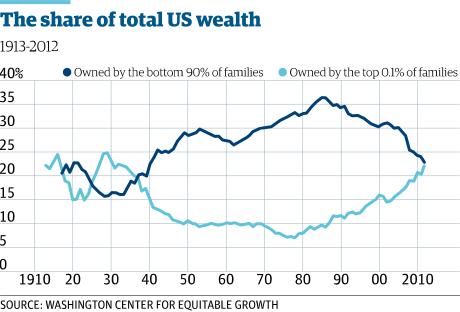
For example, if you look at the boom of the middle classes in the mid 20th century, this appears to me largely a consequence of the fact that industrial technology at the time was both incredibly productive compared to what came before but it also required legions of humans to operate it. Ford didn't pay his workers more out of the goodness of his heart, but he correctly realized that it would ultimately be the most profitable to him if he could build legions of cars and had a large customer base that could afford them. In a similar vein, it looks like we may eventually (at least at some point) turn the tide on CO2 emissions, but not because anyone (at large) really sacrificed anything, or did something that was mildly painful now in the hopes for a better future, but instead because renewable and battery tech is just getting to be the economic best option.
So I guess I'm looking for some specific examples of where we've actually consciously, as a collective society, altered the course of technological progress for the greater good, because I honestly can't think of any. But this is not a rhetorical question - I'd like to be corrected if I'm wrong.
reply