When you merge a commit in that changed a file that has been already changed since the common ancestor, Git runs a tool of your choice on this file. If the tool fails, it marks the file as needing a merge and doesn't let you commit it until you unmark it to confirm that you have merged it manually. In case of octopus merges, it will just abort early. That's basically its whole behavior when it comes to conflicts.
Such as moving down a fixup during interactive rebase when it's going to conflict with parents, or I've added more commits mid-rebase, or the rebase started in a tool and now I need to think about the tool's command and understand how many times the rebase point is view is backwards to interpret which is "ours" and which is "theirs" and whether it's the tool, my editor, or my own experience I should ignore because it's going to mislead me.
None of that word salad should matter, but it does. Git will ruin everything with glee and there is always an excuse for why that's fine and it's the user's fault.
There's nothing "backwards" in "rebase point of view". It's just automated cherry-picking - it's like applying patches, it's as forwards as it gets. People who think it's "backwards" usually just have holes in their mental model of the repository. And yes, I find tools doing what you're asking them to do to be rather fine. In fact, Git makes it easy to notice when you're adding commits mid-rebase, which is something I often do intentionally, as it tells you what the HEAD is (and even shows a detailed state of the in-progress rebase) while authoring the commit message.
These aren't troubles of someone who understands. If anyone else reading this has these kinds of troubles too - don't worry, understanding abstractions takes time and effort, you'll get there eventually (not if you'll keep blaming others though).
Let me eat the crow of getting drawn back in and cap this conversation with a summary. I think this is important because criticizing Git's UX is always like this.
OP: No one should be worried about using Git to do a thing.
bulatb: I'm worried it will be unpleasant.
seba_dos1: Here is what will happen when you do the thing.
bulatb: I know, but doing it will be unpleasant.
seba_dos1: You must not understand what's going to happen.
bulatb: I do. The process is unpleasant.
seba_dos1: You must not understand what's going to happen.
Had you actually read what I wrote, you would rather summarize it as "Git is showing exactly what's going to happen when you attempt to do it, all you have to do to make is pleasant is to not ignore it". Reading things requires unpleasant effort though, I get it.
I'm sorry (like actually sorry) if I'm getting into counter-condescension here, but, like...
> all you have to do to make is pleasant
This is an assumption about what I find unpleasant and why. I take it you think "reading information" and "understanding instructions" are some of those things I don't like. Your conclusion that I must not understand is based on that assumption.
The assumption is wrong.
If you can grant me that, my problem looks different. If you can't or won't, my summary was right.
If the assumption was wrong, then your first comment was pretty much useless, and the second one didn't help either as it just describes doing things carelessly and without proper understanding. So if that reading of it is wrong, then it was just complaining for complaining's sake and not about Git at all, but rather about what you happen to find scary for some undisclosed reason?
People do have genuine troubles with these behaviors when they don't grasp what's going on well enough. These troubles go away pretty much entirely once they do. I think explaining them is the only thing one could write in such thread that will be useful to anyone, as the Git's UX already does make a pretty good effort to help the user orient themselves in these cases and has been visibly improving in this regard over time.
My point to the OP is the same thing I'm saying to you. "I understand the thing and think it's fine" does not imply that nobody who understands the thing can think it isn't fine, or anyone who doesn't like the thing just doesn't understand it.
It's not some deep or interesting idea, but it needs to be repeated any time "git gud" is used as an excuse for Git's UX, which is always.
> but it needs to be repeated any time "git gud" is used as an excuse for Git's UX, which is always.
It's uncanny how a completely different community can have discussions this similar. I wonder if somebody wrote an article like "Git is Dark Souls of VCS, here's 10 reasons why". It could become a hit in both communities (poor potential author, would he even live through that?)
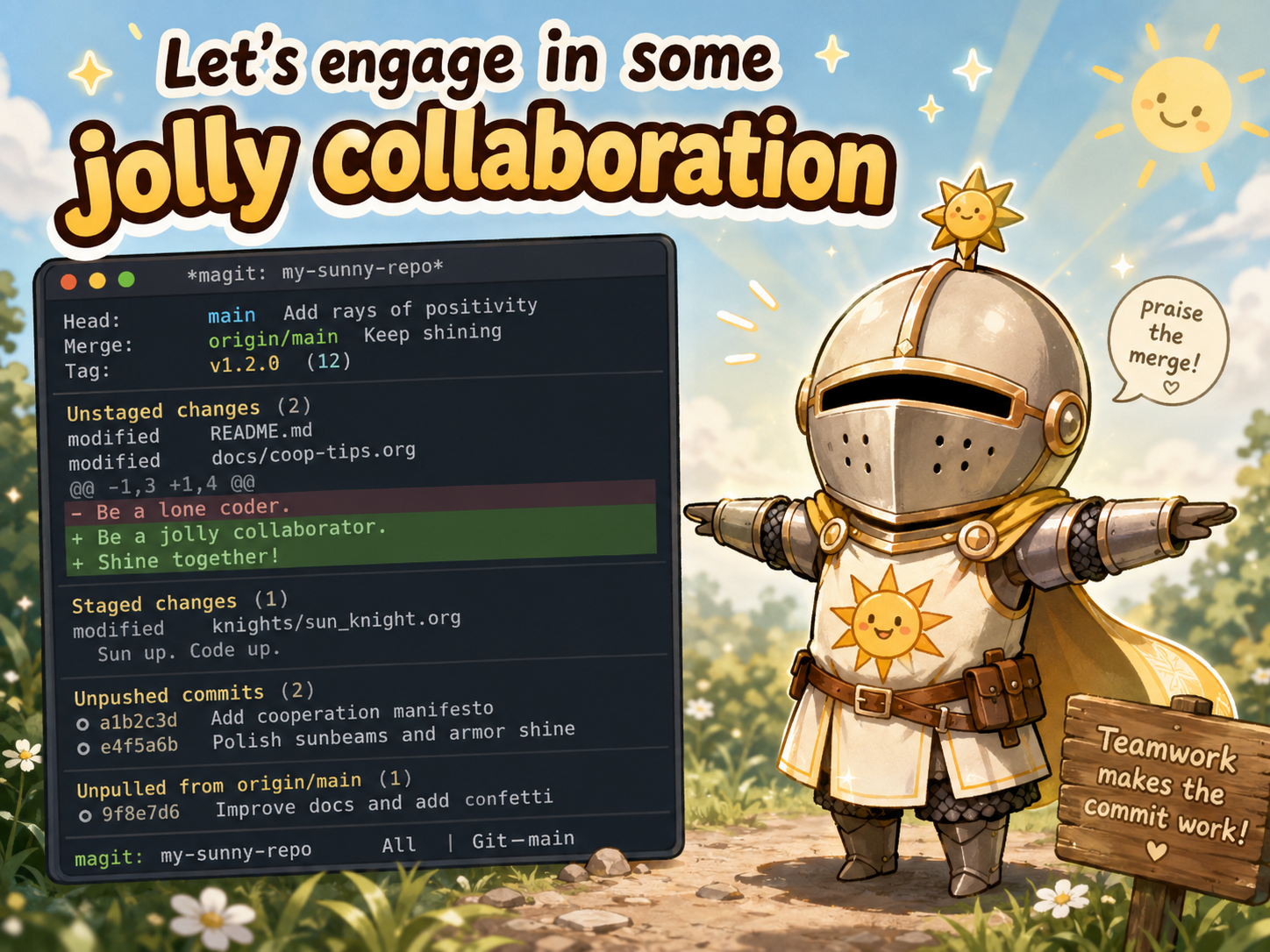
EDIT: I'm doomed. The moment I saw ChatGPT generate this: https://klibert.pl/statics/jolly_collaboration.png ("using GUI frontends is to Git veterans like using summons for Souls veterans") I knew I must write that post; the commonalities are just too funny to pass on :)
So you do just want to complain and simply choose to ignore what I mention about how Git UX makes sure the user has everything they need to avoid these pitfalls. OK, I'm afraid this is just wasting everyone's time. I'm not excusing anything, to the contrary, I'm showing a concrete example of a good UX and point out that there's been more and more stuff like this showing up in Git in the recent years, as it wasn't always like this. But I get it - complaining about Git is basically free karma, so why not just show up and state "I don't like it" or "it ruins everything with glee"?...
"ours" is always HEAD, usually meaning the state of the working_tree, "theirs" is always the commit that is going to change the working_tree.
When merging, you are taking change from another branch (theirs) to create a new commit on the current branch (ours) that ties the two together. When rebasing interactively, you switch to the new base (ours) and replay the changes of the branch (theirs) according to the edit file.
Etymology matters. The conceptual model of git is simple, but people only focus on the operations. That's like trying to learn algorithm and data structures and focusing on the words "insert", "remove", "find", without trying to learn "list", "stack", "tree",... first.
Instead learn about Git's glossary [0], then how the operations use and modify those concepts.