In February of 2011 I was a 28 year old, healthy (perfect vision, etc) software developer working for a small software company. I was working on some cool stuff, was getting the extra responsibilities I wanted and putting in at least 10 hour days every day. I was learning, and hacking and building at an awesome pace.
Until, like a switch, my eyes dried up and I could barely keep them open. Literally in the span of an hour or so I was happily hacking away to driving myself home opening one eye at a time. Since then it's been more of the same. Avoiding bad lighting, no more TV, limited computer use.
I've seen 3 Opthamologists, some name brand ones, some research clinics. They all tell me I have Blepharitis, which I disagree with (which I know sounds crazy). I wake up with tired, dry eyes and it's a battle all day long. I've tried lots of things, low light, low contrast, fish oil pills, antibiotics, anti-inflammatories, cold compresses, hot compresses, drops of all kinds, special computer glasses, restasis, books, meditation, etc.
To be honest, it's been hell. I worry about my future career and it's negatively affected relationships. It's gotten somewhat better, but it is still a constant discomfort. I just try to keep my eyes relaxed, eye drops nearby, and massage them frequently.
So, give your eyes a break once in a while and be more mindful of them. I bet if I listened to my body at the time it would have told me my eyes were strained and I should give it a break.
If anyone else suffers similarly, please reach out would really appreciate chatting with people in similar situations.
I was in a similar situation with you, I too was prescribed as having Blephartitis by multiple opthamologist, I did what they told me to do, clean my eye lids, warm compress, eye drops (various brands) didn't help.
After diligently tracking the root cause, data gathering and the likes, I found the issue and I have been dry eyes free since (mostly). As a matter of fact, I had my LASIK, which makes dry eyes worse usually, and have little to no dry eyes.
What's intriguing about your case is this sentence "I wake up with tired, dry eyes and it's a battle all day long" your symptom is the same as mine. My situation is this: My eyes don't close all the way when I sleep, thus throughout the night, they will get exposed and dry up badly. After 8 hours, it's plain to see why I would wake up with dry eyes and the dryness lasts throughout the day.
My solution is simple, before going to bed, I tape my eyes shut and I use a 3M tape. I tape it in a way if I try to open my eyes I won't be able to.
Please do try that for a few days and let me know if it helps :)
Blepharitis is basically a catch all for any issues related to lipid production by the eye lid. Basically what happens in your eye is you produce tears and you also have glands that produce oil. The oil becomes a coating over the tears so they don't evaporate. Blepharitis essentially means your glands aren't producing enough/any oil and so the tears dry up really fast.
I disagree with the diagnosis because it doesn't fit with the symptoms. My eyes actually don't feel all that dry like real dry eye suffers describe the sensation. The discomfort is a definite strain. My eyes are relatively discomfort free when I am not looking at a computer screen or in "bad" lighting. But as soon as I look at a computer screen or TV, it's an immediate discomfort. Through out the day I can feel the muscles in my eyes becoming weaker and weaker to the point where they feel almost useless. It is difficult to describe but imagine you do bicep curls until failure, for 3 years every day. You can feel the bicep, but it just doesn't work. In fact I can sense muscles in my entire face reaching back to my ears and down to my cheek bone. Muscles I never even noticed. Also one eye is definitely weaker than the other and if I completely relaxing them it closes about 50% more than the other and feels like there is a weight hanging off of my eye brow.
So I really think it is muscular and tear production or oil production is a side effect. If I fix the strain, I fix the dry eyes.
Around 15 years ago I had redness and pain in my eye. It got bad enough, that although after-hours, I went to a Cigna Urgent Care center. I was examined by a non-specialist who didn't know what the problem was, but guessed it was probably a bacterial infection. So he sent me home with antibiotics, and told me to come back in "about a week" if things did not clear up. Well, a week later it was only worse, so he told me I needed to see a specialist "immediately".
I was in terrible pain. Redness, photosensitivity, etc. I get an appointment with a real opthamologist, and he said I have a viral infection in the cornea, and its serious. I had already permanently lost vision (from 20/20 to 20/50). Antivirals + steroids cleared it up, but it created a dynamic that is difficult to manage to this day.
Now with corneal ulcers, the surface of the cornea is uneven. This prevents the tear film from distributing evenly.
With poor tear film (tear break up time, TBUT) the eye becomes inflamed.
With inflammation, comes neo-vascularization, nerve destruction, and more epithelial defects. All these conspire against proper tearing, and the cycle repeats.
So - its very important to get whatever dynamic you have under control. 'Dry eyes' is actually pretty serious, but most opthamologists agree we don't have good weapons for it.
Some people have dry eyes, even though they produce too many tears. Its because their tears are defective. Like some people having high HDL, but their HDL is defective.
Almost all the OTC stuff is crap. All I can do is recommend
1) Find the best specialist in your area, and see them. I saw a cornea specialist at the Mayo Clinic for a while; they were "OK". But I was surprised they had an even more famous individual there - and she never once said "hmm, what we've been trying for the last 2 years hasn't been working, lets see what my (famous) colleague X thinks". So you have to manage your doctors with great attention. Also, my suspicion - is that cornea MDs like to operate (in my case - cornea replacement), not treat. Operating is probably more profitable.
2) For dry-eyes, you should consider a few things. I use Systane Gel Drops going to sleep. Friction between cornea and eye lids is a problem. The various PM oil formulations are too goopy; but this is the thickest liquid that seems to protect me through the night. I don't wake up with red eyes.
3) For the office, consider moisture being wicked away from your cornea by ventilation. I wear a hat and glasses. Try things that make a full seal, like something Ridick would wear, or a motorcycler. Try Wiley-X Climate control stuff. Since the seal needs to be perfect, try them on first.
4) I love my Oakley M-Frame Heater lenses. Huge, wrap around the face. I wear clear even at night if I'm not wearing goggles to protect that micro-climate around the eyes.
Just to drive this one point home (IANAD, but personal experience): the cornea of the eye is simultaneously very susceptible to infections and more or less immunosuppressed by design to maintain clear vision (see [1]). Infections can spread extremely fast and will (even if promptly treated) leave behind permanent damage such as photosensitivity (best case really). Ideally you would have daily checkups to see if the antibiotic is actually effective.
If you use contacts, make sure to be extremely diligent in cleaning them.
I'm genuinely interested in what steps do other people on HN who spend their work day on a computer take to "protect" their vision ?
I took on the habit of looking a distant wall every half hour or so for a couple minute or go drink a coffee, but while it helps with the "always looking close" vision I still have a very tired feel in my eyes at the end of a long day.
I do have good vision and have it checked every year, but I worry I'm doing some long term damage anyway, and the white of my eyes does look more bloodshot than they do in average people my ages (and gets a lot worse after big long hours release/bugfix days).
I feel that modern LCD monitors are too bright. Typically I have mine set at 50% brightness. Adjusting environmental/ambient light is important too if you can. I try to adjust my desk/chair orientation that overhead lights are behind my head instead of in front of me (no line-of-sight light sources other than my monitors). I also use f.Lux (http://justgetflux.com/).
I'm not sure what combination of this list of things does the most good, but I rarely get eyestrain and I look at screens for 12+ hours per day.
Not sure if this matters, but I had LASIK surgery 7 years ago and ever since my eyes have been pretty sensitive to light (night vision FTW), so this is something I've been working on for a while now.
Edit: I am 40 years old, and have been looking at screens for long hours at least 10-15 years now.
Indeed. But I'd describe it as modern LCDs have a default brightness that it likely too bright for most uses.
Manufacturers likely set this so that the colours 'pop' when being demoed (the same reason they sell/create/display glossy monitors, because they demo well).
Taking the brightness down almost never impacts usability, but I've found can significantly affect eye strain (that 'OMG, my eyeballs are hurting' feeling).
I totally agree with this. I usually turn my monitor brightness down to the lowest setting (my work monitor has been set this way for years). I've done the A/B testing on myself and find that I will develop something like a mild headache (probably eye strain) after a day of working at the default brightness. On my old LCD monitor the brightness would reset if power got disconnected so I did the experiment several times accidentally. My current monitor (Dell U3014) remembers the setting across power resets. I have my brightness control set to zero. It looks dim at first but after a few minutes it looks completely normal and you forget about it.
>(the same reason they sell/create/display glossy monitors, because they demo well).
They create very few of them. The few they do create are because some of us want monitors that are not intentionally blurry. I am capable of controlling the lighting in my environment. I do not want my monitor to deliberately make everything fuzzy just to avoid a glare problem I don't have.
Similar here - my cube is as dark as I can get it (which really just means the lights directly overhead are off), and my monitors are at the minimum brightness setting. My screens glow, guys. I don't need to light them up externally.
Any reference on working with lights on vs off? I've seen 1 or 2 people do that in office. I've been told that lack of ambient light might cause more strain. Is there any study supporting what you've said?
Only my own anecdotal study here. It's not total darkness, because I'm in a well-windowed cube farm (along a far wall that has no windows, though), so there's still a bit of ambient light.
I have a 30in monitor and I put all fonts at 16+ pt so they are easily readable from a distance, then I relax instead of leaning in toward the screen. I am often mentally tired at the end of day but no eye strain.
When I work remote using my laptop I always end with a headache and often tired eyes as well.
Many many hackers at my office use 3 column tmux or screen terminal sessions all day long on 11 in laptop screens, but monitors are cheap so why strain your eyes?
As others have mentioned check on ambient lighting and brightness settings. You may also want to try setting your white balance, contrast and saturation levels. Factory defaults are for making them look good in on display in a store, not for daily use.
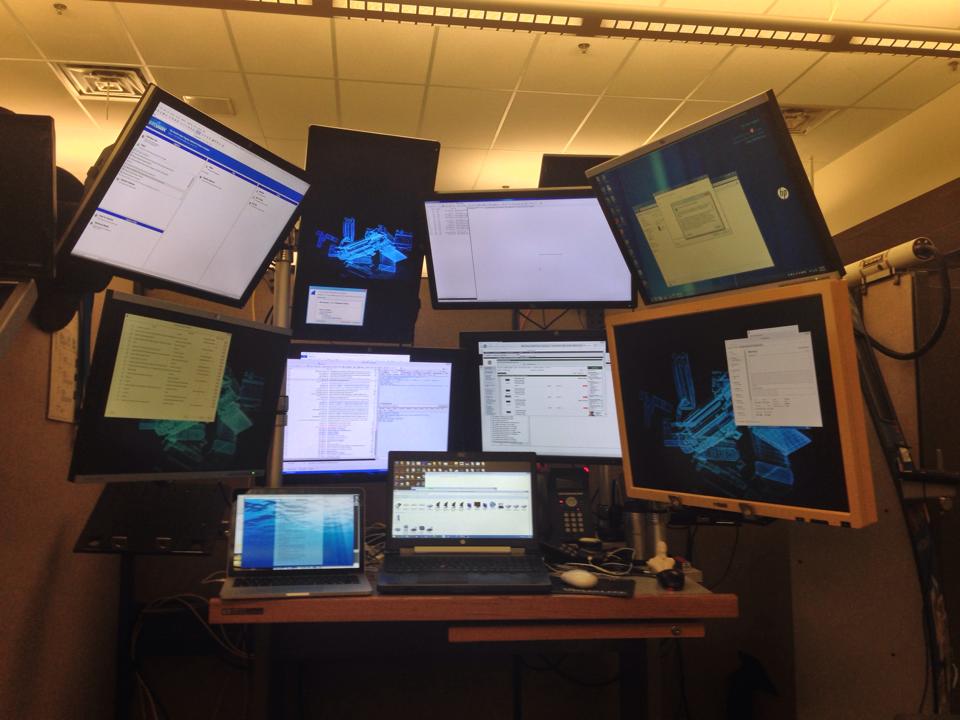
Diversity of focus. To start I have nine monitors attached to my laptop via the internal video card & four DisplayLink docs. They are placed around me in such a way that requires that I do a small amount of refocusing throughout the day as I move from monitor to monitor. I also sit next to a window and will make sure to stand up ever 30 minutes to an hour and focus far into the distance. I do this because my eye doctor was growing concerned that my eyesight continued to get worse when it should be stabilizing. Since I've gone to what some may consider to be an extreme in terms of constant eye refocus my eye's have stabilized and haven't changed for a decade. Your results may vary.
>I still have a very tired feel in my eyes at the end of a long day.
I asked my optometrist about this. He said that our extraocular muscles get tired like any other muscle on the body, and it's normal to feel that way after staring at a screen for extended periods.
I'd love to learn how to manually perform the equivalent of whatever true REM sleep does for my eyes. No matter how I try to focus or rest my eyes myself they don't truly feel rested any other way.
There are software tools like Flux and Redshift for the PC, Screen Filter for Android (which I just use to turn off the LED lights) -- all intended to reduce the light (typically the 'harsher' blues) to absorb. Some people use orange safety glasses to accomplish the same goal: http://www.amazon.com/dp/B000USRG90
I got an "eye pillow" - it's just a little bag with beans in it. I place it over my eyes when I sleep. The pressure and complete light blocking helps me reach REM sleep MUCH better and I feel much more refreshed.
"blue lights block melatonin creation". They sell lights designed to keep the room lit but not interrupt with your melatonin production thus allowing you to turn off the computer & reach sleep.
There is an interesting read about lutein and macular degeneration [1] .. might be quackery, but I've started to include kale in my ration. If it does nothing, well it's not unhealthy. But if it helps though it wouldn't be wise to ignore it.
I highly recommend using an app like http://breaktimeapp.com. You set an interval and length of breaks and Breaktime will lock your screen so you are forced to rest your eyes. Use it to look outside the window every once in a while.
As a tip, definitely enforce the break. You are always tempted to get out of it if you don't.
Reading glasses, intermittently. They're something like +0.5 or +1.0 diopter (I have perfect vision; adjust accordingly); enough to push my monitor toward (but not at) the edge of my focal range. I code for a few hours with them off, then for a few hours with them on. I usually switch when I feel strain setting in.
Adjusting the brightness of your screen helps reduce fatigue. The ideal is to have the screen at the same brightness as the room, as if it were a naturally lit piece of paper. For instance, right now it's 15:00 for me and I'm using the MacBook at 25% brightness.
To my understanding the main thing that causes myopia in children and contributes to age related vision deterioration is insufficient bright light. You simply have to clock up an hour or two outside in daylight every day. Even very brightly lit rooms are a fraction as bright as the outdoors on a cloudy day.
Glad I'm not a mouse: "After two weeks, half of the mice in each group were exposed to a searingly bright light for four hours. The other animals stayed in dimly lit cages. This light exposure is a widely used and accepted means of inducing retinal degeneration in animals."
This sounds like torture to me. I love you scientific method, but sometimes you bum me out.
"But obviously, mice are not people, so whether exercise can prevent or ameliorate macular degeneration in human eyes is “impossible to know, based on the data we have now,”"
I have a fairly complex view of animal testing where I think it may be justified in some situations, but this type of testing in situations where you self-admit you didn't learn anything knowingly human-applicable when you could have done a more long term study just observing the eye health of multiple sets of older humans (one set which lives an active lifestyle and one which does not) is pretty fucked up.
Animal testing is horrible. There are some cases where it may be necessary, but this is just excessive. There was one guy who exploded hundreds of dogs in a vacuum, basically just to see what would happen. And I bet there are probably worse things being done even today.
Most important part:
"But obviously, mice are not people, so whether exercise can prevent or ameliorate macular degeneration in human eyes is “impossible to know, based on the data we have now,” said Machelle Pardue, a research career scientist at the Atlanta Veterans Administration Medical Center, who is the senior author of the study. She and her colleagues are trying to find ways to determine the impact of exercise on human eyes. But such experiments will take years to return results."
"These growth factors, especially one called brain-derived neurotrophic factor, or B.D.N.F., are known to contribute to the health and well-being of neurons and consequently, it is thought, to improvements in brain health and cognition after regular exercise."
That's interesting, and it sounds great, but like nearly any study of the brain there is conflicting information from other studies:
Where's the conflict? Plenty of chemicals/hormones/etc. in the body follow the pattern of:
too little = bad
enough = good
too much = bad
A study showing the chronic, high levels of something are bad doesn't generalize to mean that increasing levels is always (or even usually) a bad thing.
I spend 10-16 hours in front a monitor too (work + come back home, watch movies etc.). After getting flux[0], I immediately noticed a marked difference in how much lesser my eyes were tired by the end of the day.
It takes a day or two to get used to the yellow tint that flux adds, but it makes the screen so much easier to look at. After using flux for a while, you'll be surprised how much a monitor not running flux hurts your eyes - it just feels jarringly bright.
Some good comments here that I feel like implementing
@ColonelPanic001 : dark cube, overhead lights off, monitor at minimum brightness
@jisaacstone : large monitor, big font, keep it far away. Relax instead of leaning in toward the screen. I am often mentally tired at the end of day but no eye strain.
Need a beverage that deceives the mind into thinking the body has just finished exercising to release "growth factors" such as "B.D.N.F". This way, we can stay at home and keep on reading hacker news, as apose to, you know... exercising.
Where in the article does it mention or speculate about BDNF having an effect on nearsightedness? And what would be a theoretical basis for that, given that it relates to the shape of the eye and not the health of sensory neurons?
Exercise doesn't work, broadly speaking, or millions who are nearsighted and who exercise a lot would notice their vision improve.
Assuming you're not simply trolling, did you start eating or drinking something new shortly before your eyesight improved? Did something change in your environment? Although I think it's more likely that a dramatic improvement in eyesight is the result of a rare chemical signalling fluke (possibly genetic), if you changed habits beforehand that's worth investigating as a possible cause. Exercise [alone], however, even Qi Gong/Tai Chi, is not worth investigating. Plenty of people practice those arts and other Oriental physiological philosophies, not to mention other things like yoga and meditation, and don't see improvement in their eyesight.
We're presuming here actual corneal deformation which muscles can modify (that's why some squint to see better), and not any of other potential vision-related issues.
It might just be cookies or some kind of tracking. I got the login requirement in chrome (my default browser) but don't see it in IE (which I rarely use)


In February of 2011 I was a 28 year old, healthy (perfect vision, etc) software developer working for a small software company. I was working on some cool stuff, was getting the extra responsibilities I wanted and putting in at least 10 hour days every day. I was learning, and hacking and building at an awesome pace.
Until, like a switch, my eyes dried up and I could barely keep them open. Literally in the span of an hour or so I was happily hacking away to driving myself home opening one eye at a time. Since then it's been more of the same. Avoiding bad lighting, no more TV, limited computer use.
I've seen 3 Opthamologists, some name brand ones, some research clinics. They all tell me I have Blepharitis, which I disagree with (which I know sounds crazy). I wake up with tired, dry eyes and it's a battle all day long. I've tried lots of things, low light, low contrast, fish oil pills, antibiotics, anti-inflammatories, cold compresses, hot compresses, drops of all kinds, special computer glasses, restasis, books, meditation, etc.
To be honest, it's been hell. I worry about my future career and it's negatively affected relationships. It's gotten somewhat better, but it is still a constant discomfort. I just try to keep my eyes relaxed, eye drops nearby, and massage them frequently.
So, give your eyes a break once in a while and be more mindful of them. I bet if I listened to my body at the time it would have told me my eyes were strained and I should give it a break.
If anyone else suffers similarly, please reach out would really appreciate chatting with people in similar situations.