In my experience using both for years, Gnome has always been more stable.
Multi-monitor, Hi-Dpi support, in particular, is properly broken in KDE (while it's only half broken on Gnome).
As for features, the titlebar integration used by a few applications (ala MacOS) is a nice touch.
Otherwise it's true that the KDE experience, especially around customization, seems more thought out. Gnome's UX is nonsensical in more than a few places. The problem with KDE has always been stability and reliability. Having to reboot your machine due to crashes even once a week is enough to justify putting up with Gnome's overall worst UX.
> Hi-Dpi support, in particular, is properly broken in KDE
Not true. I use KDE everyday on my primary computer (an HP Envy 17t laptop), and have so since June this year. It works excellently on my 4K display. (You even get to pick a non-integer scaling factor.)
Just FYI, I run Arch Linux, and am (consequently) always on the latest version of KDE.
Everything worked out of the box with KDE. Including my laptop’s various hot keys, sleep/wake, networking, etc.
KDE was quite incredible compared to the 1 kLOC xmonad that I’d been using in my previously laptop. Zero configuration. Everything working perfectly with no headache.
Does multi-monitor mixed-DPI work in Gnome? Because that's the only thing that I couldn't get working in KDE about 2 years ago. (The problem was most easily solved with a new monitor.)
I restart perhaps every six months due to some problem that could be KDE; I find it very reliable both at home and at work. Granted, both machines are desktops, I use a laptop so rarely that I usually shut it down after use.
> titlebar integration
This is personal preference, but that's a showstopper for me ever using Gnome (or Mac OS) for anything beyond web browsing. I use focus-follows-mouse, which is incompatible with a titlebar outside the relevant window.
Nothing built on X does mixed DPI well, because X itself (in most configurations) treats multiple monitors as simple viewports onto a single screen. A single screen with multiple DPIs doesn't make sense virtually any more than it does physically.
Wayland is supposed to help with this, since it has a more modern take on screen virtualization (a la Windows or Mac). Getting all the user software to work on Wayland (via XWayland) is a nontrivial ongoing task. I'm not sure what Gnome Shell's state of affairs is w.r.t. Wayland, but I do know the ecosystem missed the boat with Ubuntu 18.04, which elected not to make Wayland the default due to stability and usability issues. So it might be a while before a major stable distro makes the move.
Not by default. I had to hack a script by mixing xrandr scaling and Gnome scaling settings, which works, with some caveats I haven't figured out yet[1].
The reason I stick to Gnome is that plug-and-play works like a charm, remembering my settings with various monitors.
> I restart perhaps every six months due to some problem that could be KDE; I find it very reliable both at home and at work. Granted, both machines are desktops, I use a laptop so rarely that I usually shut it down after use.
Most crashes came from laptop-related actions: monitor hot plugging, closing the lid while being awake, waking up with another monitor plugged in, etc.
> I use focus-follows-mouse, which is incompatible with a titlebar outside the relevant window.
What I meant by "titlebar integration" was when the applications themselves draw UI on the titlebar like in Nautilus or Tilix for instance[2].
The "menu in top bar" feature can be deactivated, so I think you could use Gnome.
[1]: 1. The Gnome UI (dock and topbar) are huge, which isn't much of a problem for me since they are on a smaller monitor.
2. Some applications don't scale properly and are either too zoomed in or out.


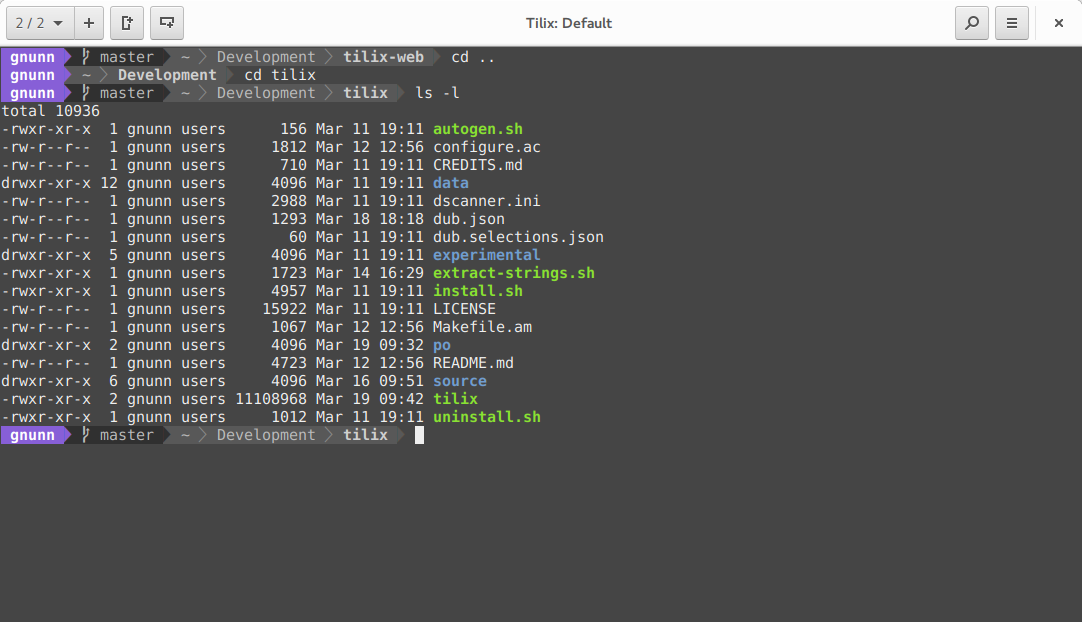

As for features, the titlebar integration used by a few applications (ala MacOS) is a nice touch.
Otherwise it's true that the KDE experience, especially around customization, seems more thought out. Gnome's UX is nonsensical in more than a few places. The problem with KDE has always been stability and reliability. Having to reboot your machine due to crashes even once a week is enough to justify putting up with Gnome's overall worst UX.